UNITED STATES
SECURITIES AND EXCHANGE COMMISSION
Washington, D.C. 20549
__________________________________________
SCHEDULE
(Amendment No. 1)
__________________________________________
Proxy Statement Pursuant to Section 14(a) of the
Securities Exchange Act of 1934
|
Filed by the Registrant |
☒ |
|
|
Filed by a Party other than the Registrant |
☐ |
Check the appropriate box:
|
☐ |
Preliminary Proxy Statement |
|
|
☐ |
Confidential, for Use of the Commission Only (as permitted by Rule 14a-6(e)(2)) |
|
|
☒ |
Definitive Proxy Statement |
|
|
☐ |
Definitive Additional Materials |
|
|
☐ |
Soliciting Material under §240.14a-12 |
(Name of Registrant as Specified in its Charter)
______________________________________________________________
(Name of Person(s) Filing Proxy Statement, if other than the Registrant)
Payment of Filing Fee (Check the appropriate box):
|
☒ |
No fee required. |
|
|
☐ |
Fee paid previously with preliminary materials. |
|
|
☐ |
Fee computed on table in exhibit required by Item 25(b) per Exchange Act Rules 14a-6(i)(1) and 0-11. |
Explanatory Note
This Amendment No. 1 (this “Amendment”) amends the definitive proxy statement of Olenox Industries Inc. (formerly known as Safe & Green Holdings Corp.) (“we”, “our”, or the “Company”) filed with the Securities and Exchange Commission on December 19, 2025 (the “Proxy Statement”). The Proxy Statement was filed in connection with the Company’s 2025 annual meeting of stockholders (the “2025 Annual Meeting”) that was convened on December 29, 2025, reconvened on January 14, 2026, reconvened on January 28, 2026, and has subsequently been adjourned until March 31, 2026 at 1:00 p.m. Central Daylight Time (the “Adjourned Meeting Date”).
This Amendment is being filed to (i) provide an amended notice notifying the Company’s stockholders of a new record date, location, and Adjourned Meeting Date for the 2025 Annual Meeting, (ii) amend and restate Proposal 2, the proposal for ratification of our independent registered public accounting firm for our fiscal year ending December 31, 2025, (iii) include a new Proposal 8, related to the approval, for purposes of Nasdaq Listing Rule 5635(d), the issuance of securities in connection with the Series C Convertible Preferred Stock financing, (iv) include a new Proposal 9, related to the approval of a reverse stock split of the Company’s common stock, (v) correct certain clerical errors in Proposal 6, (vi) remove the prior Proposal 4, related to the advisory vote on the frequency of the advisory vote on executive compensation proposal, and the prior Proposal 8, related to a proposed amendment to the Company’s amended and restated bylaws, (vii) include other disclosures intended to comply with the requirements of Schedule 14A, and (viii) reflect the new name of the Company, Olenox Industries Inc. (formerly known as Safe & Green Holdings Corp.) and the new ticker symbol of the Company, OLOX (formerly SGBX). This Amendment restates the Proxy Statement in its entirety. We will print and distribute this Amendment to our stockholders as of February 11, 2026, the record date for determining the stockholders entitled to notice of and to vote at the 2025 Annual Meeting.
Capitalized terms used but not otherwise defined in this Amendment have the meanings ascribed to them in the Proxy Statement. This Amendment should be read together with the Proxy Statement, and the information contained in this Amendment modifies or supersedes any inconsistent material contained in the Proxy Statement.
Except as specifically discussed in this Explanatory Note, this Amendment does not modify or update any other disclosures in the Proxy Statement. In addition, this Amendment does not reflect events occurring after the date of the Proxy Statement or modify or update disclosures that may have been affected by subsequent events.

Olenox Industries Inc.
1207 N. FM 3083 E. Bldg C
Conroe, Texas 77304
AMENDED NOTICE OF ANNUAL MEETING OF STOCKHOLDERS
To Be Held on March 31, 2026
NOTICE IS HEREBY GIVEN that the 2025 Annual Meeting of Stockholders (the “2025 Annual Meeting”) of Olenox Industries Inc. (formerly known as Safe & Green Holdings Corp.) (the “Company”) has been adjourned to March 31, 2026, at 1:00 P.M. Central Time, and will be held at 1207 N FM 3083 Rd E, Building C, Conroe, TX 77304 for the following purposes:
(1) to elect the seven nominees for director named in the accompanying proxy statement to our Board of Directors, each to serve a one-year term expiring at the 2026 Annual Meeting of Shareholders and until such director’s successor is duly elected and qualified (the “Election of Directors Proposal”);
(2) to ratify the appointment of RBSM LLP, as our independent registered public accounting firm for our fiscal year ending December 31, 2025 (the “Auditor Ratification Proposal”);
(3) to approve, on an advisory, non-binding basis, the compensation of our named executive officers (the “Advisory Vote on Executive Compensation Proposal”);
(4) to approve, the merger pursuant to the terms of the Agreement and Plan of Merger, dated February 2, 2025, by and between the Company and New Asia Holdings, Inc., and subsequently, the conversion of the Company’s Series A Convertible Preferred Stock, par value $1.00 (the “Preferred Stock”), into shares of the Company’s common stock, par value $0.01 per share the (the “Common Stock”), whereby each share of Series A Convertible Preferred Stock converts into fifteen (15) shares of Common Stock (the “Merger Proposal”);
(5) to approve in compliance with Nasdaq Rule 5635(d), the issuance of shares of our Common Stock, pursuant to those certain securities purchase agreements, dated as of March 27, 2025, April 11, 2025, and May 29, 2025, respectively, in each case by and between the Company and Generating Alpha Ltd., in an amount equal to or in excess of 20% of our Common Stock outstanding immediately prior to the issuance of such shares (the “Generating Alpha Issuance Proposal”);
(6) to increase the maximum number of authorized shares subject to the SG Blocks, Inc. Stock Incentive Plan, as amended from time to time (as amended, the “Stock Incentive Plan”), by 1,500,000 shares and to automatically increase the maximum number of authorized shares subject to the Stock Incentive Plan on January 1 of each calendar year for a period of ten years commencing on January 1, 2026, in an amount equal to 4.5% of the number of shares of Common Stock outstanding on December 31 of the preceding calendar year (the “Incentive Plan Increase Proposal”);
(7) to amend the articles of incorporation to increase the authorized shares of Common Stock from 75,000,000 shares to 3,000,000,000 shares (the “Authorized Common Stock Increase Proposal”);
(8) to approve, in compliance with Nasdaq Rule 5635(d) the issuance of shares of our Common Stock, pursuant that certain Securities Purchase Agreement, dated as of November 25, 2025, by and between the Company and JAK INDUSTRIAL VENTURES I LLC, in an amount equal to or in excess of 20% of our Common Stock outstanding immediately prior to the issuance of such shares (the “Series C Conversion Proposal”);
(9) to approve an amendment to the Company’s Certificate of Incorporation, in substantially the form attached to the accompanying proxy statement as Appendix D, to effect a reverse stock split with respect to the Company’s issued and outstanding common stock, par value $0.01 per share, including stock held by
the Company as treasury shares, at a ratio of 1-for-10 to 1-for-20, with the ratio within such range to be determined at the discretion of the Board and included in a public announcement, subject to the authority of the Board of Directors to abandon such amendment; and
(10) to approve one or more adjournments of the 2025 Annual Meeting, if necessary or appropriate, to solicit additional proxies in favor of the Proposals listed hereinabove, if there are not sufficient votes at the 2025 Annual Meeting to approve and adopt the Proposals listed hereinabove (the “Adjournment Proposal”).
The Proxy Statement accompanying this amended notice describes each of these items of business in detail. The Board of Directors has fixed the close of business on February 11, 2026 as the record date for the determination of stockholders entitled to notice of and to vote at the 2025 Annual Meeting and any adjournments or postponements of the 2025 Annual Meeting. Accordingly, only stockholders of record at the close of business on February 11, 2026 are entitled to notice of, and to vote at, the 2025 Annual Meeting and any adjournments or postponements of the 2025 Annual Meeting.
Your vote is important. Whether or not you expect to attend the 2025 Annual Meeting, please vote via the Internet, by telephone, or complete, date, sign and promptly return the enclosed proxy card so that your shares may be represented at the meeting.
|
By Order of the Board of Directors, |
||
|
/s/ Michael McLaren |
||
|
Michael McLaren |
||
|
Chairman of the Board |
||
|
Miami, Florida |
||
|
February 13, 2026 |
IMPORTANT: WHETHER OR NOT YOU PLAN TO ATTEND THE ANNUAL MEETING OF THE STOCKHOLDERS, WE ASK YOU TO VOTE BY TELEPHONE, MAIL, FAX OR ON THE INTERNET USING THE INSTRUCTIONS PROVIDED IN THE ENCLOSED PROXY CARD.
TABLE OF CONTENTS
|
PAGE |
||
|
1 |
||
|
SECURITY OWNERSHIP OF CERTAIN BENEFICIAL OWNERS AND MANAGEMENT |
8 |
|
|
9 |
||
|
20 |
||
|
21 |
||
|
FEES PAID TO THE INDEPENDENT REGISTERED PUBLIC ACCOUNTING FIRM |
22 |
|
|
PROPOSAL 3: THE ADVISORY VOTE ON EXECUTIVE COMPENSATION PROPSAL |
23 |
|
|
24 |
||
|
26 |
||
|
31 |
||
|
37 |
||
|
39 |
||
|
41 |
||
|
48 |
||
|
49 |
||
|
50 |
||
|
53 |
||
|
TRANSACTIONS WITH RELATED PERSONS, PROMOTERS AND CERTAIN CONTROL PERSONS |
57 |
|
|
61 |
||
|
61 |
||
|
61 |
||
|
62 |
||
|
APPENDICES |
||
|
A-1 |
||
|
B-1 |
||
|
C-1 |
||
|
D-1 |
i
Olenox Industries Inc.
1207 N. FM 3083 E. Bldg C
Conroe, Texas 77304
PROXY STATEMENT
For the 2025 Annual Meeting of Stockholders to be reconvened on March 31, 2026
ABOUT THE MEETING
Why am I receiving this Proxy Statement?
This Proxy Statement contains information related to the solicitation of proxies for use at our 2025 Annual Meeting, to be held at 1207 N FM 3083 Rd E, Building C, Conroe, TX 77304 on March 31, 2026, at 1:00 P.M. Central Time for the purposes stated in the accompanying Amended Notice of 2025 Annual Meeting (the “Notice”). This solicitation is made by our Board of Directors (also referred to as the “Board” in this Proxy Statement) on behalf of Olenox Industries Inc. (formerly known as Safe & Green Holdings Corp.). In this Proxy Statement, the terms “we,” “our,” “us” and the “Company” refer to Olenox Industries Inc.
On or about February 23, 2026, we are mailing the Notice, along with this Proxy Statement and accompanying proxy card, which includes voting instructions, to all stockholders entitled to notice of and to vote at the 2025 Annual Meeting. Whether or not you expect to attend the 2025 Annual Meeting, please read these materials carefully, complete, sign and date the enclosed proxy card and return it promptly, or complete and submit your proxy via phone or the Internet in accordance with the instructions provided on the enclosed proxy card.
The Notice, this Proxy Statement and the accompanying form of proxy card are available at www.proxyvote.com. You are encouraged to access and review all of the important information contained in the proxy materials before voting.
IMPORTANT NOTE REGARDING THE SEPTEMBER 2025 REVERSE STOCK SPLIT: On September 8, 2025, we effected a 1-for-64 reverse stock split of our then-outstanding Common Stock (the “September 2025 Reverse Stock Split”). Accordingly, all share and per share amounts for all periods presented in this Proxy Statement have been retroactively adjusted to reflect the September 2025 Reverse Stock Split. In addition, all equity awards, warrants, and debenture outstanding immediately prior to the September 2025 Reverse Stock Split were proportionately adjusted.
What am I being asked to vote on?
You are being asked to vote on the following proposals:
• Proposal 1 (Election of Directors): to elect the seven (7) nominees for director named in the accompanying proxy statement to our Board of Directors, each to serve a one-year term and until such director’s successor is duly elected and qualified (the “Election of Directors Proposal”).
• Proposal 2 (Auditor Ratification): to ratify the appointment of RBSM LLP as our independent registered public accounting firm for our fiscal year ending December 31, 2025 (the “Auditor Ratification Proposal”).
• Proposal 3 (Advisory Vote on Executive Compensation): to approve, on an advisory, non-binding basis, the compensation of our named executive officers (the “Advisory Vote on Executive Compensation Proposal”).
• Proposal 4 (Merger): to approve the merger pursuant to the terms of the Agreement and Plan of Merger, dated February 2, 2025, by and between the Company and New Asia Holdings, Inc. (the “Merger Agreement”), and subsequently, the conversion of the Company’s Series A Convertible Preferred Stock,
1
par value $1.00 (the “Preferred Stock”), into shares of the Company’s common stock, par value $0.01 per share (the “Common Stock”), whereby each share of Series A Convertible Preferred Stock converts into fifteen (15) shares of Common Stock (the “Merger Proposal”).
• Proposal 5 (Generating Alpha Issuance): to approve the issuance of shares of our Common Stock, pursuant to those certain securities purchase agreements, dated as of March 27, 2025, April 11, 2025, and May 29, 2025, respectively, in each case by and between the Company and Generating Alpha Ltd., in an amount equal to or in excess of 20% of our Common Stock outstanding immediately prior to the issuance of such shares (the “Generating Alpha Issuance Proposal”).
• Proposal 6 (Incentive Plan Increase): to approve the increase of the maximum number of authorized shares subject to the Company’s Stock Incentive Plan, as amended from time to time (as amended, the “Stock Incentive Plan”), by 1,500,000 shares and to automatically increase the maximum number of authorized shares subject to the Stock Incentive Plan on January 1 of each calendar year for a period of ten years commencing on January 1, 2026, in an amount equal to 4.5% of the number of shares of Common Stock outstanding on December 31 of the preceding calendar year (the “Incentive Plan Increase Proposal”).
• Proposal 7 (Authorized Common Stock Increase): to approve the increase of the number of authorized shares of the Common Stock from 75,000,000 to 3,000,000,000 shares (the “Authorized Common Stock Increase Proposal”).
• Proposal 8 (Series C Conversion): to approve, in compliance with Nasdaq Rule 5635(d) the issuance of shares of our Common Stock, pursuant that certain Securities Purchase Agreement, dated as of November 25, 2025, by and between the Company and JAK INDUSTRIAL VENTURES I LLC, in an amount equal to or in excess of 20% of our Common Stock outstanding immediately prior to the issuance of such shares (the “Series C Conversion Proposal”).
• Proposal 9 (Reverse Stock Split): to approve an amendment to the Company’s Certificate of Incorporation, in substantially the form attached to the accompanying proxy statement as Appendix D, to effect a reverse stock split with respect to the Company’s issued and outstanding common stock, par value $0.01 per share, including stock held by the Company as treasury shares, at a ratio of 1-for-10 to 1-for-20, with the ratio within such range to be determined at the discretion of the Board and included in a public announcement, subject to the authority of the Board of Directors to abandon such amendment (the “Reverse Stock Split Proposal”).
• Proposal 10 (Adjournment): to approve an adjournment of the 2025 Annual Meeting to a later date or dates, if necessary, to permit further solicitation and vote of proxies in the event there are not sufficient votes in favor of any of the following: Proposal 1, Proposal 2, Proposal 3, Proposal 4, Proposal 5, Proposal 6, Proposal 7, Proposal 8, and Proposal 9, or to establish a quorum (the “Adjournment Proposal”).
To transact any other business that may properly come before the 2025 Annual Meeting or any adjournment(s) or postponements of the 2025 Annual Meeting.
What are the Board’s voting recommendations?
The Board recommends that you vote as follows:
• Proposal 1 (Election of Directors Proposal): “FOR” the Election of Directors Proposal
• Proposal 2 (Auditor Ratification Proposal): “FOR” the Auditor Ratification Proposal
• Proposal 3 (Advisory Vote on Executive Compensation Proposal): “FOR” the Advisory Vote on Executive Compensation Proposal
• Proposal 4 (Merger Proposal): “FOR” the Merger Proposal
• Proposal 5 (Generating Alpha Issuance Proposal): “FOR” the Generating Alpha Issuance Proposal
• Proposal 6 (Incentive Plan Increase Proposal): “FOR” the Incentive Plan Increase Proposal
2
• Proposal 7 (Authorized Common Stock Increase Proposal): “FOR” the Authorized Common Stock Increase Proposal
• Proposal 8 (Series C Conversion Proposal): “FOR” the Series C Conversion Proposal
• Proposal 9 (Reverse Stock Split Proposal): “FOR” the Reverse Stock Split Proposal
• Proposal 10 (Adjournment Proposal): “FOR” the Adjournment Proposal
Who is entitled to vote at the 2025 Annual Meeting?
Holders of record of our Common Stock, as of the close of business on February 11, 2026, the record date for the 2025 Annual Meeting (the “Record Date”), are entitled to receive notice of the 2025 Annual Meeting. Holders of record shares of our Common Stock have the right to vote on all matters brought before the 2025 Annual Meeting.
As of the Record Date, there were 9,609,436 shares of our Common Stock were issued and outstanding.
What are the voting rights of stockholders?
Each share of our 9,609,436 Common Stock outstanding as of the Record Date, is entitled to receive notice of the 2025 Annual Meeting and to one vote per share on all matters properly brought before the 2025 Annual Meeting.
No dissenters’ rights are provided under the Delaware General Corporation Law, our Charter or our Second Amended and Restated Bylaws (the “Bylaws”) with respect to any of the proposals described in this Proxy Statement.
Who can attend the 2025 Annual Meeting?
All holders of our Common Stock at the close of business on the Record Date, or their duly appointed proxies, may attend the 2025 Annual Meeting. If you attend the 2025 Annual Meeting in person, you will be asked to present photo identification (such as a state-issued driver’s license) and proof of your ownership of shares of Common Stock before entering the meeting. Please note that if you hold shares in “street name” (through a bank or broker, for example), you will need to bring a recent brokerage statement or a letter from your broker or bank reflecting your ownership of our Common Stock as of the Record Date. If you want to vote shares you hold in street name in person at the 2025 Annual Meeting, you must bring a legal proxy in your name from the broker, bank or other nominee that holds your shares.
What is the difference between holding shares as a stockholder of record and as a beneficial owner?
Many stockholders hold their shares through a stockbroker, bank or other nominee rather than directly in their own name. As summarized below, there are some distinctions between shares held of record and those owned beneficially.
• Stockholder of record. If your shares are registered directly in your name with our transfer agent, Vinyl Equity, Inc., you are considered the stockholder of record of those shares, and the Notice is being sent directly to you by us.
• Beneficial owner of shares held in street name. If your shares are held in a stock brokerage account or by a bank or other nominee, you are considered the “beneficial owner” of shares held in “street name,” and the Notice is being forwarded to you by your broker or nominee, which is considered, with respect to those shares, the stockholder of record. As the beneficial owner, you have the right to direct your broker how to vote your shares and are also invited to attend the 2025 Annual Meeting.
What will constitute a quorum at the 2025 Annual Meeting?
A quorum is the minimum number of shares required to be present in person or represented by proxy at the 2025 Annual Meeting to properly hold a meeting of stockholders and conduct business under our Bylaws and Delaware law. The presence at the meeting, in-person or by proxy, of the holders of one-third of the voting power of the stock issued, outstanding and entitled to vote at the 2025 Annual Meeting on the Record Date, will constitute a quorum, permitting our stockholders to conduct business at the 2025 Annual Meeting. We will include abstentions and broker non-votes
3
in the calculation of the number of shares considered to be present at the meeting for purposes of determining the presence of a quorum at the meeting. As of the Record Date, there were 9,609,436 shares of our Common Stock outstanding.
If a quorum is not present to transact business at the 2025 Annual Meeting or if we do not receive sufficient votes in favor of the proposals by the date of the 2025 Annual Meeting, the chairperson of the 2025 Annual Meeting or the vote of the stockholders entitled to vote the shares present at the meeting in person or represented by proxy may adjourn the 2025 Annual Meeting to another time and place.
What happens if I do not vote?
Stockholder of Record: Shares Registered in Your Name
If you are a stockholder of record and do not vote at the 2025 Annual Meeting or by completing your proxy card or submitting your proxy via the Internet or by telephone, your shares will not be voted.
Beneficial Owner: Shares Registered in the Name of Broker or Bank
If you are a beneficial owner and do not instruct your broker, bank, or other nominee how to vote your shares, the question of whether your broker will still be able to vote your shares depends on whether the New York Stock Exchange (the “NYSE”) deems the particular proposal to be a “routine” matter. Although our shares of Common Stock are listed with Nasdaq, the NYSE regulates broker-dealers and their discretion to vote on stockholder proposals. Brokers can use their discretion to vote “uninstructed” shares with respect to matters that are considered to be “routine,” but not with respect to “non-routine” matters. Under the rules and interpretations of the NYSE, “non-routine” matters are matters that may substantially affect the rights or privileges of stockholder, such as mergers, stockholder proposals, elections of directors (even if not contested), executive compensation (including any advisory stockholder votes on executive compensation and on the frequency of stockholder votes on executive compensation), and certain corporate governance proposals, even if management-supported. We believe that Proposals 1, 3, 4, 5, 6, and 8 will be treated by the NYSE as non-routine matters and Proposals 2, 7, 9, and 10 will be treated by the NYSE as routine matters. Accordingly, your broker may register your shares as being present at the 2025 Annual Meeting for purposes of determining the presence of a quorum, but not vote your shares on Proposals 1, 3, 4, 5, 6, and 8 without your instructions (referred to as “broker non-votes”), but may vote your shares on Proposals 2, 7, 9, and 10 even in the absence of your instruction. This belief is based on preliminary guidance from the NYSE and may be incorrect or change before the 2025 Annual Meeting.
How many votes are needed for the proposals to pass?
The proposals to be voted on at the 2025 Annual Meeting have the following voting requirements:
• Proposal 1 (Election of Directors Proposal): For the Election of Directors Proposal, the 7 director nominees named herein receiving the highest number of FOR votes (from the holders of shares present or represented by proxy at the 2025 Annual Meeting and entitled to vote on the election of directors) will be elected. You may vote either FOR all of the nominees, WITHHOLD your vote from all of the nominees or WITHHOLD your vote from any one of the nominees. Only votes FOR will affect the outcome. Withheld votes and broker non-votes, if any, will have no effect on the outcome of the vote as long as each nominee receives at least one FOR vote. You do not have the right to cumulate your votes.
• Proposal 2 (Auditor Ratification Proposal): To be approved, the Auditor Ratification Proposal must receive the affirmative vote of a majority of the shares of the Company’s Common Stock, present in person or represented by proxy at the 2025 Annual Meeting and entitled to vote thereon. Abstentions, which are considered present and entitled to vote on this matter, will have the same effect as a vote AGAINST this proposal. Broker non-votes are not expected for this proposal because we believe this matter is a routine matter. Proposal 2 is an advisory vote, and therefore is not binding on us, the Audit Committee of the Board (the “Audit Committee”) or the Board. If our stockholders do not approve the Auditor Ratification Proposal, the Audit Committee will reconsider whether to retain that firm. Even if the Auditor Ratification Proposal is approved, the Audit Committee in its discretion may direct the appointment of different independent auditors at any time during the year if it determines that such a change would be in the best interests of the Company and its stockholders.
4
• Proposal 3 (Advisory Vote on Executive Compensation Proposal): To be approved, the Advisory Vote on Executive Compensation Proposal must receive the affirmative vote of a majority of the shares of the Company’s Common Stock, present in person or represented by proxy at the 2025 Annual Meeting and entitled to vote thereon. Abstentions, which are considered present and entitled to vote on this matter, will have the same effect as a vote AGAINST this proposal. Broker non-votes, if any, will have no effect on the vote with respect to this proposal. Proposal 3 is an advisory vote, and therefore is not binding on us, the Compensation Committee of the Board (the “Compensation Committee”) or the Board. However, the Board and the Compensation Committee value the opinion of our stockholders and will consider our stockholders’ opinion when making future compensation decisions for our named executive officers.
• Proposal 4 (Merger Proposal): To be approved, the Merger Proposal must receive the affirmative vote of a majority of the shares of the Common Stock entitled to vote thereon. Abstentions and broker non-votes will have the same effect as a vote AGAINST this proposal.
• Proposal 5 (Generating Alpha Issuance Proposal): To be approved, the Generating Alpha Issuance Proposal must receive the affirmative vote of a majority of the shares of Common Stock, present in person or represented by proxy at the 2025 Annual Meeting and entitled to vote thereon. Abstentions, which are considered present and entitled to vote on this matter, will have the same effect as a vote AGAINST this proposal. Broker non-votes, if any, will have no effect on the vote with respect to this proposal.
• Proposal 6 (Incentive Plan Increase Proposal): To be approved, the Incentive Plan Increase Proposal must receive the affirmative vote of a majority of the shares of Common Stock, present in person or represented by proxy at the 2025 Annual Meeting and entitled to vote thereon. Abstentions, which are considered present and entitled to vote on this matter, will have the same effect as a vote AGAINST this proposal. Broker non-votes, if any, will have no effect on the vote with respect to this proposal.
• Proposal 7 (Authorized Common Stock Increase Proposal): To be approved, the Authorized Common Stock Increase Proposal must receive the affirmative vote of a majority of the votes cast by the holders of all shares of Common Stock present in person or represented by proxy at the 2025 Annual Meeting and entitled to vote thereon. Since abstentions are not considered votes cast, they will have no effect on this proposal. Broker non-votes are not expected for this proposal because we believe this matter is a routine matter.
• Proposal 8 (Series C Conversion Proposal): To be approved, the Series C Conversion Proposal must receive the affirmative vote of a majority of the shares of Common Stock, present in person or represented by proxy at the 2025 Annual Meeting and entitled to vote thereon. Abstentions, which are considered present and entitled to vote on this matter, will have the same effect as a vote AGAINST this proposal. Broker non-votes, if any, will have no effect on the vote with respect to this proposal.
• Proposal 9 (Reverse Stock Split Proposal): To be approved, the Reverse Stock Split Proposal must receive the affirmative vote of a majority of the votes cast by the holders of all shares of Common Stock present in person or represented by proxy at the 2025 Annual Meeting and entitled to vote thereon. Since abstentions are not considered votes cast, they will have no effect on this proposal. Broker non-votes are not expected for this proposal because we believe this matter is a routine matter.
• Proposal 10 (Adjournment Proposal): To be approved, the Adjournment Proposal must receive the affirmative vote of a majority of the shares of Common Stock, present in person or represented by proxy at the 2025 Annual Meeting and entitled to vote thereon. Abstentions, which are considered present and entitled to vote on this matter, will have the same effect as a vote AGAINST this proposal. Broker non-votes are not expected for this proposal because we believe this matter is a routine matter.
5
Will any other matters be voted on?
As of the date of this Proxy Statement, we are not aware of any matters that will come before the 2025 Annual Meeting other than those disclosed in this Proxy Statement. If any other matters are properly brought before the 2025 Annual Meeting, the persons named in the accompanying proxy card will vote the shares represented by the proxies on the other matters in the manner recommended by the Board, or, if no such recommendation is given, in the discretion of the proxy holders.
How do I vote?
• Stockholders of record: If your shares are registered directly in your name with our transfer agent, Vinyl Equity, Inc., as of the Record Date, you may submit your proxy by U.S. mail, Internet or by following the instructions provided on the enclosed proxy card. The deadline for submitting your vote by Internet is 11:59 p.m. Eastern Time on March 30, 2026, which is the day before the 2025 Annual Meeting. The designated proxy holders named in the proxy card will vote according to your instructions. You may also attend and vote at the 2025 Annual Meeting.
• Beneficial owner of shares held in street name: If you are a street name or beneficial stockholder because your shares are held in a brokerage account or by a bank or other nominee, your broker or nominee firm will provide you with the proxy materials, together with a voting instruction card. Follow the instructions provided by your broker or nominee firm by referring to the voting instruction card so that you can instruct your broker or nominee how to vote your shares.
If you sign and submit your proxy card without specifying how you would like your shares voted, your shares will be voted in accordance with the Board’s recommendations specified above under “What are the Board’s voting recommendations?” and in accordance with the discretion of the proxy holders with respect to any other matters that may be voted upon at the 2025 Annual Meeting.
If I plan to attend the 2025 Annual Meeting, should I still vote by proxy?
Yes. Voting in advance does not affect your right to attend the 2025 Annual Meeting. If you send in your proxy card and also attend the 2025 Annual Meeting, you do not need to vote again at the 2025 Annual Meeting unless you want to change your vote.
All stockholders as of the record date are welcome to attend the 2025 Annual Meeting. If you attend, please note that you will be asked to present government-issued identification (such as a driver’s license or passport) and evidence of your share ownership of our Common Stock on the record date. This can be your proxy card if you are a stockholder of record. If your shares are held beneficially in the name of a bank, broker or other holder of record and you plan to attend the 2025 Annual Meeting, you will also be required to present proof of your ownership of our Common Stock on the record date, such as a bank or brokerage account statement or a letter from your broker or bank reflecting your ownership of our Common Stock as of the record date, to be admitted to the 2025 Annual Meeting.
No cameras, recording equipment or electronic devices will be permitted in the 2025 Annual Meeting.
How are proxy card votes counted?
If the proxy card is properly signed and returned to us, and not subsequently revoked, it will be voted as directed by you. Unless contrary instructions are given, the persons designated as proxy holders on the proxy card will vote: “FOR” the Election of Directors Proposal, “FOR” the Auditor Ratification Proposal, “FOR” the Advisory Vote on Executive Compensation Proposal, “FOR” the Merger Proposal, “FOR” the Generating Alpha Issuance Proposal, “FOR” the Incentive Plan Increase Proposal, “FOR” the Authorized Common Stock Increase Proposal, “FOR” the Series C Conversion Proposal, “FOR” the Reverse Stock Split Proposal, and “FOR” the Adjournment Proposal; and as recommended by our Board with regard to any other matters that may properly come before the 2025 Annual Meeting, or, if no such recommendation is given, in their own discretion.
6
May I revoke my vote after I return my proxy card?
Yes. You may revoke a previously granted proxy and change your vote at any time before the taking of the vote at the 2025 Annual Meeting. If you are the record holder, you may change how your shares are voted or revoke your proxy by (i) filing with our Corporate Secretary a written notice of revocation or a duly executed proxy bearing a later date or (ii) voting during the 2025 Annual Meeting. For shares you hold beneficially, you may change your vote by following the instructions provided by your broker, bank or nominee.
Who pays the costs of soliciting proxies?
We will pay the costs of soliciting proxies, including preparation and mailing of the Notice, preparation and assembly of this Proxy Statement and the proxy card, coordination of the Internet and telephone voting process, and any additional information furnished to you by the Company. Copies of solicitation materials will be furnished to banks, brokerage houses, fiduciaries and custodians holding in their names shares of our Common Stock beneficially owned by others to forward to such beneficial owners. We may reimburse persons representing beneficial owners of shares of our Common Stock for their costs of forwarding solicitation materials to such beneficial owners. Original solicitation of proxies by Internet and mail may be supplemented by telephone, facsimile, or personal solicitation by our directors, officers or other regular employees without additional compensation. We may request by telephone, facsimile, mail, electronic mail or other means of communication the return of the proxy cards. In addition, we have retained D.F. King & Co., Inc. to aid in the solicitation of proxies for this year. We will pay D.F. King & Co., Inc. fees of not more than $12,500 plus expense reimbursement for its services. Please contact D.F. King & Co., Inc. toll-free at (800) 549-6697 with any questions you may have regarding our proposals.
Where can I find the voting results of the 2025 Annual Meeting?
We intend to announce preliminary voting results at the 2025 Annual Meeting and publish final results in a Current Report on Form 8-K, which will be filed within four (4) business days of the 2025 Annual Meeting. If final voting results are not available to us in time to file a Current Report on Form 8-K within four (4) business days after the 2025 Annual Meeting, we intend to file a Current Report on Form 8-K to publish preliminary results and, within four (4) business days after the final results are known to us, file an additional Current Report on Form 8-K to publish the final results.
Who will count the votes?
A representative of Broadridge Financial Solutions, Inc., our inspector of election, will tabulate and certify the votes.
You should rely only on the information provided in this Proxy Statement. We have not authorized anyone to provide you with different or additional information. You should not assume that the information in this Proxy Statement is accurate as of any date other than the date of this Proxy Statement or, where information relates to another date set forth in this Proxy Statement, then as of that date.
7
SECURITY OWNERSHIP OF CERTAIN BENEFICIAL OWNERS AND MANAGEMENT
The following table sets forth certain information, to the best knowledge and belief of the Company, as of February 11, 2026 (unless provided herein otherwise), with respect to holdings of our common stock by (1) each person known by us to be the beneficial owner of more than 5% of the total number of shares of our common stock outstanding as of such date; (2) each of our directors; (3) each of our named executive officers; and (4) all of our directors and our executive officers as a group. The table is based on 9,609,436 shares of common stock issued and outstanding as of February 11, 2026.
Unless otherwise indicated the mailing address of each of the stockholders below is c/o Olenox Industries Inc., 1207 N. FM 3083 E. Bldg C, Conroe, Texas 77304. Except as otherwise indicated, and subject to applicable community property laws, except to the extent authority is shared by both spouses under applicable law, the Company believes the persons named in the table have sole voting and investment power with respect to all shares of common stock held by them. Beneficial ownership is determined in accordance with the rules of the SEC and generally includes voting or investment power with respect to securities.
|
Name of Beneficial Owner |
Shares of |
Percentage of |
||||
|
Paul M. Galvin, Former Chairman and Former Chief Executive Officer |
4,428 |
(1) |
* |
% |
||
|
Michael McLaren, Chief Executive Officer |
1,523,638 |
|
15.86 |
% |
||
|
Patricia Kaelin, Chief Financial Officer |
183 |
|
* |
|
||
|
Jim Pendergast, Chief Operating Officer |
0 |
|
* |
|
||
|
Jill Anderson, Director |
418 |
|
* |
|
||
|
Thomas Meharey, Director |
478 |
|
* |
|
||
|
Christopher Melton, former Director |
444 |
(2) |
* |
|
||
|
Samarth Verma, Director |
0 |
|
* |
|
||
|
All current executive officers, directors and nominees as a group (11 persons) |
1,523,638 |
|
15.87 |
% |
||
|
|
|
|||||
|
5% Stockholders other than executive officers and directors |
|
|
||||
____________
* Less than 1% ownership interest.
(1) Includes 669 shares of Common Stock held directly by Mr. Galvin and 1 share held by TAG Partners, LLC (“TAG”), an investment partnership formed for the purpose of investing in the Company. Mr. Galvin is a managing member of, and has a controlling interest in, TAG and may be deemed to beneficially own the share of Common Stock held by TAG, over which he has shared voting and dispositive power. Mr. Galvin disclaims beneficial ownership of the shares of Common Stock held by TAG except to the extent of his pecuniary interest therein. Also includes 19 options to purchase our presently exercisable Common Stock.
(2) Includes 1 share of Common Stock held in Mr. Melton’s retirement account, which Mr. Melton indirectly owns, and 69 shares of Common Stock held directly by Mr. Melton.
8
PROPOSAL 1: ELECTION OF DIRECTORS
At the 2025 Annual Meeting, seven nominees will be elected as directors. The following persons: Michael McLaren, Adam Falkoff, Jill Anderson, Thomas Meharey, Paula J. Dobriansky, Erik Blum and Samarth Verma have been nominated by the Nominating, Environmental, Social and Corporate Governance Committee of the Board of Directors (the “Nominating Committee”) and the Board of Directors of the Company for election as directors of the Company at the 2025 Annual Meeting. The Board of Directors believes that it is in the best interests of the Company to elect the above-described nominees, each to serve as a director until the next annual meeting of stockholders and until his/her successor shall have been duly elected and qualified. All of the nominees have consented to being named in this proxy statement and to serve as a director if elected. At the time of the 2025 Annual Meeting, if any of the nominees named above is not available to serve as director (an event that the Board of Directors does not currently have any reason to anticipate), all proxies may be voted for any one or more other persons that the Board of Directors designates in their place. It is the intention of the persons named as proxies to vote all shares of Common Stock for which they have been granted a proxy for the election of each of the nominees, each to serve as a director until the next annual meeting of stockholders and until his/her successor shall have been duly elected and qualified.
The Board of Directors believes that each of the nominees is highly qualified to serve as a member of the Board of Directors and each has contributed to the mix of skills, core competencies and qualifications of the Board of Directors. When evaluating candidates for election to the Board of Directors, the Nominating Committee and the Board of Directors seeks candidates with certain qualities that it believes are important, including experience, skills, expertise, personal and professional integrity, character, business judgment, time availability in light of other commitments, dedication, conflicts of interest, those criteria and qualifications described in each director’s biography below and such other relevant factors that the Nominating Committee considers appropriate in the context of the needs of the Board of Directors.
Director Nomination Process
The Nominating Committee evaluates and recommends director nominees for the Board’s consideration. Each of the director nominees for the 2025 Annual Meeting was evaluated and recommended by the Nominating Committee and unanimously approved by the Board of Directors.
Director Qualifications
The Nominating Committee has not established specific criteria or minimum qualifications that must be met by director nominees, but recognizes the value of nominating candidates who bring a variety of experiences, skills, perspectives and backgrounds to the Board deliberations. When identifying nominees to serve as directors of the Company, the Nominating Committee, considers each nominee’s qualifications, including educational, business and professional experience, such as real estate, manufacturing and finance, and whether such nominee will satisfy the independence standards under The Nasdaq Capital Market and SEC rules and regulations. We do not have a set policy or process for considering diversity in identifying nominees, but strive to identity and recruit nominees with a broad diversity of experience, talents, professions, backgrounds, perspective, age, gender, ethnicity and country of citizenship, and who possess the commitment necessary to make a significant contribution to the Company. Board nominees should be committed to enhancing long-term stockholder value and should possess high standards of integrity and ethical behavior. The Nominating Committee may also consider other elements it deems appropriate.
We believe that the continuing service of qualified incumbent directors promotes stability and continuity in the function of the Board of Directors, contributing to the Board of Directors’ ability to work as a collective body, while giving us the benefit of the familiarity and insight into our affairs that our directors have accumulated during their tenure. Therefore, the Nominating Committee will generally re-nominate incumbent directors who continue to be qualified for Board of Directors service and are willing to continue in such role. If an incumbent director is not standing for re-election or if a vacancy occurs between annual stockholder meetings, the Nominating Committee will seek out potential candidates who meet the criteria for selection as a nominee and have the specific qualities or skills being sought for appointment to the Board of Directors. Director candidates will be selected based upon input from the members of the Board of Directors, senior management of the Company and, if the Committee deems it appropriate, a third-party search firm.
9
Stockholder Recommendations
We will also consider director candidates submitted in writing by stockholders. A stockholder who wishes to nominate a person for election must provide written notice to the Company in accordance with the procedures set forth in our Amended and Restated Bylaws. Among other requirements, such notification shall contain certain background information and the consent of each nominee to serve as one of our directors, if elected. Stockholder nominations for election to the Board of Directors for the 2026 Annual Meeting must be made by written notification. See “Stockholder Proposals For the 2026 Annual Meeting.”
All potential director candidates will be evaluated in the same manner, regardless of the source of recommendation.
2025 Nominees for Election as Directors
The following table sets forth the nominees to be elected at the 2025 Annual Meeting, each nominee’s age as of the Record Date, the year each nominee joined the Board of Directors and each nominee’s current position with the Company:
THE NOMINEES
|
Name of Director or Executive Officer |
Ages |
Position |
Served as an Officer |
|||
|
Michael McLaren(7) |
62 |
Chairman of the Board, |
January 2025 |
|||
|
Jill Anderson(2)(3)(5) |
50 |
Director |
May 2021 |
|||
|
Adam Falkoff |
57 |
Director |
Nominee |
|||
|
Thomas Meharey(4) |
42 |
Director |
August 2023 |
|||
|
Samarth Verma(1)(3)(6) |
47 |
Director |
May 2025 |
|||
|
Paula J. Dobriansky |
70 |
Director |
Nominee |
|||
|
Erik Blum |
60 |
Director |
Nominee |
____________
(1) Audit Committee Member
(2) Audit Committee Chair
(3) Compensation Committee Member
(4) Compensation Committee Chair
(5) Nominating, Environmental, Social and Governance Committee Member
(6) Nominating, Environmental, Social and Governance Committee Chair
(7) Executive Committee Member
Michael McLaren was appointed as the Company’s Chief Executive Officer and a director of the Company in January 2025. Mr. McLaren has more than 30 years of leadership experience in the energy industry, including significant contributions to military and energy projects, field services, and mergers and acquisitions. He is the founder of several startups where he has led innovative energy solutions, manufacturing systems and is the developer and patent holder of an extensive catalog of energy and green technologies. Mr. McLaren earned a Master’s Degree in Science and a Master’s Degree in Business from the University of British Columbia.
We selected Mr. McLaren to serve on our Board because he brings extensive knowledge with respect to the Oil & Gas, Renewable Energy and Technology industries. Mr. McLaren’s pertinent experience, qualifications, attributes and skills include his expertise business, physics and science.
Jill Anderson was appointed as a director of the Company in August 2023. Ms. Anderson has over twenty years of in-house and law firm experience counseling life sciences and healthcare companies on a variety of business issues and transactions, including corporate, regulatory, data privacy and security, employment, marketing and sales, real estate and litigation matters. Since August 2020, Ms. Anderson has served as Chief Legal Officer and Privacy Officer of miR Scientific, a precision healthcare company committed to transforming cancer management globally by developing non-invasive tests for the detection and risk classification of cancers. From December 2006 to August 2020, Ms. Anderson was a partner in the Healthcare and Privacy & Cybersecurity departments at the law firm of Moses & Singer LLP in New York City. Before that, Ms. Anderson held legal roles at Dana-Farber Cancer Institute and Mass General Brigham (formerly Partners Healthcare System). Ms. Anderson also serves on the Board
10
of Directors of Fight Cancer Global, a nonprofit organization dedicated to creating patient-centric solutions which unite all constituents to end the isolation for cancer patients globally. Ms. Anderson successfully completed training at the 2023 Program on Corporate Compliance and Enforcement (PCCE) at NYU School of Law in Board Governance, Board Effectiveness, Risk Management, ESG and DEI. Ms. Anderson earned her J.D. at Widener University School of Law and holds a Bachelor of Science degree in Pre-Medicine from Rutgers University.
We selected Ms. Anderson to serve on our Board because she brings extensive knowledge with respect to the healthcare industry. Ms. Anderson’s pertinent experience, qualifications, attributes and skills include scientific expertise, managerial experience and the knowledge and experience she has attained through her healthcare experience.
Adam Falkoff was appointed as a director of the Company on February 3, 2026. Mr. Falkoff has over 20 years of experience in public policy, international relations, and business development and diplomacy. He has advised CEOs and Boards of the Fortune 100, Presidents, Prime Ministers, Cabinet Ministers and Ambassadors. He is a life member of the Council on Foreign Relations and a member of The Trilateral Commission. Mr. Falkoff is the President of CapitalKeys, a bipartisan global public policy and strategic consulting firm based in Washington D.C. with offices in London and Singapore. Mr. Falkoff has been serving as the Global Managing Partner of Strategic Ventures at Microsoft. Prior to Microsoft, he was the Global Head of Government Relations and Philanthropy at Amazon. Previously he served Chairman of the House International Relations Committee, Congressman Ben Gilman, and also served, in the United States Senate, Chairman of the Banking Committee Senator Alfonse D’Amato as professional staff and was the White House Liaison. Mr. Falkoff also served Vice President Dan Quayle. Mr. Falkoff is a recipient of the Ellis Island Medal of Honor, one of the nation’s highest honors, for achievement and inspired service to the United States. He was twice named to the Washington, D.C. Power 100, a list of the 100 most influential non-elected people in Washington, D.C. He was appointed by Secretary of State as a United States Public Diplomacy Envoy. Mr. Falkoff received a B.A. from Duke University and both an M.B.A. and M.I.M. (Master of International Management) from the Thunderbird School of Global Management.
Thomas Meharey was appointed as a director of the Company in October 2023. Mr. Meharey currently serves as a Vice President and board member for kathy ireland Worldwide, a global lifestyle company (“kiWW”). Mr. Meharey was appointed Vice President of kiWW in 2007 and as a board member of kiWW in 2017. During his time with kiWW, Mr. Meharey launched the MIVI Millennial brand for men and women alongside global lifestyle designer Kathy Ireland. From 2003 to 2007, Mr. Meharey served as the Director of kathy ireland Weddings and Resorts, where he managed a portfolio of properties in excess of $40 million dollars. In 2004, Mr. Meharey founded a general contracting business in Hawaii, where he managed projects ranging from modest homes to multi-million dollar estates. Mr. Meharey served our country as a marine from 1999-2003.
We selected Mr. Meharey to serve on our Board due to his leadership skills and experience, his expertise in scaling businesses and his knowledge of the luxury brand, advertising, real estate and construction industries.
Samarth Verma was appointed as a director of the Company on May 21, 2025. Mr. Verma currently serves as Co-Founder and Chairman of the Board of FansXR, where he has led the global product development and launch of immersive, real-time media broadcasting technologies. FansXR delivers live, fan-controlled broadcasts in 2D, 360, and animated environments for entertainment and sports gamification. Its platform leverages extended reality, augmented data overlays, and artificial intelligence to enhance digital streaming and asset creation, while integrating features such as betting, interactive data, and optimized hardware performance. Mr. Verma is a proven technology innovator and entrepreneur with a diverse background spanning immersive media, advanced mathematics, and corporate development across a range of sectors including hospitality, gaming, energy, and real estate. Mr. Verma’s background originated in research, and it encompasses the vast field of mathematics. At the age of nine, he published his first research paper in The Abstract of the American Mathematics Society’s Conjectures in Number Theory. He became a member of the Wisconsin Space Grant Consortium and worked on a NASA grant project as a student research associate. Mr. Verma attended the University of Wisconsin, Madison.
Paula J. Dobriansky was appointed as a director of the Company in November 2025. Ambassador Paula J. Dobriansky, a foreign policy expert and diplomat specializing in national security affairs, is Vice Chair of the Atlantic Council’ Scowcroft Center for Strategy & Security and Senior Fellow, Harvard University Belfer Center. She brings over 30 years of government and international experience across senior levels of diplomacy, business, and defense. She was Senior Vice President and Global Head of Government and Regulatory Affairs at Thomson Reuters and held the Distinguished National Security Chair at the U.S. Naval Academy. Her high-level government positions include Under Secretary of State for Global Affairs, President’s Envoy to Northern Ireland (for which she received
11
the Secretary of State’s highest honor — the Distinguished Service Medal, and National Security Council Director of European and Soviet Affairs). A member of the Council on Foreign Relations and the American Academy of Diplomacy, Dobriansky also served on the Defense Policy Board, the Secretary of State’s Foreign Policy Board and as Chair of ExIm Bank’s Council on China Competition. She has a BSFS summa cum laude from Georgetown University School of Foreign Service and an MA and Ph.D. in Soviet political/military affairs from Harvard University. She has received high-level international recognition from the governments of Poland, Ukraine, Hungary, Romania, Lithuania and Colombia and is the recipient of five honorary degrees.
Erik Blum was appointed as a director of the Company on February 3, 3026. Mr. Blum currently serves as Chief Executive Officer of Fynntechnical Innovations Inc (FYNN), where he has lead the corporate turnaround of a publicly traded company, taking FYNN from a nonreporting pink sheet status to a fully audited, fully reporting entity under the 1934 Act as of November 2023. With over 30 years’ experience in debt, corporate finance, and company management, Mr. Blum has extensive expertise in equity and debt markets. Beginning in 2001, Mr. Blum structured CMOs with a specialization in inverse floaters for Fannie Mae and Freddie Mac. In 2005, he created a reverse convertible bond desk for Stern Agee. He was a registered principal compliance offer for close to 27 years on Wall Street. He left Wall Street in 2010 to found JW Price LLC, a corporate consulting firm, which focused on providing business development services to microcaps and other small public companies. During his time at JW Price, Mr. Blum helped multiple companies become successful public trade entities. He has sat as CEO, CFO, and director of multiple companies and has been instrumental in enabling their turnaround.
Vote Required and Board of Directors’ Recommendation
The affirmative vote of a plurality of the votes cast, either in person or by proxy, at the 2025 Annual Meeting is required for the election of these nominees as directors. You may vote FOR or WITHHOLD authority to vote for each of the nominees for director. Withheld votes and broker non-votes, if any, will have no effect on the outcome of the vote as long as each nominee receives at least one FOR vote.
THE BOARD UNANIMOUSLY RECOMMENDS A VOTE “FOR” THE ELECTION OF THE SEVEN NOMINEES LISTED ABOVE AS DIRECTORS
12
CORPORATE GOVERNANCE
Stockholder Communications with Directors
The Board of Directors has established a process to receive communications from stockholders. Stockholders may contact any member or all members of the Board of Directors, any Board committee, or any chair of any such committee by mail. To communicate with the Board of Directors, any individual director or any group or committee of directors, correspondence should be addressed to the Board of Directors or any such individual director or group or committee of directors by either name or title. All such correspondence should be sent “c/o Corporate Secretary” at Olenox Industries Inc., 1207 N. FM 3083 E. Bldg C, Conroe, Texas 77304.
All communications received as set forth in the preceding paragraph will be opened by the office of our Corporate Secretary and the Corporate Secretary’s office will make sufficient copies of the contents to send to each director who is a member of the group or committee to which the envelope or e-mail is addressed. The Board of Directors has instructed the Corporate Secretary to forward stockholder correspondence only to the intended recipients and has also instructed the Corporate Secretary to review all stockholder correspondence and, in the Corporate Secretary’s discretion, refrain from forwarding any items deemed to be of a commercial or frivolous nature or otherwise inappropriate for the Board of Directors’ consideration. Any such items may be forwarded elsewhere in our company for review and possible response.
Board Leadership Structure
The Board recognizes that one of its key responsibilities is to evaluate and determine its optimal leadership structure to provide independent oversight of management. Our Board is currently led by a Chair of the Board who also serves as our Chief Executive Officer. The Board understands that the right Board leadership structure may vary depending on the circumstances, and our independent directors periodically assess these roles and the Board leadership to ensure the leadership structure serves the best interests of the Company and stockholders.
Mr. McLaren currently holds the Chairman and Chief Executive Officer roles. Prior to his resignation, effective January 31, 2026, Christopher Melton served as the Lead Independent Director appointed by the majority of the Board. The Board is in the process of identifying a replacement Lead Independent Director.
The responsibilities of the Lead Independent Director include, among others: (i) serving as primary intermediary between non-employee directors and management; (ii) approving the agenda and meeting schedules for the Board; (iii) advising the Chairman of the Board as to the quality, quantity and timeliness of the information submitted by management to directors; (iv) recommending director candidates and selections for the membership and chairman position for each committee of the Board; (v) calling meetings of independent directors; and (vi) serving as liaison for consultation and communication with stockholders.
We believe the current leadership structure, with combined Chair and Chief Executive Officer roles and a Lead Independent Director, best serves the Company and its stockholders at this time. Mr. McLaren possesses detailed and in-depth knowledge of the Company and the industry and the issues, opportunities and challenges we face, and is best positioned to ensure the most critical business issues are brought for consideration by the Board. In addition, having one leader serving as both the Chair and Chief Executive Officer provides decisive, consistent and effective leadership, as well as clear accountability to our stockholders and customers. This enhances our ability to communicate our message and strategy clearly and consistently to our stockholders, employees, customers and suppliers, particularly during times of turbulent economic and industry conditions. The Board believes the appointment of a strong Lead Independent Director and the use of regular executive sessions of the non-management directors, along with a majority the Board being comprised of independent directors, allow it to maintain effective oversight of management. We believe that the combination of the Chair and Chief Executive Officer roles is appropriate in the current circumstances and, based on the relevant facts and circumstances, separation of these offices would not serve our best interests and the best interests of our stockholders at this time.
13
Director Independence
Nasdaq Listing Rule 5605 requires a majority of a listed company’s board to be comprised of independent directors. In addition, the Nasdaq Listing Rules require that, subject to specified exceptions, each member of a listed company’s audit and compensation committees be independent under the Exchange Act. Members of the Audit Committee and Compensation Committee must also satisfy the independence criteria set forth in Rules 10A-3 and 10C-1 under the Exchange Act, respectively. Under Nasdaq Listing Rule 5605(a)(2), a director will only qualify as an “independent director” if, in the opinion of the Board, that person does not have a relationship that would interfere with the exercise of independent judgment in carrying out the responsibilities of a director. In order to be considered independent for purposes of Exchange Act Rule 10A-3, an Audit Committee member may not, other than in his or her capacity as a member of the Audit Committee, the Board or any other committee of the Board, accept, directly or indirectly, any consulting, advisory or other compensatory fee from the Company or any of its subsidiaries, or otherwise be affiliated with the Company or any of its subsidiaries. In order for Compensation Committee members to be considered independent for purposes of Exchange Act Rule 10C-1, the Board must consider all factors specifically relevant to determining whether a director has a relationship to the Company that is material to that director’s ability to be independent from management in connection with the duties of a Compensation Committee member, including, but not limited to: (1) the source of compensation of the director, including any consulting advisory or other compensatory fee paid by the Company to the director; and (2) whether the director is affiliated with the Company or any of its subsidiaries or affiliates.
The Board has reviewed the materiality of any relationship that each of our directors has with the Company and has determined that each of Messrs. Dobriansky, Verma, Meharey, Falkoff, Blum and Ms. Anderson, is considered to be “independent” in accordance with the Nasdaq Listing Rules. Mr. McLaren is not considered “independent” due to his executive position with the Company. As such, independent directors comprise a majority of our Board, and the members of our Audit, Compensation, and Nominating, Environmental, Social and Corporate Governance Committees are fully independent.
Board and Committee Responsibilities
Generally
The Board is in charge of most decisions of the Company, except with respect to those matters to be decided by the stockholders. The Board selects the Chief Executive Officer and other members of the senior management team, who are in charge of conducting the Company’s day-to-day business. The Board acts as an advisor and counselor to senior management and ultimately monitors its performance. The function of the Board to monitor the performance of senior management is facilitated by the presence of non-employee directors who have substantive knowledge of the Company’s business.
Our Board has established a separate standing Audit Committee, Compensation Committee and Nominating, Environmental, Social and Corporate Governance Committee. Each of the Audit Committee, Compensation Committee and Nominating, Environmental, Social and Corporate Governance Committee operates pursuant to a written charter, a copy of which may be viewed on the Company’s website at https://www.safeandgreenholdings.com under the “Investors — Governance” tab.
14
Committees of the Board of Directors
The Board of Directors has a standing Audit Committee, Compensation Committee, Nominating, Environmental, Social and Corporate Governance Committee, and Executive Committee. The following table shows the directors who are currently members or Chairman of each of these committees.
|
Board Members |
Audit |
Compensation |
Nominating |
Executive |
||||
|
Samarth Verma |
Member |
Member |
Chair |
— |
||||
|
Michael McLaren |
— |
— |
— |
Member |
||||
|
Jill Anderson |
Member |
Member |
— |
— |
||||
|
Thomas Meharey |
— |
Chair |
— |
Member |
||||
|
Erik Blum |
Chair |
— |
— |
— |
||||
|
Adam Falkoff |
— |
— |
— |
— |
||||
|
Paula J. Dobriansky |
— |
— |
— |
— |
Audit Committee
Prior to Christopher Melton’s resignation, effective January 31, 2026, the members of our Audit Committee were Mr. Melton, who served as chairperson, Mr. Verma and Ms. Anderson. The Audit Committee Charter requires that the Audit Committee consist of at least three members of the Board, each of whom is required to be independent as defined by Nasdaq and SEC rules. The Board has determined that each member of the Audit Committee is independent, as defined by Rule 10A-3 of the Exchange Act and Nasdaq Listing Rule 5605(a)(2). The Board has identified director Erik Blum as an “audit committee financial expert,” as defined in Item 407(d)(5) of Regulation S-K under the Exchange Act, to replace Mr. Melton.
The Audit Committee is directly responsible for the appointment, compensation, retention and oversight of our independent registered public accounting firm. Functions of the Audit Committee include, but are not limited to, reviewing the results and scope of the audit performed, and the financial recommendations provided by, our independent registered public accounting firm and coordinating the Board’s oversight of our internal financing and accounting processes.
All audit services to be provided to the Company by our independent public accounting firm, are pre-approved by the Audit Committee prior to the initiation of such services (except for items exempt from pre-approval requirements under applicable laws and rules). The Audit Committee approved all services provided by our independent public accounting firms to us during 2023 and 2024.
Compensation Committee
The members of our Compensation Committee are Mr. Meharey, who serves as chairperson, Ms. Anderson and Mr. Verma. The Compensation Committee Charter requires that the Compensation Committee consist of at least two members of the Board, each of whom is required to be independent as defined by Nasdaq rules. The Board has determined that each member of the Compensation Committee is independent, as defined in Nasdaq Listing Rule 5605(a)(2).
Functions of the Compensation Committee, include, but are not limited to: reviewing and approving, or recommending the Board to approve, compensation arrangements for our executive officers, including salary and payments under the Company’s equity-based plans; reviewing compensation for non-employee directors and recommending changes to the Board; and administering our stock compensation plans. Our principal executive officer annually reviews the performance of each of the named executive officers and other officers and makes recommendations regarding the compensation of the named executive officers and other officers and managers of the company, while the Compensation Committee reviews the performance of our principal executive officer. The conclusions and recommendations resulting from our principal executive officer’s review are then presented to the Compensation Committee for its consideration and approval. The Compensation Committee can exercise its discretion in modifying any of our principal executive officer’s recommendations. The Compensation Committee may delegate its authority to a subcommittee of its members.
15
In performing its functions, the Compensation Committee may retain or obtain the advice of compensation consultants, legal counsel and other advisors.
Nominating, Environmental, Social and Corporate Governance Committee
Prior to Christopher Melton’s resignation, effective January 31, 2026, the Nominating, Environmental, Social and Corporate Governance Committee was comprised of Mr. Verma, who serves as chairperson, and Mr. Melton. The Nominating, Environmental, Social and Corporate Governance Committee Charter requires that the Nominating, Environmental, Social and Corporate Governance Committee consist of at least two members of the Board, each of whom is required to be independent as defined by Nasdaq rules. The Board has determined that each member of the Nominating, Environmental, Social and Corporate Governance Committee is independent, as defined in Nasdaq Listing Rule 5605(a)(2). The Board is in the process of identifying a replacement for Mr. Melton. Specific responsibilities of the Nominating, Environmental, Social and Corporate Governance Committee include: (i) considering and recommending candidates for election to the Board; (ii) considering recommendations and proposals submitted by stockholders in respect of Board nominees, establishing policies in respect of such recommendations and proposals (including stockholder communications with the board of directors), and recommending any action to the Board in respect of such stockholder recommendations and proposals; (iii) identifying, evaluating and recommending candidates to serve on committees of the Board; (iv) assessing the performance of the Board; (v) reviewing the Company’s sustainability and societal impact and (vi) reviewing risk governance structure, risk assessment and risk management practices and guidelines, policies and processes for risk assessment and risk management, including cyber security measures.
Role of the Board in Risk Oversight
Our executive officers are responsible for the day-to-day management of risks the Company faces, while our Board has an advisory role in the Company’s risk management process, as a whole and at the committee level, and, in particular, the Board is responsible for monitoring and assessing strategic and operational risk exposures, including cybersecurity risk. The Board and committees rely on the representations of management, the external audit of our financial and operating results, our systems of internal control and our historic practices when assessing the Company’s risks. The Audit Committee oversees management of financial risk exposures and the steps that management has taken to monitor and control these exposures, and additionally provides oversight of internal controls. The Compensation Committee, in conjunction with the Audit Committee, assesses and monitors whether any of the Company’s compensation policies and programs have the potential to encourage excessive risk-taking. While each committee is responsible for evaluating certain risks and overseeing the management of such risks, the entire Board is regularly informed about such risks by committee reports, as well as advice and counsel from expert advisors.
Family Relationships
There are no family relationships between the directors of the Board or any of the executive officers of the Company.
Conduct of Board Meetings
The Chairman sets the agenda for Board meetings with the understanding that the Board is responsible for providing suggestions for agenda items that are aligned with the advisory and monitoring functions of the Board. Agenda items that fall within the scope of responsibilities of a committee of the Board are reviewed with the chair of that committee. Any member of the Board may request that an item be included on the agenda. Board materials related to agenda items are provided to Board members sufficiently in advance of Board meetings to allow the directors to prepare for discussion of the items at the meeting. At the invitation of the Board, members of senior management recommended by the Chairman attend Board meetings or portions thereof for the purpose of participating in discussions.
16
Code of Business Conduct and Ethics
Our Board has adopted a Code of Business Conduct and Ethics that applies to all of our employees, officers and directors, including our principal executive officer, principal financial officer and principal accounting officer. The Code of Business Conduct and Ethics is posted on our website at https://www.safeandgreenholdings.com under the “Investors — Governance” tab, and is available free of charge, upon request to our Corporate Secretary at Olenox Industries Inc., 1207 N. FM 3083 E. Bldg C, Conroe, Texas 77304; telephone number: (936) 323-6332. Any substantive amendment of the Code of Business Conduct and Ethics, and any waiver of the Code of Business Conduct and Ethics for executive officers or directors, will be made only after approval by the Board or a committee of the Board and will be disclosed on our website. In addition, any such waiver will be disclosed within four days on a Form 8-K filed with the SEC if then required by applicable rules and regulations.
Insider Trading Policy
We have
The insider trading policy prohibits, among other things, insider trading and certain speculative transactions in our securities (including short sales, buying put and selling call options and other hedging or derivative transactions in our securities) and establishes a regular blackout period schedule during which directors, executive officers, employees, and other covered persons may not trade in our securities, as well as certain pre-clearance procedures that directors and executive officers must observe prior to effecting any transaction in our securities.
We believe that the insider trading policy is reasonably designed to promote compliance with insider trading laws, rules and regulations, and listing standards applicable to us. A copy of the insider trading policy is filed as Exhibit 19.1 to our Annual Report on Form 10-K for the fiscal year ended December 31, 2024.
Anti-Hedging and Anti-Pledging Policy
We maintain an insider trading policy that applies to our officers and directors that prohibits trading our securities when in possession of material non-public information. It also prohibits the hedging of our securities, including short sales or purchases or sales of derivative securities based on our securities, and, unless an exemption is approved by our Audit Committee, the pledging of our securities. Since the adoption of our insider trading policy, the Audit Committee has not granted any such exemptions to the policy’s general prohibition on pledging.
Ad Hoc Committees
From time-to-time we establish ad hoc committees to address particular matters.
Board and Committee Meetings
During the fiscal year ended December 31, 2024, the Board of Directors held 16 meetings. During the fiscal year ended December 31, 2024, our Audit Committee, Compensation Committee and Nominating, Environmental, Social and Corporate Governance Committee met four times, five times, and six times, respectively. Each of our incumbent directors that were directors during our fiscal year ended December 31, 2024 attended no less than 75% of the meetings of the Board of Directors and Board committees on which such director served during 2024.
Director Attendance at Annual Meetings
Our directors are encouraged, but not required, to attend the Annual Meeting of Stockholders. Paul Galvin, Christopher Melton, Thomas Meharey and Jill Anderson attended the 2024 Annual Meeting of Stockholders in person.
17
DIRECTOR COMPENSATION
Our director compensation program is designed to attract and retain highly qualified directors and align their interests with those of our stockholders. We compensate directors who are not employed by the Company with a combination of cash and equity awards. Mr. Galvin did not receive any compensation for serving on our Board in 2024.
The Compensation Committee reviews the director compensation program and recommends proposed changes for approval by the Board. As part of this review, the Compensation Committee considers the significant amount of time dedicated, and the skill level required by each director not employed by the Company in fulfilling his or her duties on the Board, each director’s role and involvement on the Board and its committees and the market compensation practices and levels of our peer companies.
Following a review of the Company’s compensation program, the Compensation Committee recommended, and the Board approved, the compensation program for non-employee directors described below, which has been in effect since 2024.
Cash Fees
The following table sets forth the cash fee schedule for compensating non-employee directors from January 2024 through December 2024:
|
1/24 – 12/24 |
|||
|
Annual Board Retainer |
$ |
80,000 |
|
|
Lead Independent Director |
$ |
5,000 |
|
|
Audit Committee Chair |
$ |
5,000 |
|
|
Compensation Committee Chair |
$ |
5,000 |
|
|
Nominating, Environmental, Social and Corporate Governance Committee Chair |
$ |
5,000 |
|
The above cash fees were to be paid quarterly in four equal installments, to each person serving as a non-employee director at the time when such payment is made. Non-employee directors may choose to receive the annual Board retainer as equity in the form of restricted stock units or stock options. Directors receive no additional per-meeting fee for Board or committee meeting attendance. All director fees owed for 2024 were paid in the first quarter of 2025 in restricted stock units or stock options, at each director’s election.
Equity Awards
In addition, our director compensation program for 2024 provided that each director was to receive, pursuant to our stock incentive plan, an equity grant of restricted stock units with a grant date value of approximately $80,000 that would vest quarterly over two years, subject to such director’s continued service as a director. The number of RSUs granted as described herein have been adjusted to reflect the September 2025 Reverse Stock Split (see “Important Note Regarding the September 2025 Reverse Stock Split” for more information).
During 2024, each of Thomas Meharey, Christopher Melton, Jill Anderson and Shafron Hawkins received a grant of RSUs, with a grant date value of approximately $80,000, vesting quarterly over two years. David Villareal, who also serves as the Chief Executive Officer of SG DevCorp, received a grant of RSUs, with a grant date value of $80,000, vesting quarterly over two years. All director equity awards owed for 2023 were paid in the first quarter of 2024 in RSUs or stock options, at each director’s election.
Additional Compensation
In connection with special committees that the Board may form from time to time in connection with various transactions or undertakings, the Board may award additional compensation to the directors, in its discretion, for membership on such special committees. The Board may, from time to time, grant additional merit-based cash or equity compensation to non-employee directors for extraordinary service. All directors are reimbursed for expenses incurred in connection with each Board and committee meeting attended.
18
2024 Director Compensation
The following table sets forth information regarding all forms of compensation that were both earned by and paid to our non-employee directors during the year ended December 31, 2024. The compensation arrangements for Mr. Galvin is disclosed in the Summary Compensation Table set forth in the “Executive Compensation” section of this Annual Report. Mr. Galvin did not receive compensation for his services as a director during the year ended December 31, 2024.
|
Fees Earned or |
Stock |
All Other |
Total(2) |
|||||||||
|
Thomas Meharey |
$ |
63,750 |
$ |
107,326 |
$ |
— |
$ |
171,076 |
||||
|
Christopher Melton |
$ |
67,500 |
$ |
56,306 |
$ |
— |
$ |
123,806 |
||||
|
Jill Anderson |
|
60,000 |
|
81,421 |
|
— |
|
141,421 |
||||
|
David Villarreal(3) |
$ |
60,000 |
$ |
91,187 |
$ |
— |
$ |
151,187 |
||||
|
Shafron Hawkins |
$ |
63,750 |
$ |
81,411 |
$ |
— |
$ |
145,161 |
||||
____________
(1) This column indicates the aggregate grant date fair value, as determined in accordance with Financial Accounting Standards Board Accounting Standards Codification Topic 718, Compensation — Stock Compensation (“FASB ASC Topic 718”), of the RSUs granted on April 4, 2024.
(2) Amounts to be paid in equity in 2024 related to 2023 compensation as described in “— Compensation Program” are not included in this table.
(3) This table does not include amounts paid to Mr. Villarreal, a former director, in 2023 by SG DevCorp for his services as Chief Executive Officer of SG DevCorp
The aggregate number of option and stock awards outstanding (including exercisable and unexercised stock options and vested and unvested RSUs) as of December 31, 2024 for each non-employee director was as follows:
|
Name |
Option |
Stock |
||
|
Thomas Meharey |
— |
— |
||
|
Christopher Melton |
42 |
4,406 |
||
|
Jill Anderson |
— |
— |
||
|
David Villarreal |
— |
7,500 |
||
|
Shafron Hawkins |
— |
1,875 |
19
PROPOSAL 2: AUDITOR RATIFICATION
The Audit Committee of the Board of Directors has appointed RBSM LLP, an independent registered public accounting firm, to audit the books and financial records of the Company for the year ending December 31, 2025. The Company is asking its stockholders to ratify the appointment of RBSM LLP as the Company’s independent registered public accounting firm for the fiscal year ending December 31, 2025.
The Board approved the appointment of RBSM LLP on January 20, 2026, following the resignation of the Company’s prior independent auditors, M&K CPAS, PLLC, which was effective January 6, 2026, as disclosed in our Current Report on Form 8-K dated January 9, 2026. There were no disagreements with M&K CPAS, PLLC on accounting principles, practices, financial statement disclosure, or auditing scope during the relevant periods, and M&K CPAS, PLLC provided a letter to the SEC concurring with the Company’s disclosures under Item 4.01 of Form 8-K.
The Audit Committee conducted a process to identify and recommend a successor independent registered public accounting firm, and the Board approved the appointment of RBSM LLP for the fiscal year ending December 31, 2025, subject to stockholder ratification at the 2025 Annual Meeting. The Company expects continuity of high-quality audit services with the appointment of RBSM LLP.
A representative of RBSM LLP is expected to be present via teleconference at the 2025 Annual Meeting and available to respond to appropriate questions, have the opportunity to make a statement if he or she desires to do so, and be available to respond to appropriate questions.
Ratification of the appointment of RBSM LLP by our stockholders is not required by law, our Amended and Restated Bylaws or other governing documents. As a matter of policy, however, the appointment is being submitted to our stockholders for ratification at the 2025 Annual Meeting. If our stockholders fail to ratify the appointment, the Audit Committee will reconsider whether to retain that firm. Even if the appointment is ratified, the Audit Committee, in its discretion, may direct the appointment of a different independent registered public accounting firm at any time during the year if they determine that such a change would be in our best interest and the best interests of our stockholders.
Required Vote
The affirmative vote of a majority of the shares present in person or represented by proxy at the 2025 Annual Meeting and entitled to vote will be required to approve the ratification of the appointment of the independent registered public accounting firm. Abstentions will have the effect of a vote AGAINST this proposal. We do not expect there to be any broker-non-votes since this is a routine matter for which brokers may vote in their discretion if beneficial owners of our stock do not provide voting instructions.
THE BOARD OF DIRECTORS UNANIMOUSLY RECOMMENDS THAT YOU VOTE “FOR” RATIFICATION OF THE SELECTION OF RBSM LLP AS OUR INDEPENDENT REGISTERED PUBLIC ACCOUNTING FIRM FOR OUR FISCAL YEAR ENDING DECEMBER 31, 2025.
20
AUDIT COMMITTEE REPORT
The Audit Committee of the Board of Directors of the Company reviewed and discussed the Company’s audited consolidated financial statements as of and for the year ended December 31, 2024 with the management of the Company and M&K CPAS PLLC, the Company’s independent registered public accounting firm. Further, the Audit Committee discussed with M&K CPAS PLLC the matters required by applicable requirements of the Public Company Accounting Oversight Board (“PCAOB”) and the SEC, and other applicable regulations, relating to the firm’s judgment about the quality, not just the acceptability, of the Company’s accounting principles, the reasonableness of significant judgments and estimates, and the clarity of disclosures in the consolidated financial statements.
The Audit Committee also has received the written disclosures and the letter from M&K CPAS PLLC required by PCAOB Ethics and Independence Rule 3526, Communication with Audit Committees Concerning Independence, which relate to M&K CPAS PLLC’s independence from the Company, and has discussed with M&K CPAS PLLC its independence from the Company. The Audit Committee has concluded that the independent registered public accounting firm is independent from the Company and its management. The members of the Audit Committee are not employees of the Company and are not performing the functions of auditors or accountants. Accordingly, it is not the duty or responsibility of the Audit Committee or its members to conduct “field work” or other types of auditing or accounting reviews or procedures or to set auditor independence standards. Members of the Audit Committee necessarily rely on the information provided to them by management and the independent auditors. Accordingly, the Audit Committee’s considerations and discussions referred to above do not constitute assurance that the audit of the Company’s consolidated financial statements has been carried out in accordance with the standards of the PCAOB or that the Company’s auditors are in fact independent.
Based on the reviews, reports and discussions referred to above, the Audit Committee of the Board of Directors approved, that Company’s audited consolidated financial statements for the year ended December 31, 2024 be included in the Company’s 2024 Annual Report for filing with the SEC.
|
Submitted by the Audit Committee of the Board of Directors. |
||
|
Erik Blum |
||
|
Jill Anderson |
||
|
Samarth Verma |
The material in this report is not “soliciting material,” is not deemed “filed” with the SEC and is not incorporated by reference in any filing of the Company under the Securities Act of 1933, as amended (the “Securities Act”), or the Exchange Act, whether made before or after the date hereof and irrespective of any general incorporation language in any such filing.
21
FEES PAID TO THE INDEPENDENT REGISTERED PUBLIC ACCOUNTING
Aggregate fees for professional services rendered by our independent registered public accounting firms to us as of and for the fiscal years ended December 31, 2024 and December 31, 2023 are set forth in the table below:
|
2024 |
2023 |
|||||
|
Audit fees(1) |
$ |
245,432 |
$ |
370,145 |
||
|
Audit-related fees(2) |
|
|
||||
|
Tax fees(3) |
|
|
||||
|
All other fees(4) |
|
|
|
|
||
|
Totals |
$ |
245,432 |
$ |
370,145 |
||
____________
(1) Audit fees include $82,961 paid to Whitley Penn and accrual for M&K in the amount of $93,120 for professional services rendered for the audit for our annual financial statements and reviews of the financial statements included in our Quarterly Reports on Form 10-Q and fees related to securities registration statements and related comfort letter procedures.
(2) Audit-related fees principally involve other assurance and related services.
(3) Tax services include tax compliance and tax planning consulting services. No tax services were performed for us by Whitley Penn in 2024 or 2023.
(4) No other services were performed for us by Whitley Penn or M&K in 2024 or 2023.
The Audit Committee has implemented pre-approval procedures consistent with the rules adopted by the SEC. All audit services to be provided to the Company by our independent public accounting firm are pre-approved by the Audit Committee prior to the initiation of such services (except for items exempt from pre-approval requirements under applicable laws and rules). The Audit Committee has determined that the provision of the services by our independent public accounting firm reported hereunder had no impact on its independence.
The Audit Committee pre-approved all of the audit services provided by our independent registered public accounting firm to us during the fiscal years ended December 31, 2024 and December 31, 2023.
22
PROPOSAL 3: THE ADVISORY VOTE ON EXECUTIVE COMPENSATION
As required by the Dodd-Frank Wall Street Reform and Consumer Protection Act of 2010 (the “Dodd-Frank Act”) and Section 14A of the Exchange Act, we are providing stockholders with the opportunity to cast an advisory, non-binding vote regarding the compensation of our named executive officers. The advisory stockholder vote to approve the compensation of our named executive officers is often referred to as the “say-on-pay vote.” This say-on-pay vote will not be binding on us, the Board of Directors, or the Compensation Committee. The most recent advisory vote on named executive officer compensation was held at our 2024 Annual Meeting, and our stockholders voted in favor of the compensation of our named executive officers. At the 2024 Annual Meeting, stockholders approved, by advisory vote, an annual frequency for future advisory votes on the compensation of our named executive officers. This advisory vote was accepted by our Board of Directors. The next say-on-pay vote is expected to occur at the 2030 Annual Meeting of Stockholders unless the Board of Directors modifies its policy on the frequency of holding such advisory approvals based on the outcome of the Say-When-on-Pay Proposal of this proxy statement to be voted on by our stockholders.
This proposal allows our stockholders to express their views on the compensation of our named executive officers. This vote is not intended to address any specific item of compensation or any single compensation philosophy, policy or practice, but rather the overall compensation of our named executive officers as described in this proxy statement.
We are asking our stockholders to indicate their support for the compensation of our named executive officers by voting FOR the following advisory, non-binding resolution at our 2025 Annual Meeting:
“RESOLVED, that the stockholders of Olenox Industries Inc. approve, on an advisory, non-binding basis, the compensation of the Company’s named executive officers, as disclosed in the Company’s proxy statement for the 2025 Annual Meeting of Stockholders pursuant to the compensation disclosure rules of the Securities and Exchange Commission, including the Summary Compensation Table and the other related tables and disclosure.”
While the Board of Directors values the opinions of our stockholders, this vote is advisory and is not binding on the Company, the Board of Directors or the Compensation Committee. We will consider the results of the vote, along with other relevant factors, when evaluating our executive compensation practices and considering future executive compensation arrangements.
Vote Required and Board of Directors’ Recommendation
This proposal requires the affirmative vote of a majority of the total number of shares present in person or represented by proxy at the 2025 Annual Meeting and entitled to vote on this matter. Abstentions will count as a vote AGAINST this proposal, and broker non-votes will have no effect on the vote.
THE BOARD UNANIMOUSLY RECOMMENDS THAT STOCKHOLDERS VOTE “FOR” THE APPROVAL OF THE COMPENSATION OF THE NAMED EXECUTIVE OFFICERS, PURSUANT TO THE ABOVE NON-BINDING RESOLUTION.
23
PROPOSAL 4: THE MERGER AND CONVERSION OF SERIES A PREFERRED STOCK INTO COMMON SHARES OF THE COMPANY
The Company is asking its stockholders to consider and vote on a proposal to approve the Agreement and Plan of Merger (the “Merger Agreement”) executed on February 2, 2025, by New Asia Holdings, Inc., (“NAHD”) a Nevada corporation and Olenox Industries Inc. (formerly known as Safe & Green Holdings Corp.), (the “Company”). Under the terms of the Merger Agreement, the Company will become the parent and NAHD will be a subsidiary of the Company. The Company and NAHD agreed that two wholly-owned subsidiaries of the Company will be formed for the purpose of effecting the transaction (the “First Merger Sub” and the “Second Merger Sub”, and together, the “Merger Subs”). Approval of this proposal will also authorize the conversion of the to-be-issued Company’s Series A Convertible Preferred Stock (“Preferred Stock”) into shares of Company Common Stock pursuant to the terms described below. A complete copy of the Merger Agreement is included as Appendix A to this Proxy Statement. The Company urges you to read the full text of the Merger Agreement.
Structure of the Merger
The Merger will occur through a two-step transaction. The first merger shall become effective at the time of the filing of the First Certificate of Merger with the Secretary of State of the State of Delaware and the NV Certificate of Merger with the Secretary of State of Nevada or at such later time as may be specified in such First Certificate of Merger or the NV Certificate of Merger with the consent of NAHD and the Company (the time as of which the First Merger becomes effective being referred to as the “First Effective Time”). The Second Merger shall become effective at the time of the filing of such Second Certificate of Merger with the Secretary of State of the State of Delaware or at such later time as may be specified in such Second Certificate of Merger with the consent of NAHD and the Company (the time as of which the Second Merger becomes effective being referred to as the “Second Effective Time”).
At the First Effective Time, First Merger Sub will merge with and into NAHD, with NAHD surviving as a wholly-owned subsidiary of the Company (the “First Step Surviving Corporation”). Following this step, First Merger Sub will cease to exist. Immediately thereafter, and as part of the same integrated transaction, the First Step Surviving Corporation will merge with and into Second Merger Sub, with Second Merger Sub surviving as the continuing entity (the “Surviving Entity”), which will be renamed New Asia Holdings, LLC. The parties intend that both mergers together constitute a single transaction qualifying as a “reorganization” under Section 368(a) of the Internal Revenue Code.
Terms and Consideration
Prior to effectiveness of the First Merger, the Company will file a Certificate of Designation, creating 4,000,000 shares of Series A Convertible Preferred Stock, which are non-voting and convertible into Company Common Stock on a 1-to-15 basis, subject to approval by a majority of the Company’s stockholders.
The Series A Convertible Preferred Stock constitutes the merger consideration upon completion of the merger. Upon the Second Effective Time, each share of the Series A Convertible Preferred Stock issued will thereafter be convertible into 15 shares of Company common stock upon approval of the Company’s common stockholders.
Pacific Stock Transfer Company will act as exchange agent for the transaction.
For a period of three months following the Second Effective Time, continuing employees will receive base salary, bonus opportunities, and benefits that are substantially comparable in the aggregate to those provided immediately prior to consummation of the Merger, excluding equity and retirement benefits.
Closing and Effectiveness
The closing will occur remotely by electronic exchange of documents. The First Merger becomes effective upon filing of certificates of merger with the States of Delaware and Nevada. The Second Merger becomes effective upon filing of the applicable certificate of merger in Delaware.
Management and Governance Following the Mergers
The directors and officers of the First Step Surviving Corporation will be those individuals mutually agreed upon by NAHD and the Company. Similarly, the managers and officers of the Surviving Entity following the Second Merger will be mutually determined by the parties.
24
Termination, Conditions, and Default
The Merger Agreement expressly conditions closing on the absence of any such injunctions or legal restraints. If, prior to closing, a Governmental Entity enacts or enters a law or order that “make[s] illegal, enjoin[s], or otherwise prohibit[s] consummation of the Merger,” the parties are not required to proceed to closing. If the Merger Agreement is validly terminated, the Merger Agreement provides that it will become void and of no further force or effect, except that certain sections, such as confidentiality, remedies, and other provisions that by their nature are intended to survive, remain in effect. The Merger Agreement recognizes that failure by either party to perform its contractual obligations constitutes a breach. The Merger Agreement provides the parties with cumulative legal and equitable remedies.
If one party materially breaches the Agreement prior to closing, the non-breaching party may elect to terminate the Agreement under the applicable termination provisions, seek specific performance to compel the breaching party to satisfy its obligations; and/or pursue other cumulative legal remedies.
Interests of Officers and Directors in this Proposal
Our Chief Executive Officer is a majority shareholder of NAHD through Olenox Corp., Olenox Corp. will become an indirect subsidiary of the Company after the Merger with NAHD, therefore our Chief Executive Officer would be considered an interested party.
Vote required and Board of Directors’ Recommendation
Approval of the Merger Proposal requires the affirmative vote of a majority of the shares of the Company’s Common Stock entitled to vote thereon. Abstentions and broker non-votes will have the same effect as a vote AGAINST the Company’s Merger Proposal.
THE BOARD UNANIMOUSLY RECOMMENDS A VOTE “FOR” THE MERGER PROPOSAL.
25
PROPOSAL 5: THE GENERATING ALPHA ISSUANCE
Background and Description of the Generating Alpha Issuance Proposal
The March SPA
On March 27, 2025 (the “March Issue Date”), the Company executed and issued a Promissory Note (the “March Note”) in favor of Generating Alpha Ltd. (“Generating Alpha”) in the aggregate principal amount of $375,700 (the “Principal”), and an accompanying Securities Purchase Agreement (the “March SPA”) and Registration Rights Agreement.
The March Note was purchased by Generating Alpha for a purchase price of $300,560, representing an original issue discount of $75,140. The March Note shall bear interest at a rate of fifteen percent (15%) per annum, with the understanding that the first twelve months of interest under the Node (equal to $56,355), shall be guaranteed and earned in full as of the March Issue Date. Any amount of Principal or interest due under the March Note which is not paid when due shall bear interest at eighteen percent (18%) per annum. The Company shall make monthly payments on the March Note (each a “March Amortization Payment”) in the amount of $43,205.50, due and payable on the 6th of each month commencing on June 6, 2025, and ending on March 6, 2026. The Company may accelerate the payment date of any March Amortization Payment by giving notice to Generating Alpha.
If the Company fails to pay any March Amortization Payment when due, in addition to all other rights under the March Note, Generating Alpha shall have the right to convert at any time any portion of the March Note at a price per share equal to the Market Price. “Market Price” shall mean the lesser of (i) the then applicable conversion price under the March Note or (ii) 80% of the lowest closing price of the Company’s shares of common stock, par value $0.01 (“Common Stock”) on any trading day during the ten trading days prior to the conversion date. If an event of default occurs under the March Note, then, in addition to all other rights under the March Note, Generating Alpha shall have the right to convert at any time any portion of the March Note at a price per share equal to the Alternate Price. “Alternate Price” shall mean the lesser of (i) the then applicable conversion price, (ii) the closing price of the Common Stock on the date of the event of default (provided, however, that if such date is not a trading day, then the next trading day after the event of default), or (iii) $33.28 (subject to adjustment as provided in the March Note).
The total cumulative number of shares of Common Stock issued to Lender under the March Note, together with the March SPA, may not exceed the requirements of Nasdaq Listing Rule 5635(d) (the “Nasdaq 19.99% Cap”), except that if the number of shares of Common Stock issued to Lender reaches the Nasdaq 19.99% Cap, the Company, at its election, will use reasonable commercial efforts to obtain stockholder approval of the March Note and the issuance of additional conversion shares, in accordance with the requirements of Nasdaq Listing Rule 5635(d) (the “Approval”). If the Company is unable to obtain such Approval, any remaining outstanding balance of the March Note must be repaid in cash.
Among others, the following shall be considered events of default under the March Note (“March Note Event of Default”): if the Company fails to pay a March Amortization Payment when due on the March Note; the Company fails to perform or observe any covenant, term, provision, condition, agreement, or obligation of the Company under the March Note, the March SPA, or the related Registration Rights Agreement; the Company shall make an assignment for the benefit of creditors, or apply for or consent to the appointment of a receiver or trustee for it or for a substantial part of its property or business.
After an March Note Event of Default, in addition to all other rights under the March Note, Generating Alpha shall have the right to convert any portion of the March Note at any time at a price per share equal to the Alternate Price. The “Alternate Price” shall mean the lesser of (i) the applicable conversion price under the March Note, (ii) the closing price of the Common Stock on the date of the March Note Event of Default, or (iii) $33.28.
So long as the Company has any obligation under the March Note, the Company shall not, without Generating Alpha’s written consent: pay, declare, or set apart for such payment, any dividend or other distribution; redeem, repurchase, or otherwise acquire any shares of capital stock the Company; repay any indebtedness of the Company; or sell, lease, or otherwise dispose of any significant portion of the Company’s assets outside the ordinary course of business.
26
Commencing sixty (60) days after free trading shares of Common Stock are available to Generating Alpha, the Company may deliver a notice to Generating Alpha (an “Optional Redemption Notice”) of its election to redeem the outstanding balance together with all unpaid interest accrued thereon of the March Note for cash at a redemption price equal to: one hundred and ten percent (110%) multiplied by the then-outstanding balance together with all unpaid interest accrued thereon of the March Note. Upon receipt of the Optional Redemption Notice, Generating Alpha shall have the option to convert up to 1/3 of the outstanding balance of the March Note at the lower of the fixed conversion price or the alternative conversion price. If a change of control occurs, an additional 5% premium would be owed on the outstanding balance.
The April SPA
On April 11, 2025 (the “April Issue Date”), the Company executed and issued a Promissory Note (“April Note”) in favor of Generating Alpha in the aggregate principal amount of $267,000 (the “Principal”), and an accompanying Securities Purchase Agreement (the “April SPA”) and Registration Rights Agreement.
The April Note was purchased by Generating Alpha for a purchase price of $213,600, representing an original issue discount of $53,400. The April Note shall bear interest at a rate of fifteen percent (15%) per annum, with the understanding that the first twelve months of interest under the Node (equal to $40,050), shall be guaranteed and earned in full as of the April Issue Date. Any amount of Principal or interest due under the April Note which is not paid when due shall bear interest at eighteen percent (18%) per annum (“Default Interest”). The Company shall make monthly payments on the April Note (each an “April Amortization Payment”) in the amount of $30,705, due and payable each month commencing on July 4, 2025, and ending on April 6, 2026. The Company may accelerate the payment date of any April Amortization Payment by giving notice to Generating Alpha.
If the Company fails to pay any April Amortization Payment when due, in addition to all other rights under the April Note, Generating Alpha shall have the right to convert at any time any portion of the April Note at a price per share equal to the Market Price. “Market Price” shall mean the lesser of (i) the then applicable conversion price under the April Note or (ii) 80% of the lowest closing price of the Company’s Common Stock on any trading day during the ten trading days prior to the conversion date. If an event of default occurs under the April Note, then, in addition to all other rights under the April Note, Generating Alpha shall have the right to convert at any time any portion of the April Note at a price per share equal to the Alternate Price. “Alternate Price” shall mean the lesser of (i) the then applicable conversion price, (ii) the closing price of the Common Stock on the date of the event of default (provided, however, that if such date is not a trading day, then the next trading day after the event of default), or (iii) $33.28 (subject to adjustment as provided in the April Note).
The total cumulative number of shares of Common Stock issued to Lender under the April Note, together with the April SPA, may not exceed the requirements of the Nasdaq 19.99% Cap, except that if the number of shares of Common Stock issued to Lender reaches the Nasdaq 19.99% Cap, the Company, at its election, will use reasonable commercial efforts to obtain stockholder approval of the April Note and the issuance of additional conversion shares, in accordance with the requirements of Nasdaq Listing Rule 5635(d) (the “Approval”). If the Company is unable to obtain such Approval, any remaining outstanding balance of the April Note must be repaid in cash.
Among others, the following shall be considered events of default under the April Note (“April Note Event of Default”): if the Company fails to pay an April Amortization Payment when due on the April Note; the Company fails to perform or observe any covenant, term, provision, condition, agreement, or obligation of the Company under the April Note, the April SPA, or the related Registration Rights Agreement; the Company shall make an assignment for the benefit of creditors, or apply for or consent to the appointment of a receiver or trustee for it or for a substantial part of its property or business.
After an April Note Event of Default, in addition to all other rights under the April Note, Generating Alpha shall have the right to convert any portion of the April Note at any time at a price per share equal to the Alternate Price. The “Alternate Price” shall mean the lesser of (i) the applicable conversion price under the April Note, (ii) the closing price of the Common Stock on the date of the April Note Event of Default, or (iii) $33.28.
So long as the Company has any obligation under the April Note, the Company shall not, without Generating Alpha’s written consent: pay, declare, or set apart for such payment, any dividend or other distribution; redeem, repurchase, or otherwise acquire any shares of capital stock the Company; repay any indebtedness of the Company; or sell, lease, or otherwise dispose of any significant portion of the Company’s assets outside the ordinary course of business.
27
Commencing sixty (60) days after free trading shares of Common Stock are available to Generating Alpha, the Company may deliver a notice to Generating Alpha (an “Optional Redemption Notice”) of its election to redeem the outstanding balance together with all unpaid interest accrued thereon of the April Note for cash at a redemption price equal to: one hundred and ten percent (110%) multiplied by the then-outstanding balance together with all unpaid interest accrued thereon of the April Note. Upon receipt of the Optional Redemption Notice, Generating Alpha shall have the option to convert up to 1/3 of the outstanding balance of the April Note at the lower of the fixed conversion price or the alternative conversion price. If a change of control occurs, an additional 5% premium would be owed on the outstanding balance.
The May SPA
On May 29, 2025 (the “May SPA Date”), the Company entered into a stock purchase agreement in connection with an equity line of credit (the “ELOC SPA”) with Generating Alpha, whereby the Company shall issue and sell to Generating Alpha, subject to the terms and conditions of the ELOC SPA, up to an aggregate of $100 million (the “Commitment Amount”) of newly issued shares (the “ELOC Shares”) of the Company’s Common Stock.
The Company does not have a right to commence any sales of Common Stock to the Generating Alpha under the ELOC SPA until the time when all of the conditions to the Company’s right to commence sales of Common Stock to the Generating Alpha set forth in the ELOC SPA have been satisfied, including that a registration statement of such shares is declared effective by the SEC and the final form of prospectus is filed with the SEC (the “Commencement Date”). Over the period ending on the earlier of May 8, 2026, or the date on which the Purchaser shall have purchased ELOC Shares pursuant to the ELOC SPA for an aggregate purchase price of the Commitment Amount, the Company will control the timing and amount of any sales of ELOC Shares to the Generating Alpha. Actual sales of shares of Common Stock to the Generating Alpha under the ELOC SPA will depend on a variety of factors to be determined by the Company from time to time, including, among others, market conditions, the trading price of the Common Stock and determinations made by the Company as to appropriate sources of funding.
The purchase price of the shares of ELOC Shares that the Company elects to sell to the Generating Alpha pursuant to the ELOC SPA will be equal to the lowest traded price of Common Stock during the seven (7) trading days prior to the applicable closing date multiplied by 90%.
In no event may the Company issue to the Generating Alpha under the ELOC SPA more than the 4.99% of the total number of the Company’s shares of Common Stock issued and outstanding immediately prior to the execution of the ELOC SPA (the “Applicable Exchange Cap”), unless the Company obtains stockholder approval to issue shares of Common Stock in excess of the Applicable Exchange Cap. In any event, the ELOC SPA provides that the Company may not issue or sell any shares of Common Stock under the ELOC SPA if such issuance or sale would breach any applicable Nasdaq rules.
The ELOC SPA prohibits the Company from directing the Company to purchase any shares of Common Stock if those shares, when aggregated with all other shares of Common Stock then beneficially owned by the Generating Alpha (as calculated pursuant to Section 13(d) of the Securities Exchange Act of 1934, as amended), would result in the Generating Alpha beneficially owning more than 4.99% of the outstanding Common Stock.
The ELOC SPA provides that the Company shall file a registration statement registering the resale of the maximum number of ELOC Shares as shall be permitted by applicable law within ten (10) calendar days following the May SPA Date. The Company shall use its best efforts to have the registration statement declared “effective” within thirty (30) days of the date of the ELOC SPA, but no more than sixty (60) calendar days after the Company has filed the registration statement.
Nasdaq Listing Rule 5635 requires that a listed company seek stockholder approval in certain circumstances, including prior to the issuance, in a transaction other than a public offering, of 20% or more of the company’s outstanding common stock or voting power outstanding before the issuance at a price that is less than the lower of (i) the Nasdaq Official Closing Price (as reflected on Nasdaq.com) immediately preceding the signing of the binding agreement in connection with such transaction, or (ii) the average Nasdaq Official Closing Price of the common stock (as reflected on Nasdaq.com) for the five trading days immediately preceding the signing of such binding agreement (the “Minimum Price”).
28
Reasons for the Generating Alpha Private Placements
In approving the Private Placements, the Board considered the pros and cons of the Private Placements versus other alternatives for raising capital, the working capital needs of the Company, and the opportunities and risks presented with the Purchase Agreement. We believe the Private Placements, which yielded gross proceeds of approximately $459,172.40, was necessary in light of the Company’s cash and funding requirements at the time. In addition, at the time of the Private Placements, our Board considered other alternatives to the transaction, none of which proved to be feasible or, in the opinion of our Board, would have resulted in aggregate terms equivalent to, or more favorable than, the terms obtained in the Private Placements. In light of the foregoing, the Company determined that the Private Placements were in the best interests of the Company and its stockholders.
The Private Placements provide that the Generating Alpha’s purchase of Common Stock (or securities convertible into Common Stock) in the Private Placements may not result in Generating Alpha’s beneficial ownership exceeding 4.99% (or, at the election of the Purchaser, 9.99%) of the Company’s outstanding Common Stock.
Reasons for Nasdaq Stockholder Approval
Our Common Stock is listed on The Nasdaq Capital Market and trades under the ticker symbol “OLOX” (previously SGBX). Nasdaq Listing Rule 5635(d) requires us to obtain stockholder approval prior to the issuance of securities in connection with a transaction other than a public offering involving the sale, issuance or potential issuance by us of our Common Stock (or securities convertible into or exercisable for our Common Stock) at a price less than the Minimum Price. In the case of the March Note and the April Note, the 20% threshold is determined based on the shares of our Common Stock outstanding immediately preceding the signing of the March Issue Date. In the case of the ELOC SPA, the 20% threshold is determined based on the shares of our Common Stock outstanding immediately preceding the signing of the May SPA Date.
Immediately prior to the execution of the March Note on the March Issue Date, we had 6,389,041 shares of Common Stock issued and outstanding (or 99,829 Shares of Common Stock after the September 2025 Reverse Stock Split). Therefore, the potential issuance of shares of our Common Stock under the March Note and the April Note could constitute an amount greater than 20% of the shares of Common Stock outstanding immediately prior to the execution of the March Note. We are seeking stockholder approval under Nasdaq Listing Rule 5635(d) for the sale, issuance or potential issuance by us of our Common Stock (or securities exercisable for our Common Stock) in excess of 19,966 shares, which is 20% of the shares of Common Stock outstanding immediately prior to the execution of the March Note (after taking into consideration the September 2025 Reverse Stock Split).
Immediately prior to the execution of the ELOC SPA on the May SPA Date, we had 10,120,651 shares of Common Stock issued and outstanding (or 158,135 Shares of Common Stock after the September 2025 Reverse Stock Split). Therefore, the potential issuance of shares of our Common Stock under the ELOC SPA could constitute an amount greater than 20% of the shares of Common Stock outstanding immediately prior to the execution of the ELOC SPA. We are seeking stockholder approval under Nasdaq Listing Rule 5635(d) for the sale, issuance or potential issuance by us of our Common Stock (or securities exercisable for our Common Stock) in excess of 31,627 shares, which is 20% of the shares of Common Stock outstanding immediately prior to the execution of the ELOC SPA (after taking into consideration the September 2025 Reverse Stock Split).
We cannot predict whether Generating Alpha will convert the March Note or the April Note. For these reasons, we are unable to accurately forecast or predict with any certainty the total amount of shares underlying the March Note and the April Note that may ultimately be issued. Under certain circumstances, however, it is possible, that we will issue more than 20% of our outstanding shares of Common Stock to Generating Alpha. Therefore, we are seeking stockholder approval under this proposal to issue more than 20% of our outstanding shares of Common Stock, if necessary, to Generating Alpha.
Any transaction requiring approval by our stockholders under Nasdaq Listing Rule 5635(d) would likely result in a significant increase in the number of shares of our Common Stock outstanding, and, as a result, our current stockholders will own a smaller percentage of our outstanding shares of Common Stock.
29
Potential Consequences if the Generating Alpha Issuance Proposal is Not Approved
The Board is not seeking the approval of our stockholders to authorize our entry into or consummation of the transactions contemplated by the Purchase Agreement, as the Private Placements have already been completed.
The failure of our stockholders to approve the Generating Alpha Issuance Proposal will mean that: (i) we cannot permit the conversion of the March Note and the April Note, (ii) we cannot permit Generating Alpha to purchase the Commitment Amount, and (iii) we may incur substantial additional costs and expenses, including the costs and expense of seeking stockholder approval until our stockholders approve the issuance of the shares of Common Stock underlying the March Note, the April Note, and the ELOC SPA.
Potential Adverse Effects of the Approval of this Proposal
If this proposal is approved, existing stockholders will suffer dilution in their ownership interests in the future upon the issuance of shares of Common Stock.
Further Information
The terms of the March Note, the April Note, and the ELOC SPA are summaries only. For further information, please refer to the forms of the Purchase Agreements, which were filed with the SEC as an exhibit to our Current Reports on Form 8-K, filed with the SEC on April 2, 2025; April 17, 2025; and June 5, 2025, incorporated herein by reference. The discussion herein is qualified in its entirety by reference to the filed documents.
Interests of Directors and Executive Officers
Our directors and executive officers have no substantial interests, directly or indirectly, in the matters set forth in this proposal except to the extent of their ownership of shares of our Common Stock.
Vote Required and Board of Directors’ Recommendation
This proposal requires the affirmative vote of a majority of the total number of shares of Common Stock present in person or represented by proxy at the 2025 Annual Meeting and entitled to vote on this matter. Abstentions will have the same effect as a vote AGAINST the proposal, and broker non-votes will have no effect on the vote.
THE BOARD UNANIMOUSLY RECOMMENDS THAT YOU VOTE “FOR” THE GENERATING ALPHA ISSUANCE PROPOSAL.
30
PROPOSAL 6: THE INCENTIVE PLAN INCREASE
APPROVAL OF THE 2023 PLAN AMENDMENT TO INCREASE THE NUMBER OF SHARES OF COMMON STOCK AVAILABLE AND RESERVED FOR ISSUANCE UNDER THE 2023 EQUITY INCENTIVE PLAN TO 1,500,000, SUBJECT TO CERTAIN CONDITIONS
Summary
The Company’s 2023 Equity Incentive Plan (the “Existing Plan”) was adopted by the Board on October 5, 2023, and was approved by the stockholders on October 5, 2023. On October 29, 2025, the Board approved the 2023 Plan Amendment to (i) increase the maximum total number of shares of Common Stock the Company may issue under the Existing Plan, as amended by the 2023 Plan Amendment (the “2023 Plan”) from 6,738 to 1,500,000 shares and (ii) to automatically increase the maximum total number of shares of Common Stock the Company may issue under the 2023 Plan, on January 1 of each calendar year for a period of ten years commencing on January 1, 2026, in an amount equal to 4.5% of the number of shares of Common Stock outstanding on December 31 of the preceding calendar year, because the Company needs to be able to issue equity awards to service providers in order to motivate and retain such persons and to further align their interests with those of the Company’s stockholders. The Compensation Committee and the Board approved the amendment to the Existing Plan, subject to approval of the stockholders. If the stockholders do not approve amendment to the Existing Plan, the Existing Plan will remain in effect and unchanged. If approved by stockholders, the 2023 Plan Amendment will be effective immediately.
Reason for the Proposal
Having an adequate number of shares available for future equity compensation grants is necessary to promote the Company’s long-term success and the creation of stockholder value by:
• Enabling the Company to continue to attract and retain the services of key service providers who would be eligible to receive grants;
• Aligning participants’ interests with stockholders’ interests through incentives that are based upon the performance of the Common Stock; and
• Motivating participants, through equity incentive awards, to achieve long-term growth in the Company’s business, in addition to short-term financial performance.
Therefore, the Board approved the 2023 Plan Amendment to authorize the reservation of up to 1,500,000 shares of Common Stock, for issuance thereunder, and to automatically increase the reserve of Common Stock, for issuance thereunder, on January 1 of each calendar year for a period of ten years commencing on January 1, 2026, in an amount equal to 4.5% of the number of shares of Common Stock outstanding on December 31 of the preceding calendar year subject to availability to permit the Company to have adequate shares available for issuance under the 2023 Plan following issuances of shares of Common Stock. To the extent that there are no authorized and unreserved shares of Common Stock available, the awards underlying the 2023 Plan will not be issuable until such time, and from time to time, as shares of Common Stock are available to be reserved and in such amounts as are available. The 2023 Plan Amendment is intended to provide the Company with a sufficient number of shares to satisfy its equity grant requirements, based on the current scope and structure of its equity incentive programs and the rate at which the Company expects to grant stock options, restricted stock, and/or other forms of equity compensation. The proposed form of amendment to our 2023 Plan is attached as Appendix B to this Proxy Statement.
When approving the 2023 Plan Amendment, the Board considered a number of factors, including those set forth below:
• Alignment with our Stockholders. Achieving superior, long-term results for our stockholders remains one of the Company’s primary objectives. The Company believes that stock ownership enhances the alignment of the long-term economic interests of its employees and its stockholders.
• Attract, Motivate and Retain Key Employees. The Company competes for employees in a variety of geographic and talent markets and strive to maintain compensation programs that are competitive in order to attract, motivate and retain key employees. If the Company is unable to grant equity as part of its total compensation strategy, its ability to attract and retain all levels of talent it needs to operate its business successfully would be significantly harmed.
31
• Balanced Approach to Compensation. The Company believes that a balanced approach to compensation — using a mix of salaries, performance-based bonus incentives and long-term equity incentives (including performance-based equity) encourages management to make decisions that favor long-term stability and profitability, rather than short-term results.
After carefully considering each of these points, the Board believes the 2023 Plan Amendment is essential for the Company’s future success and encourages stockholders to consider these points in voting to approve this proposal.
Set forth below is a summary of the 2023 Plan, as amended by the 2023 Plan Amendment, which is qualified in its entirety by reference to the full text of the 2023 Plan Amendment, a copy of which is included as Appendix B to this Proxy Statement. If there is any inconsistency between the following summary of the 2023 Plan, as amended by the 2023 Plan Amendment, and the full text, the full text shall govern.
Background and Purpose of the 2023 Plan. The purpose of the 2023 Plan is to promote the Company’s long-term success and the creation of stockholder value by:
• Attracting and retaining the services of key employees who would be eligible to receive grants as selected participants;
• Motivating selected participants through equity-based compensation that is based upon the performance of the Common Stock; and
• Further aligning selected participants’ interests with the interests of stockholders, through the award of equity compensation grants which increases their interest in the Company, to achieve long-term growth over short-term performance.
The 2023 Plan permits the grant of the following types of equity-based incentive awards: (1) stock options (which can be either ISOs or NQSOs), (2) SARs, (3) restricted stock, (4) other equity awards and (5) cash awards. The vesting of awards can be based on either continuous service and/or performance goals. Awards are evidenced by a written agreement between the selected participant and the Company.
Eligibility to Receive Awards. Employees, consultants and Board members of the Company and certain of our affiliated companies are eligible to receive awards under the 2023 Plan. The 2023 Plan Committee will determine, in its discretion, the selected participants who will be granted awards under the 2023 Plan.
Shares Subject to the 2023 Plan. The maximum number of shares of Common Stock that can be issued under the 2023 Plan is 6,738 shares. The shares underlying forfeited or terminated awards (without payment of consideration), or unexercised awards become available again for issuance under the 2023 Plan. The 2023 Plan also imposes other limits that are intended to comply with the legal requirements of Section 422 of the Internal Revenue Code of 1986, as amended (the “Code”) and which are discussed elsewhere in this proposal. No fractional shares may be issued under the 2023 Plan. No shares will be issued with respect to a participant’s award unless applicable tax withholding obligations have been satisfied by the participant. To the extent that there are no authorized and unreserved shares of Common Stock available for the 2023 Plan, the awards underlying the 2023 Plan will not be issuable until such time, and from time to time, as shares of Common Stock are available and in such amounts as are available.
Administration of the 2023 Plan. The 2023 Plan will be administered by the Compensation Committee. Subject to the terms of the 2023 Plan, the Compensation Committee has the sole discretion, among other things, to:
• Select the individuals who will receive awards;
• Determine the terms and conditions of awards (for example, performance conditions, if any, and vesting schedule);
• Correct any defect, supply any omission, or reconcile any inconsistency in the 2023 Plan or any award agreement;
• Accelerate the vesting, extend the post-termination exercise term or waive restrictions of any awards at any time and under such terms and conditions as it deems appropriate, subject to the limitations set forth in the 2023 Plan;
32
• Permit a participant to defer compensation to be provided by an award; and
• Interpret the provisions of the 2023 Plan and outstanding awards.
The 2023 Plan Committee may suspend vesting, settlement, or exercise of awards pending a determination of whether a selected participant’s service should be terminated for cause (in which case outstanding awards would be forfeited). In addition, the 2023 Plan Committee may use the 2023 Plan to issue shares under other plans or sub-plans as may be deemed necessary or appropriate, such as to provide for participation by non-U.S. employees and those of any of our subsidiaries and affiliates.
Types of Awards.
Stock Options. A stock option is the right to acquire shares at a fixed exercise price over a fixed period of time. The 2023 Plan Committee will determine, among other terms and conditions, the number of shares covered by each stock option and the exercise price of the shares subject to each stock option, but such per share exercise price cannot be less than the fair market value of a share of our Common Stock on the date of grant of the stock option. The fair market value of a share of our Common Stock for the purposes of pricing our awards shall be equal to the closing price for our Common Stock as reported by the Nasdaq Capital Market or such other principal trading market on which our securities are traded on the date of determination. Stock options may not be repriced or exchanged without Stockholder approval.
Stock options granted under the 2023 Plan may be either ISOs or NQSOs. As required by the Code and applicable regulations, ISOs are subject to various limitations not imposed on NQSOs. For example, the exercise price for any ISO granted to any employee owning more than 10% of our Common Stock may not be less than 110% of the fair market value of the Common Stock on the date of grant, and such ISO must expire no later than five years after the grant date. The aggregate fair market value (determined at the date of grant) of Common Stock subject to all ISOs held by a participant that are first exercisable in any single calendar year cannot exceed $100,000. ISOs may not be transferred other than upon death, or to a revocable trust where the participant is considered the sole beneficiary of the stock option while it is held in trust. In order to comply with Treasury Regulation Section 1.422-2(b), the 2023 Plan provides that all 6,738 shares may be issued pursuant to the exercise of ISOs, subject to the availability of underlying shares of Common Stock.
A stock option granted under the 2023 Plan generally cannot be exercised until it becomes vested. The 2023 Plan Committee establishes the vesting schedule of each stock option at the time of grant. The maximum term for stock options granted under the 2023 Plan may not exceed ten years from the date of grant although the 2023 Plan Committee may establish a shorter period at its discretion. The exercise price of each stock option granted under the 2023 Plan must be paid in full at the time of exercise, either with cash, or through a broker-assisted “cashless” exercise and sale program, or net exercise, or through another method approved by the 2023 Plan Committee. The optionee must also make arrangements to pay any taxes that are required to be withheld at the time of exercise.
SARs. A SAR is the right to receive, upon exercise, an amount equal to the difference between the fair market value of the shares on the date of the SAR’s exercise and the aggregate exercise price of the shares covered by the exercised portion of the SAR. The 2024 Plan Committee determines the terms of SARs, including the exercise price (provided that such per share exercise price cannot be less than the fair market value of a share of our Common Stock on the date of grant), the vesting and the term of the SAR. The maximum term for SARs granted under the 2024 Plan may not exceed ten years from the date of grant, subject to the discretion of the 2024 Plan Committee to establish a shorter period. Settlement of a SAR may be in shares of Common Stock or in cash, or any combination thereof, as the 2024 Plan Committee may determine. SARs may not be repriced or exchanged without Stockholder approval.
Restricted Stock. A restricted stock award is the grant of shares of our Common Stock to a selected participant and such shares may be subject to a substantial risk of forfeiture until specific conditions or goals are met. The restricted shares may be issued with or without cash consideration being paid by the selected participant as determined by the 2023 Plan Committee. The 2023 Plan Committee also will determine any other terms and conditions of an award of restricted stock. In determining whether an award of restricted stock should be made, and/or the vesting schedule for any such award, the 2023 Plan Committee may impose whatever conditions to vesting it determines to be appropriate. During the period of vesting, the participant will not be permitted to transfer the restricted shares but will generally have voting and dividend rights (subject to vesting) with respect to such shares.
33
Other Awards. The 2023 Plan also provides that other equity awards, which derive their value from the value of our shares or from increases in the value of our shares, may be granted. In addition, cash awards may also be issued. Substitute awards may be issued under the 2023 Plan in assumption of or substitution for or exchange for awards previously granted by an entity which we (or an affiliate) acquire.
Limited Transferability of Awards. Awards granted under the 2023 Plan generally are not transferrable other than by will or by the laws of descent and distribution. However, the 2023 Plan Committee may in its discretion permit the transfer of awards other than ISOs. Generally, where transfers are permitted, they will be permitted only by gift to a member of the selected participant’s immediate family or to a trust or other entity for the benefit of the selected participant and/or member(s) of his or her immediate family.
Adjustments upon Changes in Capitalization.
In the event of the following actions:
• stock split of our outstanding shares of Common Stock;
• stock dividend;
• dividend payable in a form other than shares in an amount that has a material effect on the price of the shares;
• consolidation;
• combination or reclassification of the shares;
• recapitalization;
• spin-off; or
• other similar occurrences,
then the following shall each be equitably and proportionately adjusted by the 2023 Plan Committee:
• maximum number of shares that can be issued under the 2023 Plan (including the ISO share grant limit);
• number and class of shares issued under the 2023 Plan and subject to each award;
• exercise prices of outstanding awards; and
• number and class of shares available for issuance under the 2023 Plan.
Merger, Consolidation or Asset Sale. If the Company is merged or consolidated with another entity or sells or otherwise disposes of substantially all of its assets to another company while awards remain outstanding under the 2023 Plan, unless provisions are made in connection with such transaction for the continuance of the 2023 Plan and/or the assumption or substitution of such awards with new options or stock awards covering the stock of the successor company, or parent or subsidiary thereof, with appropriate adjustments as to the number and kind of shares and prices, then all outstanding awards which have not been continued, assumed or for which a substituted award has not been granted shall, whether or not vested or then exercisable, unless otherwise specified in the applicable award agreement, terminate immediately as of the effective date of any such merger, consolidation or sale.
Term of the 2023 Plan. The 2023 Plan is in effect until October 25, 2026, or until earlier terminated by the Board. Outstanding awards shall continue to be governed by their terms after the termination of the 2023 Plan.
Governing Law. The 2023 Plan shall be governed by the laws of the State of Delaware (which is the state of our incorporation) except for conflict of law provisions.
Amendment and Termination of the 2023 Plan. The Board generally may amend or terminate the 2023 Plan at any time and for any reason, except that it must obtain Stockholder approval of material amendments to the extent required by applicable laws, regulations or rules.
34
U.S. Federal Income Tax Consequences
The following is a brief summary of the general U.S. federal income tax consequences relating to the Plan. This summary is based on U.S. federal tax laws and regulations in effect on the date of this Proxy Statement and does not purport to be a complete description of the U.S. federal income tax laws.
Incentive Stock Options. Incentive stock options are intended to qualify for special treatment available under Section 422 of the Internal Revenue Code. A participant who is granted an incentive stock option will not recognize ordinary income at the time of grant. A participant will not recognize ordinary income upon the exercise of an incentive stock option provided that the participant was, without a break in service, an employee of the Company or a subsidiary during the period beginning on the grant date of the option and ending on the date three months prior to the date of exercise (one year prior to the date of exercise if the participant’s employment is terminated due to permanent and total disability).
If the participant does not sell or otherwise dispose of the shares of Common Stock acquired upon the exercise of an incentive stock option within two years from the grant date of the incentive stock option or within one year after he or she receives the shares of Common Stock, then, upon disposition of such shares of Common Stock, any amount recognized in excess of the exercise price will be taxed to the participant as a capital gain. The participant will generally recognize a capital loss to the extent that the amount recognized is less than the exercise price.
If the foregoing holding period requirements are not met, the participant will generally recognize ordinary income at the time of the disposition of the shares of Common Stock in an amount equal to the lesser of (i) the excess of the fair market value of the shares of Common Stock on the date of exercise over the exercise price or (ii) the excess, if any, of the amount recognized upon disposition of the shares of Common Stock over the exercise price. Any amount recognized in excess of the value of the shares of Common Stock on the date of exercise will be capital gain. If the amount recognized is less than the exercise price, the participant generally will recognize a capital loss equal to the excess of the exercise price over the amount recognized upon the disposition of the shares of Common Stock.
The rules described above that generally apply to incentive stock options do not apply when calculating any alternative minimum tax liability. The rules affecting the application of the alternative minimum tax are complex, and their effect depends on individual circumstances, including whether a participant has items of adjustment other than those derived from incentive stock options.
Nonqualified Stock Options. A participant will not recognize ordinary income when a nonqualified stock option is granted. When a nonqualified stock option is exercised, a participant will recognize ordinary income in an amount equal to the excess, if any, of the fair market value of the shares of Common Stock that the participant purchased over the exercise price he or she paid.
Stock Appreciation Rights. A participant will not recognize ordinary income when a SAR is granted. When a SAR is exercised, the participant will recognize ordinary income equal to the cash and/or the fair market value of shares of Common Stock the participant receives.
Restricted Shares. A participant who has been granted restricted shares will not recognize ordinary income at the time of grant, assuming that the underlying shares of Common Stock are not transferable and that the restrictions create a “substantial risk of forfeiture” for federal income tax purposes and that the participant does not make an election under Section 83(b) of the Internal Revenue Code. Generally, upon the vesting of restricted shares, the participant will recognize ordinary income in an amount equal to the then fair market value of the shares of Common Stock, less any consideration paid for such shares of Common Stock. Any gains or losses recognized by the participant upon disposition of the shares of Common Stock will be treated as capital gains or losses. However, a participant may elect, pursuant to Section 83(b) of the Internal Revenue Code, to have income recognized at the date of grant of a restricted share award equal to the fair market value of the shares of Common Stock on the grant date (less any amount paid for the restricted shares) and to have the applicable capital gain holding period commence as of that date.
Restricted Share Units. A participant generally will not recognize ordinary income when restricted share units are granted. Instead, a participant will recognize ordinary income when the restricted share units are settled in an amount equal to the fair market value of the shares of Common Stock or the cash he or she receives, less any consideration paid.
35
Other Share-Based Awards. Generally, participants will recognize ordinary income equal to the fair market value of the shares of Common Stock subject to other share-based awards when they receive the shares of Common Stock.
Cash-Based Awards. Generally, a participant will recognize ordinary income when a cash-based award is settled in an amount equal to the cash he or she receives.
Sale of Shares. When a participant sells shares of Common Stock that he or she has received under an award, the participant will generally recognize long-term capital gain or loss if, at the time of the sale, the participant has held the shares of Common Stock for more than one year (or, in the case of a restricted share award, more than one year from the date the restricted shares vested unless the participant made an election pursuant to Section 83(b) of the Internal Revenue Code, described above). If the participant has held the shares of Common Stock for one year or less, the gain or loss will be a short-term capital gain or loss.
Section 409A of the Tax Code. In 2004, the Internal Revenue Code was amended to add Section 409A, which created new rules for amounts deferred under nonqualified deferred compensation plans. Section 409A includes a broad definition of nonqualified deferred compensation plans which may extend to various types of awards granted under the Plan. If an award is subject to, but fails to comply with, Section 409A, the participant would generally be subject to accelerated income taxation, plus a 20% penalty tax and an interest charge. The Company intends that awards granted under the Plan will either be exempt from, or will comply with, Section 409A.
Tax Deductibility of Compensation Provided Under the Plan. When a participant recognizes ordinary compensation income as a result of an award granted under the Plan, the Company may be permitted to claim a federal income tax deduction for such compensation, subject to various limitations that may apply under applicable law.
For example, Section 162(m) of the Internal Revenue Code disallows the deduction of certain compensation in excess of $1.0 million per year payable to any of the “covered employees” of a public company. The Compensation Committee has granted stock options under the Plan that were intended to be exempt from the $1 million deduction limit of Section 162(m). However, as a result of changes to Section 162(m) pursuant to the Tax Cuts and Jobs Act, which was enacted on December 22, 2017, compensation paid in 2018 or a later fiscal year to one of our covered employees generally will not be deductible by the Company to the extent that it exceeds $1.0 million, except as otherwise permitted by applicable transition rules.
Further, to the extent that compensation provided under the Plan may be deemed to be contingent upon a change in control of the Company, a portion of such compensation may be non-deductible by the Company under Section 280G of the Internal Revenue Code and may be subject to a 20% excise tax imposed on the recipient of the compensation.
Plan Benefits. Because it is within the discretion of the Compensation Committee to determine which non-employee directors, employees and consultants will receive awards and the amount and type of awards received, it is not presently possible to determine the number of individuals to whom awards will be made in the future under the Plan or the amount of the awards except that we have adopted a non-employee director compensation policy that provides that on the date of the annual meeting of stockholders each non-employee director will receive RSU’s having a value of $50,000, which grant will not be made unless this proposal is approved.
Interests of Directors and Executive Officers. Our current directors and executive officers have substantial interests in the matters set forth in this proposal since equity awards may be granted to them under the Plan.
Vote Required and Board of Directors’ Recommendation
This proposal requires the affirmative vote of a majority of the shares of Common Stock, present in person or represented by proxy at the 2025 Annual Meeting and entitled to vote thereon. Abstentions will have the same effect as a vote AGAINST the proposal, and broker non-votes will have no effect on the vote.
THE BOARD UNANIMOUSLY RECOMMENDS A VOTE “FOR” THE APPROVAL OF THE 2023 PLAN AMENDMENT TO INCREASE THE NUMBER OF SHARES OF COMMON STOCK AVAILABLE AND RESERVED FOR ISSUANCE UNDER THE 2023 PLAN EQUITY INCENTIVE PLAN TO 1,500,000.
36
PROPOSAL 7: THE AUTHORIZED COMMON STOCK INCREASE
Introduction
Our Amended and Restated Certificate of Incorporation, as amended, currently authorizes the issuance of up to 75,000,000 shares of common stock and 5,405,010 shares of preferred stock. The Board has approved an amendment to increase the number of authorized shares of Common Stock from 75,000,000 to 3,000,000,000 shares.
The proposed form of Certificate of Amendment to the Amended and Restated Certificate of Incorporation to effect the increase in our authorized Common Stock is attached as Appendix C to this Proxy Statement.
Following the increase in authorized shares as contemplated in the Certificate of Amendment to the Amended and Restated Certificate of Incorporation (the “Share Increase Certificate of Amendment”), 3,000,000,000 shares of common stock, and 5,405,010 shares of preferred stock will be authorized. There will be no changes to the issued and outstanding shares of Common Stock or preferred stock as a result of the amendment.
Reasons for the Increase Certificate of Amendment
The Board has determined that the increase in our authorized shares of Common Stock is in the best interests of the Company and unanimously recommends approval by the stockholders. The Board believes that the availability of additional authorized shares of Common Stock is required for several reasons including, but not limited to, the additional flexibility to issue Common Stock for a variety of general corporate purposes as the Board may determine to be desirable including, without limitation, future financings, investment opportunities, acquisitions, or other distributions and stock splits (including splits effected through the declaration of stock dividends).
As of the Record Date, 9,609,436 shares of our Common Stock were issued and outstanding.
Our working capital requirements are significant and may require us to raise additional capital through additional equity financings in the future. If we issue additional shares of Common Stock or other securities convertible into shares of our Common Stock in the future, it could dilute the voting rights of existing stockholders and could also dilute earnings per share and book value per share of existing stockholders. The increase in authorized number of Common Stock could also discourage or hinder efforts by other parties to obtain control of the Company, thereby having an anti-takeover effect. The increase in authorized number of Common Stock is not being proposed in response to any known threat to acquire control of the Company.
Effects of the Increase in Authorized Common Stock
Following the filing of the Share Increase Certificate of Amendment with the Secretary of State of Delaware, we will have the authority to issue up to 3,000,000,000 shares of Common Stock. These shares may be issued without stockholder approval at any time (except as such approval may be required in particular cases by our charter documents, applicable law or the rules of any stock exchange on which our securities may then be listed), in the sole discretion of the Board. The authorized and unissued shares may be issued for cash or for any other purpose that is deemed in the best interests of the Company.
The increase in our authorized Common Stock could have a number of effects on the Company’s stockholders depending upon the exact nature and circumstances of any actual issuances of authorized but unissued shares. If we issue additional shares of Common Stock or other securities convertible into shares of our Common Stock in the future, it could dilute the voting rights of existing stockholders and could also dilute earnings per share and book value per share of existing stockholders. The increase in authorized number of Common Stock could also discourage or hinder efforts by other parties to obtain control of the Company, thereby having an anti-takeover effect.
The increase in our authorized Common Stock will not have any immediate dilutive effect or change the rights of current holders of our Common Stock.
37
Procedure for Implementing the Amendment
The increase in our authorized Common Stock will become effective upon the filing of the Share Increase Certificate of Amendment or such later time as specified in the filing with the Secretary of State of Delaware. The timing of the filing of the Share Increase Certificate of Amendment will be determined by the Board based on its evaluation as to when such action will be the most advantageous to the Company and our stockholders.
Interests of Officers and Directors in this Proposal
Our officers and directors do not have any substantial interest, direct or indirect, in this proposal.
Reservation of Right to Abandon Amendment to Increase Authorized Shares of Common Stock
The Board reserves the right to abandon the Share Increase Certificate of Amendment at any time before the filing with the Secretary of State of Delaware of the Share Increase Certificate of Amendment, notwithstanding stockholder approval for the amendment. For example, if the Reverse Stock Split is implemented, the Board may choose to abandon the amendment, since the Reverse Stock Split would effectively increase the number of authorized shares available for future issuance.
Vote required and Board of Directors’ Recommendation
Approval of Proposal No. 7 requires the affirmative vote of majority of the votes cast on this proposal. Since abstentions are not considered votes cast, they will have no effect on this proposal. Broker non-votes are not expected for this proposal because we believe this matter is a routine matter.
THE BOARD UNANIMOUSLY RECOMMENDS A VOTE “FOR” THE APPROVAL OF THE AUTHORIZED COMMON STOCK INCREASE. SUBJECT TO CERTAIN CONDITIONS, PROXIES SOLICITED BY THE BOARD WILL BE VOTED IN FAVOR THEREOF UNLESS A STOCKHOLDER HAS INDICATED OTHERWISE ON THE PROXY.
38
PROPOSAL 8: THE SERIES C CONVERSION PROPOSAL
Background and Description of the Series C Conversion Proposal
On November 25, 2025 (the “November SPA Date”), the Company entered into a Securities Purchase Agreement (the “November SPA”) with JAK Industrial Ventures I LLC (the “November Investor”), pursuant to which the Company issued 4,500 shares of Series C Preferred Stock to the November Investor in exchange for $4.05 million (the transaction, the “November Private Placement”). The November SPA permits additional closings for up to 45,500 additional shares of Series C Preferred Stock, for an authorized maximum of 50,000 shares of Series C Preferred Stock in the aggregate.
The Series C Preferred Stock is convertible into shares of the Company’s Common Stock (the “Conversion Shares”). The initial conversion price of the Company’s Series C Preferred Stock is $3.19 per share and is subject to adjustment as set forth in the Certificate of Designation of Rights and Preferences of Series C Preferred Stock (the “Certificate of Designation”). The stated value of each share of Series C Preferred Stock shall be $1,000 (the “Stated Value”). The conversion amount of the Company’s Series C Preferred Stock is 110% of the sum of the Stated Value plus any Additional Amount (as defined in the Certificate of Designations). The number of Conversion Shares are subject to adjustments for stock splits, recapitalizations, and reorganizations.
Approval will permit issuances that could be priced below the Nasdaq “Minimum Price” and/or exceed 19.99% of our outstanding common stock due to the Series C conversion mechanics and potential share issuance levels.
Reasons for the Generating Alpha Private Placements
In approving the November Private Placement, the Board considered the pros and cons of the November SPA versus other alternatives for raising capital, the working capital needs of the Company, and the opportunities and risks presented with the November SPA. We believe the November Private Placement, which yielded gross proceeds of approximately $4,050,000, was necessary in light of the Company’s cash and funding requirements at the time. In addition, at the time of the November Private Placement, our Board considered other alternatives to the transaction, none of which proved to be feasible or, in the opinion of our Board, would have resulted in aggregate terms equivalent to, or more favorable than, the terms obtained in the November Private Placement. In light of the foregoing, the Company determined that the November Private Placement was in the best interests of the Company and its stockholders.
Reasons for Nasdaq Stockholder Approval
Our Common Stock is listed on The Nasdaq Capital Market and trades under the ticker symbol “OLOX.” Nasdaq Listing Rule 5635(d) requires us to obtain stockholder approval prior to the issuance of securities in connection with a transaction other than a public offering involving the sale, issuance or potential issuance by us of our Common Stock (or securities convertible into or exercisable for our Common Stock) at a price less than the Minimum Price. In the case of the November Private Placement, the 20% threshold is determined based on the shares of our Common Stock outstanding immediately preceding the November SPA Date.
Immediately prior to the November SPA Date, we had 6,163,761 shares of Common Stock issued and outstanding. Therefore, the potential issuance of 8,714,285 shares of our Common Stock would constitute an amount greater than 20% of the shares of Common Stock outstanding immediately prior to the execution of the November SPA. We are seeking stockholder approval under Nasdaq Listing Rule 5635(d) for the sale, issuance or potential issuance by us of our Common Stock (or securities exercisable for our Common Stock) in excess of 1,232,753 shares, which is 20% of the shares of Common Stock outstanding immediately prior to the November SPA Date.
We cannot predict whether the November Investor will convert the March Note or the April Note. For these reasons, we are unable to accurately forecast or predict with any certainty the total amount of shares underlying the Series C Convertible Preferred Shares that may ultimately be issued. Under certain circumstances, however, it is possible, that we will issue more than 20% of our outstanding shares of Common Stock to the November Investor. Therefore, we are seeking stockholder approval under this proposal to issue more than 20% of our outstanding shares of Common Stock, if necessary, to the November Investor.
39
Any transaction requiring approval by our stockholders under Nasdaq Listing Rule 5635(d) would likely result in a significant increase in the number of shares of our Common Stock outstanding, and, as a result, our current stockholders will own a smaller percentage of our outstanding shares of Common Stock.
Potential Consequences if the Series C Conversion Proposal is Not Approved
The Board is not seeking the approval of our stockholders to authorize our entry into or consummation of the transactions contemplated by the November SPA, as the November Private Placement has already been completed.
The failure of our stockholders to approve the Series C Conversion Proposal will mean that: (i) we cannot permit the conversion of the Series C Convertible Preferred Shares and (ii) we may incur substantial additional costs and expenses, including the costs and expense of seeking stockholder approval until our stockholders approve the issuance of the shares of Common Stock underlying the Series C Convertible Preferred Shares.
Potential Adverse Effects of the Approval of this Proposal
If the Series C Conversion Proposal is approved, existing stockholders will suffer dilution in their ownership interests in the future upon the issuance of shares of Common Stock underlying the Series C Convertible Preferred Shares.
Further Information
The terms of the November SPA as described herein are summaries only. For further information, please refer to the full text of the November SPA, which was filed with the SEC as an exhibit to our Current Report on Form 8-K, filed with the SEC on December 2, 2025, incorporated herein by reference. The discussion herein is qualified in its entirety by reference to the filed documents.
Interests of Directors and Executive Officers
Our directors and executive officers have no substantial interests, directly or indirectly, in the matters set forth in this proposal except to the extent of their ownership of shares of our Common Stock.
Vote Required and Board of Directors’ Recommendation
This proposal requires the affirmative vote of a majority of the total number of shares present in person or represented by proxy at the 2025 Annual Meeting and entitled to vote on this matter. Abstentions will have the same effect as a vote AGAINST the proposal, and broker non-votes will have no effect on the vote.
THE BOARD UNANIMOUSLY RECOMMENDS THAT YOU VOTE “FOR” THE SERIES C CONVERSION PROPOSAL.
40
PROPOSAL 9: THE REVERSE STOCK SPLIT PROPOSAL
THE REVERSE STOCK SPLIT PROPOSAL
The Board of Directors has adopted a resolution setting forth a proposed amendment to the Amended and Restated Certificate of Incorporation, as amended, to effect a reverse stock split of the issued and outstanding shares of Common Stock (plus treasury shares), a copy of which is set forth in the certificate of amendment annexed to this proxy statement as Appendix D (the “Reverse Stock Split Certificate of Amendment”), declared the Reverse Stock Split Certificate of Amendment advisable, and is recommending that our stockholders approve the Reverse Stock Split Certificate of Amendment. The Reverse Stock Split Certificate of Amendment will be effected after stockholder approval thereof only in the event the Board of Directors still deems it advisable. Holders of the Common Stock are being asked to approve the proposal that Article FOURTH of the Amended and Restated Certificate of Incorporation be amended to effect a reverse stock split of the Common Stock at a ratio in the range of one (1) share of Common Stock for every ten (10) shares of Common Stock to one (1) share of Common Stock for every 20 shares of Common Stock. If the Reverse Stock Split Proposal is approved by our stockholders and if the Reverse Stock Split Certificate of Amendment is filed with the Secretary of State of the State of Delaware, the Reverse Stock Split Certificate of Amendment to the Amended and Restated Certificate of Incorporation will effect the Reverse Stock Split by reducing the number of issued shares of Common Stock. If the Board of Directors does not implement an approved Reverse Stock Split prior to the one-year anniversary of the 2025 Annual Meeting, the stockholders’ approval of the Reverse Stock Split Proposal will be of no further force and effect and the Board will again seek stockholder approval before implementing any reverse stock split after that time. The Board of Directors may abandon the Reverse Stock Split Certificate of Amendment at any time prior to its effectiveness, whether before or after stockholder approval thereof.
As of the Record Date, the Company had 9,609,436 shares of Common Stock issued and outstanding. For purposes of illustration, if the Reverse Stock Split is effected at a ratio of 1-for-10, the number of issued and outstanding shares of Common Stock after the Reverse Stock Split would be approximately 960,944 shares. The Board of Directors’ decision as to whether and when to effect the Reverse Stock Split will be based on a number of factors, including market conditions, existing and expected trading prices for the Common Stock, and the continued listing requirements of the Nasdaq Capital Market. See below for a discussion of the factors that the Board considered in determining the Reverse Stock Split Ratio range, some of which included, but was not limited to, the following: the historical trading price and trading volume of the Common Stock; the expected impact of the Reverse Stock Split on the trading market for the Common Stock in the short-term and long-term, and general market, economic conditions, and other related conditions prevailing in our industry.
The Reverse Stock Split, if effected, will not change the number of authorized shares of Common Stock or Preferred Stock, or the par value of Common Stock or Preferred Stock; however, effecting the Reverse Stock Split will provide for additional shares of authorized but unissued shares of Common Stock.
Purpose and Background of the Reverse Stock Split
As background, the Reverse Stock Split is required pursuant to the November SPA. The November SPA obligates the Company to seek stockholder approval to effect one (1) or more reverse stock splits of the Common Stock at an aggregate ratio less than or equal to 1-to-60 within twelve (12) months of the date that the stockholders approve a Reverse Stock Split, and to use reasonable best efforts to obtain such approval by the agreed meeting deadlines. Implementing the Reverse Stock Split will satisfy this contractual requirement and support continued access to capital under the transaction.
Further, the Reverse Stock Split may increase the per-share trading price of the Company’s common stock. An increased per-share trading price may help the Company: (i) maintain compliance with applicable listing requirements of The Nasdaq Stock Market, including the minimum bid price standard under Nasdaq Listing Rule 5550(a)(2); (ii) broaden the pool of potential investors that are restricted from investing in lower-priced securities; and (iii) enhance the marketability and perceived acceptability of the common stock to the financial community, including institutional investors and analysts, although there can be no assurance that the Reverse Stock Split will have such effects.
41
Finally, the Reverse Stock Split may reduce certain administrative and transactional costs for the Company and stockholders by decreasing the number of outstanding shares, including potential reductions in per-share processing costs for transfers and corporate actions. The Board also believes that the Reverse Stock Split may decrease price volatility that can be associated with very low-priced stocks, although there can be no assurance that it will have that effect.
If the stockholders approve the Reverse Stock Split Proposal and the Board of Directors determines to implement the Reverse Stock Split, we will file the Reverse Stock Split Certificate of Amendment to effect the Reverse Stock Split. The text of the form of proposed Reverse Stock Split Certificate of Amendment is annexed to this proxy statement as Appendix D.
The Reverse Stock Split will be effected simultaneously for all issued and outstanding shares of Common Stock (plus treasury shares) and the Reverse Stock Split ratio will be the same for all issued and outstanding shares of Common Stock and treasury shares. The Reverse Stock Split will affect all of our stockholders uniformly and will not affect any stockholder’s percentage ownership interests in our company, except those stockholders who would have otherwise received fractional shares will receive a rounded whole number of shares as determined in the manner set forth below under the heading “Fractional Shares.” After the Reverse Stock Split, each share of the Common Stock will have the same voting rights and rights to dividends and distributions and will be identical in all other respects to the Common Stock now authorized. The Reverse Stock Split will not affect us continuing to be subject to the periodic reporting requirements of the Exchange Act. The Reverse Stock Split is not intended to be, and will not have the effect of, a “going private transaction” covered by Rule 13e-3 under the Exchange Act.
The Reverse Stock Split may result in some stockholders owning “odd-lots” of less than 100 shares of the Common Stock. Brokerage commissions and other costs of transactions in odd-lots are generally higher than the costs of transactions in “round-lots” of even multiples of 100 shares. In addition, we will not issue fractional shares in connection with the Reverse Stock Split, and stockholders who would have otherwise been entitled to receive such fractional shares will receive a rounded whole number of shares determined in the manner set forth below under the heading “Fractional Shares.”
Following the effectiveness of the Reverse Stock Split, if approved by the stockholders and implemented by the Company, current stockholders will hold fewer shares of Common Stock.
If the Board decides to implement the Reverse Stock Split, the Company would communicate to the public, prior to the effective time of the Reverse Stock Split, additional details regarding the Reverse Stock Split (including the final Reverse Stock Split Ratio, as determined by the Board). By voting in favor of the Reverse Stock Split, you are also expressly authorizing the Board to determine not to proceed with, and to defer or to abandon, the Reverse Stock Split, in the Board’s sole discretion. In determining whether to implement the Reverse Stock Split following receipt of stockholder approval of the Reverse Stock Split, and which Reverse Stock Split Ratio to implement, if any, the Board may consider, among other things, various factors, such as:
• our ability to maintain our listing on the Nasdaq Capital Market;
• the historical trading price and trading volume of the Common Stock;
• the then-prevailing trading price and trading volume of the Common Stock and the expected impact of the Reverse Stock Split on the trading market for the Common Stock in the short and long term;
• which Reverse Stock Split Ratio would result in the greatest overall reduction in our administrative costs; and
• prevailing general market and economic conditions.
Certain Risks Associated with a Reverse Stock Split
Certain factors, such as our financial results, market conditions, the market perception of our business and other risks, including those set forth below and in our SEC filings and reports, may adversely affect the market price of the Common Stock. As a result, there can be no assurance that the Reverse Stock Split, if completed, will result in the intended benefits described above, that the market price of the Common Stock will increase following the Reverse Stock Split or that the market price of the Common Stock will not decrease in the future.
42
The Reverse Stock Split May Decrease the Liquidity of the Common Stock. The Board believes that the Reverse Stock Split may result in an increase in the market price of the Common Stock, which could lead to increased interest in the Common Stock and possibly promote greater liquidity for our stockholders. However, the Reverse Stock Split will also reduce the total number of outstanding shares of Common Stock, which may lead to reduced trading and a smaller number of market makers for the Common Stock.
The Reverse Stock Split May Result in Some Stockholders Owning “Odd Lots” That May Be More Difficult to Sell or Require Greater Transaction Costs per Share to Sell. If the Reverse Stock Split is implemented, it will increase the number of stockholders who own “odd lots” of less than 100 shares of Common Stock. A purchase or sale of less than 100 shares of Common Stock (an “odd lot” transaction) may result in incrementally higher trading costs through certain brokers, particularly “full service” brokers. Therefore, those stockholders who own less than 100 shares of Common Stock following the Reverse Stock Split may be required to pay higher transaction costs if they sell their Common Stock.
The Reverse Stock Split May Lead to a Decrease in the Overall Market Capitalization of the Company. The Reverse Stock Split may be viewed negatively by the market and, consequently, could lead to a decrease in our overall market capitalization. If the per share market price of the Common Stock does not increase in proportion to the Reverse Stock Split ratio finally decided by the Board, then our value, as measured by our market capitalization, will be reduced.
The Reverse Stock Split May Lead to Further Dilution of the Common Stock. Since the Reverse Stock Split Proposal would reduce the number of shares of Common Stock outstanding and the number of shares of Common Stock issuable on exercise of our warrants or options, while leaving the number of shares authorized and issuable under our Certificate of Incorporation unchanged, the Reverse Stock Split would effectively increase the number of shares of the Common Stock that we would be able to issue and could lead to dilution of the Common Stock in future financings.
Impact of a Reverse Stock Split If Implemented
A Reverse Stock Split would affect all holders of Common Stock uniformly and would not affect any stockholder’s percentage ownership interests or proportionate voting power. The other principal effects of the Reverse Stock Split will be that:
• the number of issued and outstanding shares of Common Stock (and treasury shares), if any, will be reduced proportionately based on the final Reverse Stock Split Ratio, as determined by the Board;
• based on the final Reverse Stock Split Ratio, the per share exercise price of all outstanding options and warrants will be increased proportionately and the number of shares of Common Stock issuable upon the exercise of all outstanding options and warrants will be reduced proportionately; and
• the number of shares reserved for issuance pursuant to any outstanding equity awards and any maximum number of shares with respect to which equity awards may be granted will be reduced proportionately based on the final Reverse Stock Split Ratio.
43
The following table sets forth the approximate number of shares of the Common Stock that would be outstanding immediately after the Reverse Stock Split based on the current authorized number of shares of Common Stock at various exchange ratios, based on 9,609,436 shares of Common Stock actually issued and outstanding as of the Record Date. The table does not account for fractional shares that will be paid rounded to the next whole number.
|
Estimated |
Estimated |
Estimated |
||||
|
Authorized Common Stock |
75,000,000 |
75,000,000 |
75,000,000 |
|||
|
Shares of Common Stock issued and outstanding |
9,609,436 |
960,944 |
480,472 |
|||
|
Shares of Common Stock issuable under outstanding options, RSUs, warrants, convertible debentures or reserved for issuance under existing plans |
39,648,344 |
3,964,834 |
1,982,417 |
|||
|
Shares of Common Stock authorized but unissued (Authorized Common Shares minus issued and outstanding shares, treasury shares, shares issuable upon outstanding options, RSUs, warrants, convertible debentures and shares reserved for issuance under existing incentive plans) |
25,742,220 |
2,574,222 |
1,287,111 |
Subject to approval and effectiveness of the Share Increase Certificate of Amendment, we are currently authorized to issue a maximum of 75,000,000 shares of our Common Stock. As of the Record Date, there were 9,609,436 shares of our Common Stock issued and outstanding. Although the number of authorized shares of our Common Stock will not change as a result of the Reverse Stock Split, the number of shares of our Common Stock issued and outstanding (plus treasury shares) will be reduced in proportion to the ratio selected by the Board. Thus, the Reverse Stock Split will effectively increase the number of authorized and unissued shares of our Common Stock available for future issuance by the amount of the reduction effected by the Reverse Stock Split.
Following the Reverse Stock Split, the Board will have the authority, subject to applicable securities laws, to issue all authorized and unissued shares without further stockholder approval, upon such terms and conditions as the Board deems appropriate. Although we consider financing opportunities from time to time, we do not currently have any plans, proposals or understandings to issue the additional shares that would be available if the Reverse Stock Split is approved and effected, but some of the additional shares underlie warrants, which could be exercised or converted after the Reverse Stock Split is effected.
Effects of the Reverse Stock Split
Management does not anticipate that our financial condition, the percentage ownership of Common Stock by management, the number of our stockholders, or any aspect of our business will materially change as a result of the Reverse Stock Split. Because the Reverse Stock Split will apply to all issued and outstanding shares of Common Stock and outstanding rights to purchase Common Stock or to convert other securities into Common Stock the proposed Reverse Stock Split will not alter the relative rights and preferences of existing stockholders, except to the extent the Reverse Stock Split will result in fractional shares, as discussed in more detail below.
The Common Stock is currently registered under Section 12(b) of the Exchange Act, and we are subject to the periodic reporting and other requirements of the Exchange Act. The Reverse Stock Split will not affect the registration of the Common Stock under the Exchange Act or the listing of the Common Stock on Nasdaq Capital Market. Following the Reverse Stock Split, the Common Stock will continue to be listed on the Nasdaq Capital Market.
The rights of the holders of the Common Stock will not be affected by the Reverse Stock Split, other than as a result of the treatment of fractional shares as described below. For example, a holder of 2% of the voting power of the outstanding shares of the Common Stock immediately prior to the effectiveness of the Reverse Stock Split will generally continue to hold 2% of the voting power of the outstanding shares of the Common Stock immediately after effecting the Reverse Stock Split. The number of stockholders of record will not be affected by the Reverse
44
Stock Split (except to the extent any rounded to the next whole number as a result of holding fractional shares). If approved and implemented, the Reverse Stock Split may result in some stockholders owning “odd lots” of less than 100 shares of the Common Stock. Odd lot shares may be more difficult to sell, and brokerage commissions and other costs of transactions in odd lots are generally higher than the costs of transactions in “round lots” of even multiples of 100 shares. The Board believes, however, that these potential effects are outweighed by the benefits of the Reverse Stock Split.
Effectiveness of the Reverse Stock Split. The Reverse Stock Split, if approved by our stockholders, would become effective upon the filing and effectiveness of an amendment to our Certificate of Incorporation with the Secretary of State of the State of Delaware, which would take place at the Board’s discretion. The exact timing of the filing of the Reverse Stock Split Certificate of Amendment, if filed, would be determined by the Board based on its evaluation as to when such action would be the most advantageous to us and our stockholders. In addition, the Board reserves the right, notwithstanding stockholder approval and without further action by the stockholders, to elect not to proceed with the Reverse Stock Split at any time prior to filing the Reverse Stock Split Certificate of Amendment with the Secretary of State of the State of Delaware, the Board, in its sole discretion, determines that it is no longer in our best interests or the best interests of our stockholders to proceed with the Reverse Stock Split. If our Board does not implement the Reverse Stock Split prior to the one-year anniversary of the date on which the Reverse Stock Split is approved by our stockholders at the 2025 Annual Meeting, the authority granted in this proposal to implement the Reverse Stock Split will terminate and the Reverse Stock Split will be abandoned.
Effect on Par Value; Reduction in Stated Capital. The proposed Reverse Stock Split will not affect the par value of our stock, which will remain at $0.01 per share of Common Stock and $1.00 per share of Preferred Stock. As a result, the stated capital on our balance sheet attributable to our Common Stock, which consists of the par value per share of Common Stock multiplied by the aggregate number of shares of Common Stock issued and outstanding, will be reduced in proportion to the Reverse Stock Split Ratio selected by the Board. Correspondingly, our additional paid-in capital account, which consists of the difference between our stated capital and the aggregate amount paid to the Company upon issuance of all currently outstanding shares of the Common Stock, will be increased by the amount by which the stated capital is reduced. Our stockholders’ equity, in the aggregate, will remain unchanged.
Book-Entry Shares. If the Reverse Stock Split is effected, stockholders, either as direct or beneficial owners, will have their holdings electronically adjusted by our transfer agent (and, for beneficial owners, by their brokers or banks that hold in “street name” for their benefit, as the case may be) to give effect to the Reverse Stock Split. Banks, brokers, custodians or other nominees will be instructed to effect the Reverse Stock Split for their beneficial holders holding Common Stock in street name. However, these banks, brokers, custodians or other nominees may have different procedures than registered stockholders for processing the Reverse Stock Split and making payment for fractional shares. If a stockholder holds shares of Common Stock with a bank, broker, custodian or other nominee and has any questions in this regard, stockholders are encouraged to contact their bank, broker, custodian or other nominee. We do not issue physical certificates to stockholders.
No Appraisal Rights. Under the Delaware General Corporation Law, our stockholders are not entitled to dissenters’ rights or appraisal rights with respect to the Reverse Stock Split described in the Reverse Stock Split Proposal, and we will not independently provide our stockholders with any such rights.
Fractional Shares. We do not intend to issue fractional shares in connection with the Reverse Stock Split. Instead, record holders who otherwise would be entitled to receive fractional shares because they hold a number of shares not evenly divisible by the Reverse Stock Split ratio as finally determined by the Board will automatically be entitled to receive an additional fraction of a share of Common Stock to round up to the next whole share. For those stockholders who hold shares with a brokerage firm, the Company intends to round up fractional shares at the participant level. Cash will not be paid for fractional shares.
Material U.S. Federal Income Tax Considerations Related to the Reverse Stock Split
The following is a general summary of the material U.S. federal income tax considerations to U.S. holders (as defined below) of the Reverse Stock Split. This discussion is based upon current provisions of the Internal Revenue Code of 1986, as amended (the “Code”), existing and proposed Treasury regulations promulgated under the Code (the “Treasury Regulations”) and judicial authority and administrative interpretations, all as of the date of this document, and all of which are subject to change, possibly with retroactive effect, and are subject to differing interpretations. Changes in these authorities may cause the tax consequences to vary substantially from the consequences described
45
below. We have not sought and will not seek an opinion of counsel or any rulings from the Internal Revenue Service (the “IRS”) with respect to any of the tax considerations discussed below. As a result, there can be no assurance that the IRS will not assert, or that a court would not sustain, a position contrary to any of the conclusions set forth below.
This discussion is limited to U.S. holders (except to the extent such discussion explicitly addresses non-U.S. holders) that hold Common Stock as “capital assets” within the meaning of Section 1221 of the Code (generally, property held for investment). This discussion does not address any tax consequences arising under the tax on net investment income or the alternative minimum tax, nor does it address any tax consequences arising under the laws of any state, local or non-U.S. jurisdiction, U.S. federal estate or gift tax laws, or any tax treaties. Furthermore, this discussion does not address all aspects of U.S. federal income taxation that may be applicable to U.S. holders in light of their particular circumstances or to U.S. holders that may be subject to special rules under U.S. federal income tax laws, including, without limitation:
• a bank, insurance company or other financial institution;
• a tax-exempt or a governmental organization;
• a real estate investment trust;
• an S corporation or other pass-through entity (or an investor in an S corporation or other pass-through entity);
• a regulated investment company or a mutual fund;
• a dealer or broker in stocks and securities, or currencies;
• a trader in securities that elects mark-to-market treatment;
• a holder of Common Stock that received such stock through the exercise of an employee option, pursuant to a retirement plan or otherwise as compensation;
• a person who holds Common Stock as part of a straddle, appreciated financial position, synthetic security, hedge, conversion transaction or other integrated investment or risk reduction transaction;
• a corporation that accumulates earnings to avoid U.S. federal income tax;
• a person whose functional currency is not the U.S. dollar;
• a U.S. holder who holds Common Stock through non-U.S. brokers or other non-U.S. intermediaries;
• a U.S. holder owning or treated as owning 5% or more of the Company’s Common Stock;
• a person subject to Section 451(b) of the Code; or
• a former citizen or long-term resident of the United States subject to Section 877 or 877A of the Code.
If a partnership, or any entity (or arrangement) treated as a partnership for U.S. federal income tax purposes, holds Common Stock, the tax treatment of a partner in such partnership generally will depend on the status of the partner and the activities of the partnership and upon certain determinations made at the partner level. Partnerships holding Common Stock and partners in such partnerships should consult their own tax advisors about the U.S. federal income tax consequences of the Reverse Stock Split.
For purposes of this discussion, a “U.S. holder” is a beneficial owner of shares of Common Stock that is for U.S. federal income tax purposes:
• an individual citizen or resident of the United States;
• a corporation (or any other entity taxable as a corporation for U.S. federal income tax purposes) created or organized in or under the laws of the United States, any state thereof or the District of Columbia;
• an estate, whose income is subject to U.S. federal income tax regardless of its source; or
46
• a trust (i) the administration of which is subject to the primary supervision of a U.S. court and that has one or more United States persons that have the authority to control all substantial decisions of the trust or (ii) that has made a valid election under applicable Treasury Regulations to be treated as a domestic trust.
A “non-U.S. holder” is, for U.S. federal income tax purposes, a beneficial owner of shares of Common Stock that is a not a U.S. holder or a partnership for U.S. federal income tax purposes.
The Reverse Stock Split is intended to qualify as a “reorganization” under Section 368 of the Code that should constitute a “recapitalization” for U.S. federal income tax purposes. Assuming the Reverse Stock Split qualifies as a reorganization, a U.S. holder generally will not recognize gain or loss upon the exchange of our shares for a lesser number of shares, based upon the Reverse Stock Split ratio as finally decided by the Board. A U.S. holder’s aggregate tax basis in the lesser number of shares received in the Reverse Stock Split will be the same such U.S. holder’s aggregate tax basis in the shares of our Common Stock that such U.S. holder owned immediately prior to the Reverse Stock Split. The holding period for the shares received in the Reverse Stock Split will include the period during which a U.S. holder held the shares of our Common Stock that were surrendered in the Reverse Stock Split. The United States Treasury regulations provide detailed rules for allocating the tax basis and holding period of the shares of our Common Stock surrendered to the shares of our Common Stock received pursuant to the Reverse Stock Split. U.S. holders of shares of our Common Stock acquired on different dates and at different prices should consult their tax advisors regarding the allocation of the tax basis and holding period of such shares.
THE FOREGOING IS INTENDED ONLY AS A SUMMARY OF CERTAIN FEDERAL INCOME TAX CONSEQUENCES OF THE REVERSE STOCK SPLIT, AND DOES NOT CONSTITUTE A TAX OPINION. EACH HOLDER OF OUR COMMON STOCK SHOULD CONSULT ITS OWN TAX ADVISOR REGARDING THE TAX CONSEQUENCES OF THE REVERSE STOCK SPLIT TO THEM AND FOR REFERENCE TO APPLICABLE PROVISIONS OF THE CODE.
Interests of Directors and Executive Officers
Our directors and executive officers have no substantial interests, directly or indirectly, in the matters set forth in this proposal except to the extent of their ownership of shares of our Common Stock.
Vote Required and Board of Directors’ Recommendation
The affirmative vote of a majority of the votes cast by the holders of all shares of stock present or represented and voting on the Reverse Stock Split Proposal at the 2025 Annual Meeting is required to approve the Reverse Stock Split Proposal. Since abstentions are not considered votes cast, they will have no effect on this proposal. Broker non-votes are not expected for this proposal because we believe this matter is a routine matter.
THE BOARD OF DIRECTORS UNANIMOUSLY RECOMMENDS A VOTE “FOR” APPROVAL OF
THE REVERSE STOCK SPLIT PROPOSAL.
47
PROPOSAL 10: THE ADJOURNMENT PROPOSAL
General
In addition to the Election of Directors Proposal, Auditor Ratification Proposal, Advisory Vote on the Executive Compensation Proposal, the Merger Proposal, the Generating Alpha Issuance Proposal, the Incentive Plan Increase Proposal, the Authorized Common Stock Increase Proposal, the Series C Conversion Proposal, and the Reverse Stock Split Proposal, our stockholders are also being asked to approve one or more adjournments of the 2025 Annual Meeting, if necessary or appropriate, to solicit additional proxies in favor of any or all of the Election of Directors Proposal, Auditor Ratification Proposal, Advisory Vote on the Executive Compensation Proposal, the Merger Proposal, the Generating Alpha Issuance Proposal, the Incentive Plan Increase Proposal, the Authorized Common Stock Increase Proposal, the Series C Conversion Proposal, and the Reverse Stock Split Proposal if there are insufficient votes at the time of such adjournment to approve and adopt any or all of the Election of Directors Proposal, Auditor Ratification Proposal, Advisory Vote on the Executive Compensation Proposal, the Merger Proposal, the Generating Alpha Issuance Proposal, the Incentive Plan Increase Proposal, the Authorized Common Stock Increase Proposal, the Series C Conversion Proposal, and the Reverse Stock Split Proposal (the “Adjournment Proposal”). If the Adjournment Proposal is approved, the 2025 Annual Meeting could be successively adjourned to another date. In addition, the Board could postpone the 2025 Annual Meeting before it commences, whether for the purpose of soliciting additional proxies or for other reasons. If the 2025 Annual Meeting is adjourned for the purpose of soliciting additional proxies, stockholders who have already submitted their proxies will be able to revoke them at any time prior to their exercise at the adjourned meeting.
Interest of Certain Persons in Matters to Be Acted Upon
No director or executive officer has any substantial interest, direct or indirect, by security holdings or otherwise, in this Proposal that is not shared by all of our other stockholders.
Vote Required and Board of Directors’ Recommendation
The affirmative vote of the holders of a majority of the shares present in person or represented by proxy at the 2025 Annual Meeting is required to approve the Adjournment Proposal. Abstentions will have the same effect as a vote AGAINST the proposal. Broker non-votes are not expected for this proposal because we believe this matter is a routine matter.
THE BOARD UNANIMOUSLY RECOMMENDS A VOTE “FOR” THE ADJOURNMENT PROPOSAL.
48
EXECUTIVE OFFICERS WHO ARE NOT DIRECTORS
Patricia Kaelin
Ms. Kaelin, age 63, was appointed as our Chief Financial Officer on May 1, 2023. Ms. Kaelin is a member of the AICPA with more than 25 years of CFO Experience, financial leadership, strategic planning, and public company experience. She has served as Chief Financial Officer for public and privately held companies and has extensive experience in the construction, real estate, manufacturing and healthcare industries. She has extensive experience and expertise in mergers and acquisitions and corporate restructuring, as well as private and public equity and debt financing. Ms. Kaelin served as Chief Financial Officer of Buddies Brand, a privately held West Coast consumer packaged goods (“CPG”) company, from October 2021 through May 2023. Prior to that, she served as Chief Financial Officer of 1933 Industries, Inc., a publicly traded CPG company based in Vancouver, British Columbia, with operations in the United States from March 2020 to October 2021. Ms. Kaelin also served as Chief Financial Officer at Clifton Larson Allen (“CLA”), one of the largest public accounting firms in the United States, from March 2019 to March 2020, and at TGG Accounting, from October 2017 until March 2019, where she served as CFO to many client companies on a fractional basis. She began her career at BDO USA, LLP, spending seven years in public accounting where she earned her CPA certificate. Ms. Kaelin earned her bachelor’s degree in Business Administration with a concentration in Accounting from California State University, Fullerton. She has served on various Boards of Directors for charitable organizations and served on the Board of Directors of LiveVu Communications from 2011-2017.
Jim Pendergast
Mr. Pendergast, age 65, was appointed as our Chief Operating Officer on January 16, 2025. Mr. Pendergast brings over 25 years of leadership in corporate operations, having served as CEO, CFO, and COO across public and private companies in the energy, construction, manufacturing, and agricultural sectors. He has expertise in mergers and acquisitions, corporate restructuring, and equity and debt financing. His previous roles include COO at MGO Systems Ltd., where he oversaw more than 50 construction projects during his time there, and CEO/CFO at Paramount Structures Inc., leading its acquisition and financial restructuring. As CEO of FP Genetics Inc., he refocused the company on profitable growth. Earlier, at Agrium Inc., he managed large-scale business development projects and represented the company to investors. He has also served on the boards of several companies, providing leadership in corporate governance, strategic planning, and financial management. He holds an MBA in International Business and Finance from McMaster University and a BA (Honors) in Political Studies and Economics from Queen’s University.
49
EXECUTIVE COMPENSATION
We are a smaller reporting company and the following compensation disclosure is intended to comply with the requirements applicable to smaller reporting companies. Although the rules allow us to provide less detail about its executive compensation program, the Compensation Committee is committed to providing the information necessary to help stockholders understand its executive compensation-related decisions. Accordingly, this section includes supplemental narratives that describe the 2024 executive compensation program for our named executive officers.
Our executive officers named in the Summary Compensation Table below are referred to herein as the named executive officers. These named executive officers are:
• Paul M. Galvin, Former Chairman and Former Chief Executive Officer
• Patricia Kaelin, Chief Financial Officer
Summary Compensation Table
The following table sets forth all compensation awarded to, paid to or earned by the following named executive officers for the fiscal years ended December 31, 2024 and 2023:
|
Name and Principal Position |
Year |
Salary |
Bonus |
Stock |
All Other |
Total |
|||||||||||
|
Paul M. Galvin, |
2024 |
$ |
522,445 |
$ |
$ |
440,656 |
$ |
6,400 |
$ |
969,501 |
|||||||
|
Former Chairman and Former Chief Executive Officer |
2023 |
$ |
572,917 |
$ |
35,100 |
$ |
127,260 |
$ |
11,250 |
$ |
746,527 |
||||||
|
|
|
|
|
|
|||||||||||||
|
Patricia Kaelin, |
2024 |
$ |
429,743 |
$ |
$ |
34,050 |
$ |
6,492 |
$ |
470,285 |
|||||||
|
Chief Financial Officer |
2023 |
$ |
200,000 |
$ |
$ |
50,172 |
$ |
1,000 |
$ |
251,172 |
|||||||
____________
(1) This column indicates the aggregate grant date fair value, as determined in accordance with Financial Accounting Standards Board Accounting Standards Codification Topic 718, Compensation Stock Compensation (FASB ASC Topic 718).
(2) For 2024, all other compensation consisted of: Mr. Galvin $6,400 auto allowance; and Ms. Kaelin $6,492 in paid health benefits.
Narrative Disclosure to Summary Compensation Table
Following is a brief summary of each core element of the compensation program for our named executive officers.
Base Salary
We provide competitive base salaries that are intended to attract and retain key executive talent. Base salary levels depend on the executives position, responsibilities, experience, market factors, recruitment and retention factors, internal equity factors and our overall compensation philosophy.
Effective January 1, 2017, we entered into an employment agreement with Mr. Galvin. Mr. Galvin’s employment agreement originally provided for base compensation in the amount of $240,000 per year. On July 24, 2018, the Compensation Committee increased Mr. Galvin’s annual base salary to $370,000, retroactive to January 1, 2018. Such increase was based on a competitive market assessment provided by Haigh & Company, the Compensation Committees independent compensation consultant. On December 1, 2019, the annual base salary for Mr. Galvin was decreased from $370,000 to $180,000. On April 24, 2020, the annual base salary for Mr. Galvin was increased from $180,000 to $400,000. On July 5, 2022, the annual base salary for Mr. Galvin was increased to $500,000. On September 19, 2023, Mr. Galvin’s employment agreement was amended to increase Mr. Galvin’s annual base salary to $750,000.
On May 1, 2023, we engaged Patricia Kaelin to serve as our Chief Financial Officer with an annual base salary of $250,000, which was increased to $300,000 on July 26, 2023. The Compensation Committee has recommended that the Board approve an increase to Ms. Kaelin’s salary to $350,000 in 2024.
50
Bonus Payments
On September 26, 2023 the Compensation Committee approved a cash bonus of $35,100 be paid to Mr. Galvin for his service to the Company in connection with the Separation and Distribution. In addition, the Compensation Committee has recommended that the Board approve 2023 bonuses of $350,000 for Mr. Galvin and $100,000 for Ms. Kaelin to be paid in cash, equity or a combination of cash and equity; this was approved by the full Board on February 27, 2024.
Equity Awards
During 2023 and 2024, we granted restricted stock unit awards to our key employees, including our named executive officers, as the long-term incentive component of our compensation program.
On April 4, 2023, Mr. Galvin was granted an award of 126,000 RSUs (6,300 as adjusted for the May Stock Split). We anticipate that the Company will, in 2024, issue to Mr. Galvin RSUs representing a contingent right to receive such number of shares of Common Stock as will result in him owning a total of 9.9% of our outstanding shares of our Common Stock.
On May 10, 2023, Ms. Kaelin was granted an award of 60,000 RSUs (3,000 as adjusted for the May Stock Split) which vested upon issuance. The Compensation Committee has recommended that the Board approve an award of 300,000 RSUs (15,000 as adjusted for the May Stock Split) to Ms. Kaelin in 2024. This was approved by the full Board on February 27, 2024.
On May 4, 2023, the Board took action to vest in full 1,627,773 RSUs (81,389 as adjusted for the May Stock Split) granted under the Company’s stock incentive plan, which included 476,049 RSUs (23,802 as adjusted for the May Stock Split) granted to Mr. Galvin and 86,960 RSUs (4,348 as adjusted for the May Stock Split) granted to Mr. Rogers. The Company expects to submit payment for each of Mr. Galvin and Mr. Rogers for a portion of the taxes paid by them in respect of the accelerated vesting.
The Board approves with the recommendation of the Compensation Committee to grant equity awards based on performance.
Employment Agreements
The following discussion relates to compensation arrangements on behalf of, and compensation paid by the Company to, Mr. Galvin and Ms. Kaelin pursuant to the terms of their employment agreements with the Company.
Paul M. Galvin
We employ Mr. Galvin, our Chief Executive Officer and Chairman of the Board, pursuant to an employment agreement, effective January 1, 2017. The employment agreement provided for an initial term of two years, with automatic renewals unless earlier terminated pursuant to the provisions of the employment agreement. The employment agreement originally provided for base compensation in the amount of $240,000 per year, which was increased to $370,000 in early 2019, but subsequently reduced to $180,000 in December 2019. The employment agreement also provides for incentive compensation at the discretion of our Board. The agreement provides for the payment of severance compensation in an amount equal to one year of his base annual salary, if his employment is terminated by the Company other than for Cause, as defined therein. In April 2020, we entered into an amendment to Mr. Galvin’s employment agreement employment to December 31, 2021 and increased the annual base salary to $400,000, provide for a performance bonus structure for a bonus of up to 50% of base salary upon the Company’s achievement of $2,000,000 EBITDA and additional performance bonus payments for the achievement of EBITDA in excess of $2,000,000 based on a percentage of the incremental increase in EBITDA (ranging from 10% of the incremental increase in EBITDA if the Company achieves over $2,000,000 and up to $7,000,000 in EBITDA, 8% of the incremental increase in EBITDA if the Company achieves over $7,000,000 and up to $12,000,000 in EBITDA and 3% of the incremental increase in EBITDA over $12,000,000), provide for a profits-based additional bonus of up to $250,000 in certain limited circumstances, and provide for one (1) year severance, plus a pro-rated amount of any unpaid bonus earned by him during the year as verified by the Company’s principal financial officer, if Mr. Galvin is
51
terminated without cause. At the Company’s option, up to fifty (50%) percent of the EBITDA performance bonuses may be paid in restricted stock units if then available for grant under the Company’s Stock Incentive Plan. In July 2022, we entered into an amendment to Mr. Galvin’s employment agreement to increase his annual base salary to $500,000 and in September 2023 we entered into an amendment to Mr. Galvin’s employment agreement to increase his annual base salary to $750,000. All other terms of the employment agreement remain in full force and effect. As of December 31, 2024, Mr. Galvin is no longer the Company’s Chief Executive Officer and Chairman of the Board of the Company.
Patricia Kaelin
On May 1, 2023, we entered into an employment agreement with Patricia Kaelin, our Chief Financial Officer, (the Kaelin Employment Agreement) to employ Ms. Kaelin in such capacity for an initial term of two (2) years, which Kaelin Employment Agreement provides for an annual base salary of $250,000, which was increased to $300,000 on July 26, 2023, a discretionary bonus of up to 20% of her base salary upon achievement of objectives as may be determined by the Board of Directors and severance in the event of a termination without cause on or after September 30, 2023 in amount equal to one years annual base salary and benefits. The Kaelin Employment Agreement also provides for the grant to Ms. Kaelin of a restricted stock grant under the stock incentive plan, as amended and as available for grant, of 60,000 shares of Common Stock (3,000 as adjusted for the May Stock Split), vesting quarterly on a pro-rata basis over the next eighteen (18) months of continuous service. On May 10, 2023, Ms. Kaelin was granted an award of 60,000 RSUs (3,000 as adjusted for the May Stock Split) which were fully vested upon issuance.
Retirement, Health, Welfare, and Additional Benefits
Our executive officers are eligible to participate in our employee benefit plans and programs, including medical benefits, flexible spending accounts, short and long-term disability and life insurance, to the same extent as our other full-time employees, subject to the terms and eligibility requirements of those plans. Our executive officers are also eligible to participate in a tax-qualified 401(k) defined contribution plan to the same extent as our other full-time employees. Currently, we do match contributions made by participants in the 401(k) plan or make other contributions to participant accounts.
Outstanding Equity Awards at Fiscal Year-End
The following table sets forth information regarding the outstanding option awards held by the named executive officers as of December 31, 2024:
|
Options Awards |
||||||||||||
|
Name |
Grant Date |
Number of |
Number of |
Option |
Option |
|||||||
|
Paul M. Galvin |
3/30/2018 |
4,108 |
(5) |
— |
$ |
92.20 |
3/30/2028 |
|||||
|
3/10/2017 |
5,298 |
(1) |
— |
$ |
100.00 |
3/10/2027 |
||||||
|
3/10/2017 |
3,973 |
(1) |
— |
$ |
120.00 |
3/10/2027 |
||||||
|
1/30/2017 |
4,841 |
(2) |
— |
$ |
60.00 |
1/30/2027 |
||||||
|
11/01/2016 |
4,914 |
(3) |
— |
$ |
60.00 |
11/01/2026 |
||||||
|
11/01/2016 |
667 |
(4) |
— |
$ |
60.00 |
11/01/2026 |
||||||
|
Patricia Kaelin |
— |
— |
|
— |
|
— |
— |
|||||
____________
(1) In connection with a public offering by the Company, completed in June 2017, Mr. Galvin was granted performance-based option awards, to vest upon the completion of certain conditions. A portion of the shares were granted at an exercise price to equal the price per share at which the public purchased shares in the offering ($100.00 per share), while the remainder were granted at an exercise price equal to 120% of such price per share ($120.00 per share). In September 2017, the Compensation Committee determined that Mr. Galvin met his performance conditions and the option awards vested in full.
(2) Of these options, 990 vested on the grant date, while the remaining 3,851 vested in equal quarterly installments on the last day of each fiscal quarter following the date of grant over a two-year period. All options vested in full as of December 31, 2018.
(3) Of these options, 2,184 vested on the grant date, while the remainder vested in three equal installments of 910 on the three anniversaries following the grant date. Such options vested in full as of November 1, 2019.
(4) These options vested in equal quarterly installments on the last day of each fiscal quarter following the date of grant and vested in full as of September 30, 2017.
(5) These options vested in equal quarterly installments over a two-year period, beginning March 31, 2018, and vested in full as of December 31, 2019.
52
PAY VERSUS PERFORMANCE
As required by Section 953(a) of the Dodd-Frank Wall Street Reform and Consumer Protection Act and `Item 402(v) of Regulation S-K, we are providing the following information about the relationship between executive compensation actually paid and certain financial performance of the Company. For the most recently completed fiscal year, the Company did not use any “financial performance measures” as defined in Item 402(v) of Regulation S-K to link compensation paid to our Named Executive Officers, or NEOs, to the Company’s performance. We are also permitted to report as a “smaller reporting company” as defined under the U.S. federal securities laws. Accordingly, we have not included a tabular list of financial performance measures, and the table below does not include a column for a “Company-Selected Measure” as defined in Item 402(v) of Regulation S-K. For further information regarding our compensation philosophy and how we seek to align executive compensation with the Company’s performance, refer to “Executive Compensation”.
| (a) | (b) | (c) | (d) | (e) | (f) | (g) | |||||||||||||
| Fiscal Year | Summary | Compensation | Average | Average | Value of | Net Loss | |||||||||||||
| 2024 | $ | | $ | | $ | | $ | | $ | | $ | ( | ) | ||||||
| 2023 | $ | | $ | | $ | | $ | | $ | | $ | ( | ) | ||||||
| 2022 | $ | | $ | | $ | | $ | | $ | | $ | ( | ) | ||||||
____________
(1)
(2)
(3)
(4)
(5)
The following adjustments were made to the amounts reported in the “Stock Awards” column in the “Summary Compensation Table” for 2024 to determine the compensation actually paid:
| PEO | Non-PEO | |||||
| Total | | | ||||
| Less: Value of stock awards and option value reported in summary compensation table | | | ||||
| Plus: Fair value as of end of year for all awards granted during year that are outstanding and unvested | | | ||||
| Plus (less): Change in fair value of equity awards granted in any prior fiscal year that are outstanding end of year |
|
| ||||
| Plus: Fair value as of vesting date of equity awards granted and vested during year |
|
| ||||
| Plus (less): Change in fair value as of vesting date of equity awards granted in prior fiscal years that vested during year |
|
|
| |||
| Total actually paid |
| | |
53
Analysis of the Information Presented in the Pay Versus Performance Table
As described in more detail above in “Executive Compensation — Narrative Disclosure to Summary Compensation Table,” the Company’s executive compensation program reflects a performance-driven compensation philosophy. While the Company utilizes several performance measures to align executive compensation with Company performance, including responsibilities, experience, market factors, recruitment and retention factors, internal equity factors, those Company measures are not financial performance measures and are therefore not presented in the Pay Versus Performance table. Moreover, the Company generally seeks to incentivize long-term performance, and therefore does not specifically align the Company’s performance measures with “compensation actually paid” (as computed in accordance with Item 402(v) of Regulation S-K) for a particular year. In accordance with Item 402(v) of Regulation S-K, we are providing the following descriptions of the relationships between information presented in the Pay Versus Performance table above.
Compensation Actually Paid and Cumulative TSR
The charts below show the relationship between the compensation actually paid to our PEO and the average compensation actually paid to our non-PEO NEOs, on the one hand, to the Company’s cumulative TSR over the three years presented in the pay versus performance table, on the other.
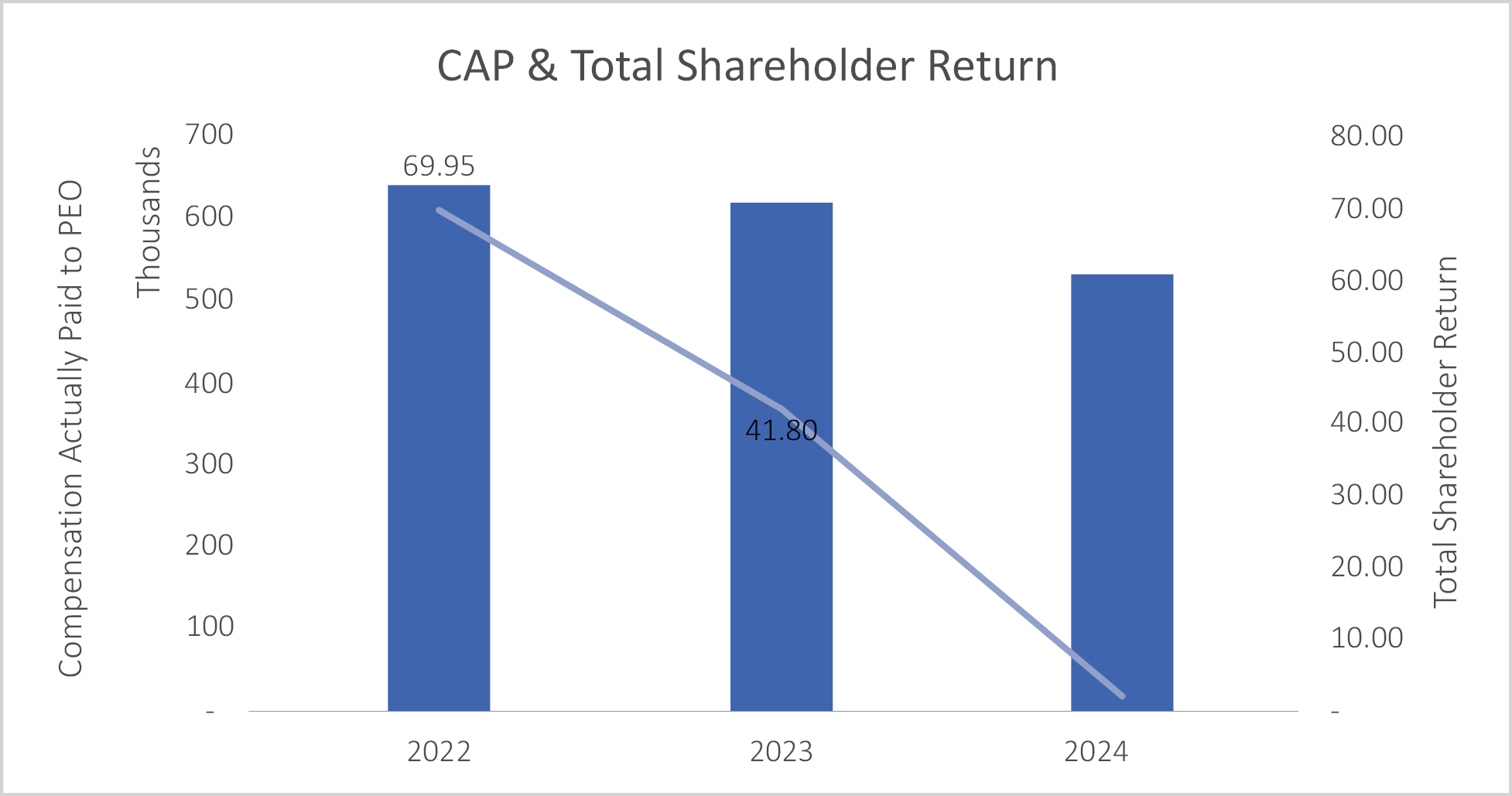
54
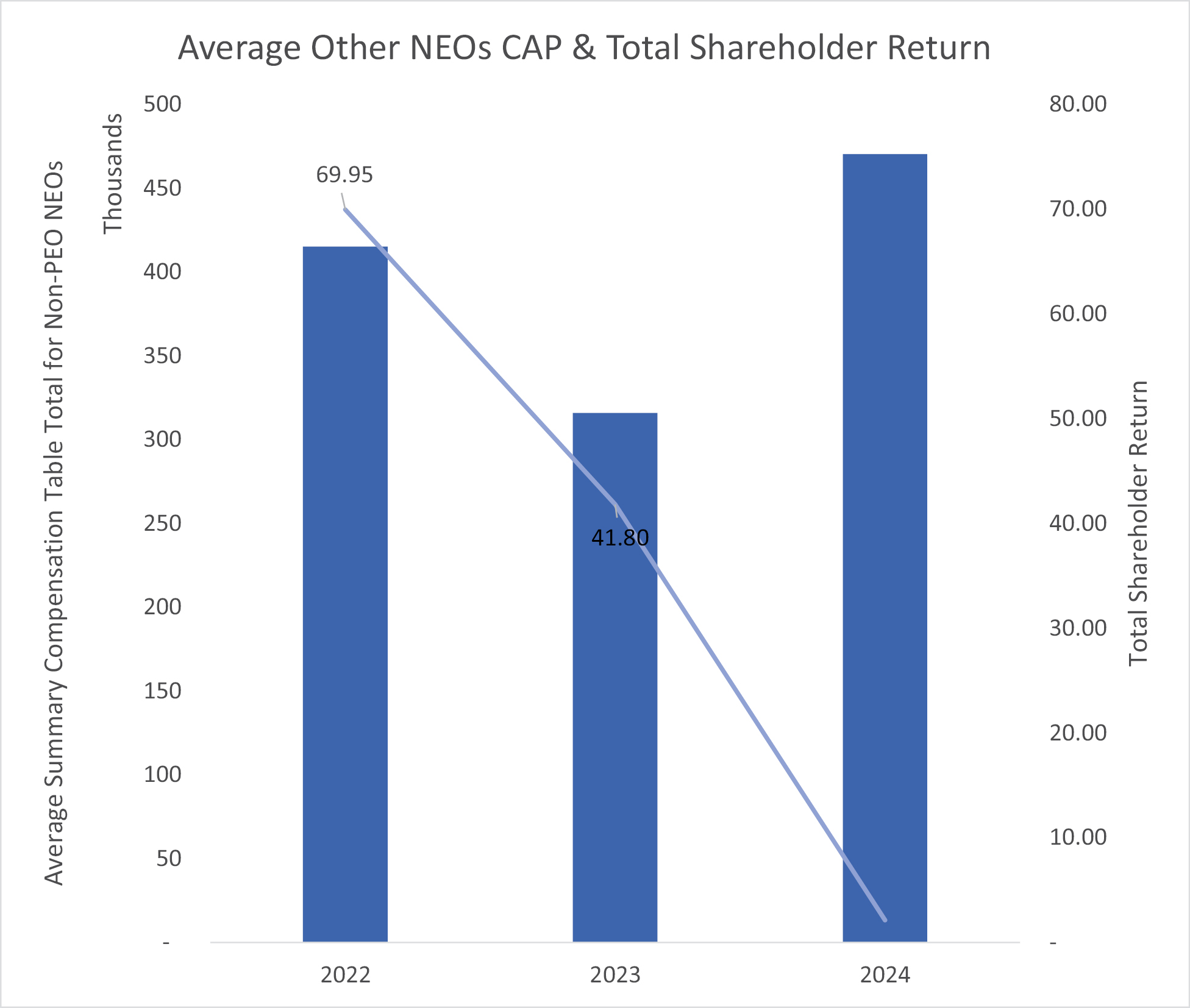
55
Compensation Actually Paid and Net Loss
The charts below show the relationship between the compensation actually paid to our PEO and the average compensation actually paid to our non-PEO NEOs, on the one hand, to the Company’s net loss, on the other hand, over the last three years presented in the pay versus performance table.
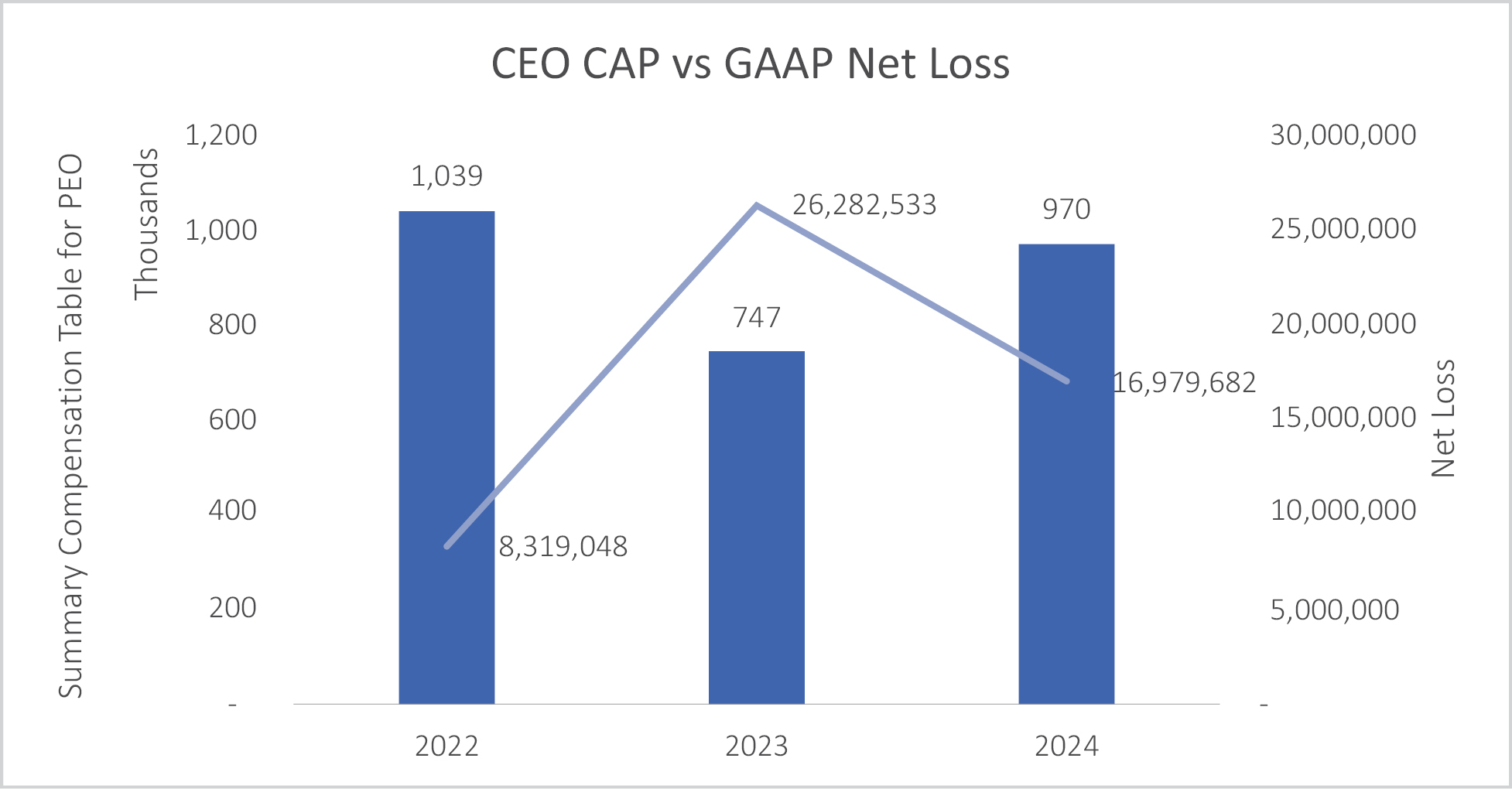
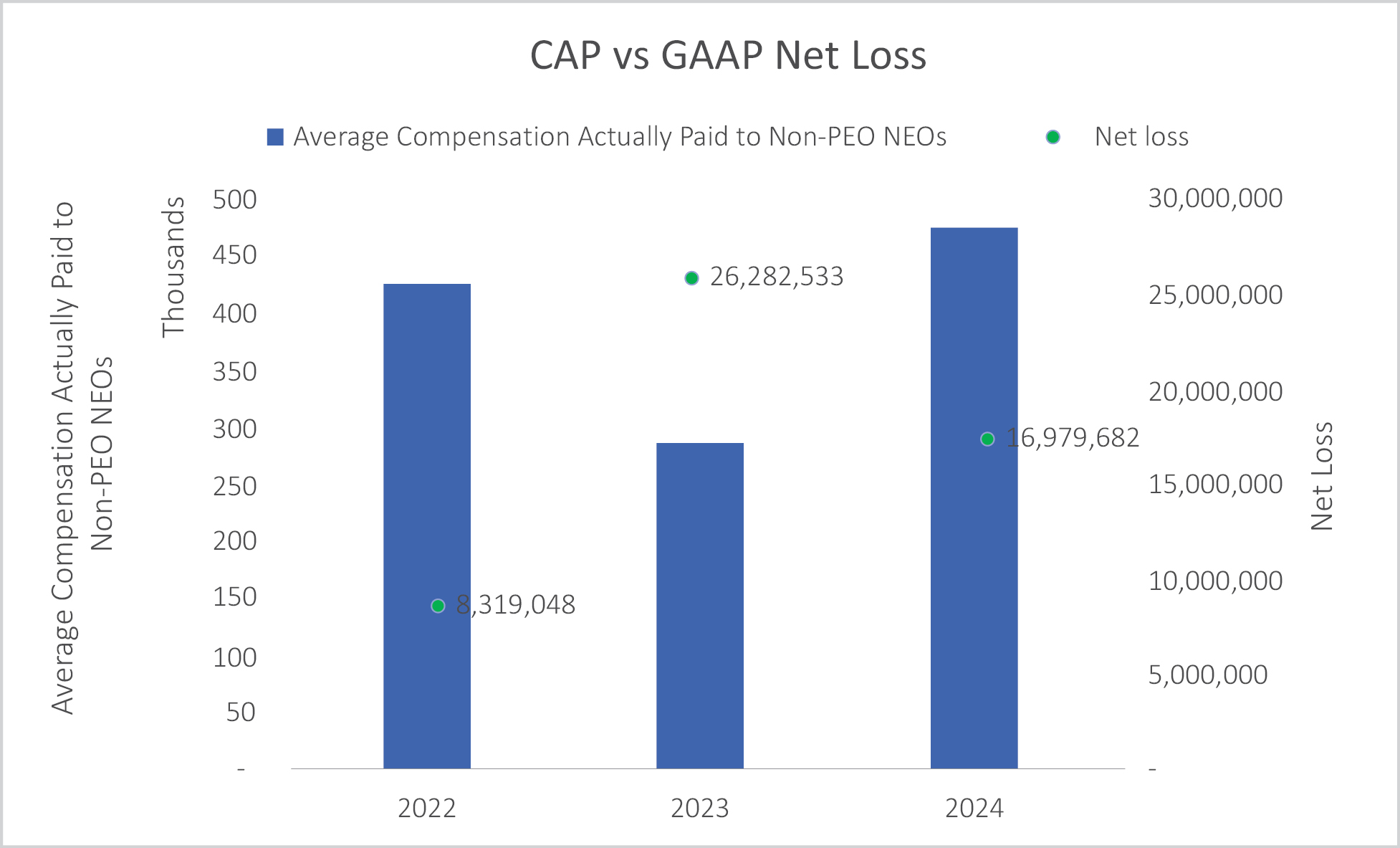
All information provided above under the heading “Pay Versus Performance” will not be deemed to be incorporated by reference into any filing of the Company under the Securities Act of 1933, as amended, or the Securities Exchange Act of 1934, as amended, whether made before or after the date hereof and irrespective of any general incorporation language in any such filing, except to the extent the Company specifically incorporates such information by reference.
56
TRANSACTIONS WITH RELATED PERSONS, PROMOTERS AND CERTAIN CONTROL PERSONS
Related Party Transactions
The following is a summary of transactions since January 1, 2023 to which we have been a party in which the amount involved exceeded $120,000 and in which any of our executive officers, directors or beneficial holders of more than five percent of our capital stock had or will have a direct or indirect material interest, other than compensation arrangements and equity awards granted to our executive officers and directors during 2023 and 2024 that are described under the sections of this proxy statement entitled Executive Compensation and Director Compensation.
On January 21, 2020, CPF GP 2019-1 LLC (CPF GP) issued to the Company a promissory note in the principal amount of $400,000 (the Company Note) and issued to Paul Galvin, the Company’s Chairman and CEO, a promissory note in the principal amount of $100,000 (the Galvin Note). The transaction closed on January 22, 2019, on which date the Company loaned CPF GP 2019-1 LLC $400,000 and Mr. Galvin personally loaned CPF GP $100,000 on behalf of the Company.
The Company Note and Galvin Note were issued pursuant to the Loan Agreement and Promissory Note, dated October 3, 2019, as amended on October 15, 2019 and November 7, 2019 by and between the CPF GP and the Company, and bear interest at five percent (5%) per annum, payable, together with the unpaid principal amount of the promissory notes, on the earlier of the July 31, 2023 maturity date or upon the liquidation, redemption sale or issuance of a dividend upon the LLC interests in CPF MF 2019-1 LLC, a Texas limited liability company of which CPF GP is the general partner. The terms of the Galvin Note, however, provide that all interest payments due to Mr. Galvin under the Galvin Note shall be paid directly to, and for the benefit of, the Company. In connection with the issuance of the Company Note and the Galvin Note, CPF GP, the Company and Mr. Galvin entered into a Security Agreement, dated January 21, 2020, pursuant to which CPF GP granted a security interest in its LLC interests in CPF MF 2019-1 LLC to the Company and Mr. Galvin to secure its obligations thereunder. Subsequent to the year ended December 31, 2021, the Galvin Note was assigned to the Company and the principal amount of $100,000 was returned to Mr. Galvin. The Company has a promissory note in the principal amount of $100,000 and the assignment of the promissory note occurred in January 2022.
On December 14, 2023, Mr. Galvin, loaned $75,000 to the Company. The loan was evidenced by a promissory note. The loan will be interest free (subject, however to any interest which may be imputed under applicable income tax laws) and is due and payable by December 14, 2024. Currently, this amount is still outstanding.
As of December 31, 2024, the Company has accrued approximately $450,000 for amounts due to Mr. Galvin, the former CEO, for deferred salary due to him.
Loan Transactions with SG DevCorp
During 2021, SG DevCorp received $4,200,000 from due to affiliates. This amount was advanced to SG DevCorp by us, was evidenced by a promissory note, non-interest bearing and was due on demand. Included in this amount, were payroll and general and administrative expenses which were paid by us and allocated to SG DevCorp.
On August 9, 2023, we and SG DevCorp entered into a Note Cancellation Agreement, effective as of July 1, 2023, pursuant to which we cancelled and forgave the remaining $4,000,000 balance then due on that certain promissory note, dated December 19, 2021, made by SG DevCorp in favor of us in the original principal amount of $4,200,000.
In addition, as of December 31, 2024, $1,717,694 is due from us for advances made by the SG DevCorp. On January 29, 2025, we entered into a mutual release and discharge agreement (the Mutual Release) with SG DevCorp pursuant to SG DevCorp forgiving and releasing from our obligations to them under that certain promissory note, dated August 9, 2023, in the principal amount of $908,322.95 and in respect of $815,522 of inter-company advances from SG DevCorp to us in exchange for us forgiving $394,329 of inter-company debt owed to us by us and for SG DevCorp(which has already been written off) transferring 276,425 shares (the Shares) of SG DevCorp’s Common Stock owned by us, with us no longer being a shareholder of SG DevCorp.
57
The Spin-Off of SG DevCorp
In connection with the Separation and Distribution, we entered into a separation and distribution agreement and several other agreements with SG DevCorp to effect the Separation and provide a framework for our relationship with SG DevCorp after the Separation. These agreements provide for the allocation between us, on the one hand, and SG DevCorp, on the other hand, of the assets, liabilities and obligations associated with the spin-off business, on the one hand, and our other current businesses, on the other hand, and will govern the relationship between our company, on the one hand, and SG DevCorp, on the other hand, subsequent to the Separation and Distribution (including with respect to transition services, employee matters and tax matters).
Separation and Distribution Agreement
The separation and distribution agreement governs the overall terms of the Separation and Distribution and specified those conditions that must be satisfied or waived by us prior to the completion of the Separation. We and SG DevCorp each agreed to indemnify the other and each of the others current and former directors, officers, and employees, and each of the heirs, executors, administrators, successors, and assigns of any of them, against certain liabilities incurred in connection with the Separation and Distribution and our and SG DevCorp’s respective businesses. The amount of either SG DevCorp’s or our indemnification obligations will be reduced by any net insurance proceeds the party being indemnified receives. The separation and distribution agreement also establishes procedures for handling claims subject to indemnification and related matters.
Tax Matters Agreement
In connection with the Separation, we and SG DevCorp entered into a tax matters agreement that contains certain tax matters arrangements and governs the parties respective rights, responsibilities, and obligations with respect to taxes, including taxes arising in the ordinary course of business and taxes incurred as a result of the Separation and the Distribution. The tax matters arrangement also sets forth the respective obligations of the parties with respect to the filing of tax returns, the administration of tax contests, and assistance and cooperation on tax matters.
The tax matters agreement governs the rights and obligations that we and SG DevCorp have after the Separation with respect to taxes for both pre- and post-closing periods. Under the tax matters arrangement, SG DevCorp will be responsible for (i) any of SG DevCorp’s taxes for all periods prior to and after the Distribution and (ii) any taxes of the Safe & Green group for periods prior to the Distribution to the extent attributable to the real estate development business. We generally will be responsible for any of the taxes of the Safe & Green group other than taxes for which SG DevCorp is responsible. In addition, we will be responsible for our taxes arising as a result of the Separation and Distribution. Notwithstanding the foregoing, sales, use, transfer, real property transfer, intangible, recordation, registration, documentary, stamp or similar taxes imposed on the Distribution shall be borne fifty percent (50%) by us and fifty percent (50%) by SG DevCorp. We shall be entitled to any refund (and any interest thereon received from the applicable tax authority) of taxes for which we are responsible for under the tax matters agreement and SG DevCorp shall be entitled to any refund (and any interest thereon received from the applicable tax authority) of taxes for which SG DevCorp is responsible for under the tax matters agreement.
Each of Safe & Green and SG DevCorp will indemnify each other against any taxes allocated to such party under the tax matters agreement and related out-of-pocket costs and expenses.
Shared Services Agreement
In connection with the Separation, we entered into a shared services agreement with SG DevCorp which sets forth the terms on which we provide to SG DevCorp certain services or functions that the companies historically have shared. Shared services will include various administrative, accounting, communications/investor relations, human resources, operations/construction services, and strategic management and other support services.
In consideration for such services, SG DevCorp pays fees to us for the services provided, and those fees are generally in amounts intended to allow us to recover all of its direct and indirect costs incurred in providing those services. We charge SG DevCorp a fee for services performed by (i) our employees which is a percentage of each employees base salary based upon an allocation of their business time spent providing such services and (ii) third parties, the fees charged by such third parties. SG DevCorp also pay us for general and administrative expenses incurred by us attributable to both the operation of Safe & Green (other than the provision of the services performed
58
by our employees) and the provision of the shared services, including but not limited to information technology, data subscription and corporate overhead expenses, the portion of such costs and expenses that are attributable to the provision of the shared services, as reasonably determined by us. SG DevCorp also reimburses us for direct out-of-pocket costs incurred by us for third party services provided to SG DevCorp.
Other Related Party Transactions
Fabrication Agreement
On December 2, 2022, SG DevCorp entered into the Fabrication Agreement with SG Echo for the fabrication of approximately 800 multifamily market rate rental units, equal to approximately 800,000 square feet of new modular buildings to be located at the McLean site (the McLean Project). The Fabrication Agreement provided that SG Echo would be paid a fee equal to 15% of the cost of the McLean Project. The McLean Project will be fabricated in Phases of 100 to 150 units per phase, with the schedule of the phasing to be determined in SG DevCorp’s sole discretion. The terms of payment are as follows: (i) down payment of 30% upon release of project for fabrication; (ii) stage payment of 65% upon completion of fabrication, testing and inspection of each unit as it leaves the facility; and (iii) final payment of 5% upon completion of installation on site, including acceptance of punch list items, startup of equipment and City of Durant inspection. Notwithstanding the foregoing, SG DevCorp may withhold 10%, as retainage, from the payment otherwise due, to be reduced to 5% after field install is watertight and 2.5% after all punch list items have been complete. The Fabrication Agreement may be terminated for cause by either party upon 30-days written notice to the other party, subject to each party’s right to cure a default or breach, except for fraud or bad faith. In the event of termination, SG Echo will be entitled to be paid for all services rendered through the date of termination. In the event the termination by SG DevCorp is without cause, SG DevCorp will also pay any expenses incurred as a result of the termination (including without limitation supplier and vendor cancellation fees, restocking fees, subcontractor termination or cancellation fees, or other similar termination costs), plus a 15% markup as compensation for SG Echo’s anticipated profit on the value of services not performed by SG Echo. In connection with the entry into the Master Purchase Agreement, on December 18, 2023, SG DevCorp and SG Echo terminated that certain Fabrication Agreement, dated December 2, 2022, between the parties relating to the McLean mixed-use site.
Master Purchase Agreement
The Master Purchase Agreement provides that SG Echo will be paid a fee equal to 12% of the agreed cost of each project. The Master Purchase Agreement further provides that payment terms for all design work and the completion of the pre-fabricated container and module shall be made in accordance with the following schedule: (a) a deposit equal to 40% of the cost of the pre- fabricated container and module only shall be paid by SG DevCorp to SG Echo within 5 business days of the mutual execution of a project order; (b) a progress payment (not to exceed to 35% of the cost of the pre-fabricated container and module) shall be paid by SG DevCorp to SG Echo monthly in proportion to the percentage of Work completed, which payment shall be made within 10 business days of the SG DevCorp’s receipt of SG Echo’s invoice; (c) a progress payment equal to 15% of the cost of the pre-fabricated container and module shall be paid by SG DevCorp to SG Echo within 10 business days of the delivery of the pre-fabricated container and module to the specific project site; and (d) the final payment equal to 10% of the cost of the pre-fabricated container and module only shall be paid by SG DevCorp to SG Echo within 10 business days of the substantial completion of the Work. Substantial completion of the Work shall be as defined by the applicable project order. Notwithstanding the foregoing, SG DevCorp may withhold 10% of the invoiced amount, as retainage, which will be paid to SG Echo once the specific project is completed (including any punch list items). The Master Purchase Agreement may be terminated by either party if there is a material default by the other party and such default continues for a period of 20 days after receipt by the defaulting party of written notice thereof. If SG DevCorp terminates the Master Purchase Agreement or any project order as a result of a default by SG Echo, SG Echo will not be entitled to receive further payment until the Work is finished. If the unpaid balance of the amount set forth in the project order for the project is less than the cost of finishing the Work, SG Echo will pay the difference to SG DevCorp. In no event will SG Echo be entitled to receive any compensation if the cost to SG DevCorp of performing the balance of the Work is less than the unpaid balance. In addition, SG DevCorp may terminate the Master Purchase Agreement or any project order without cause. In the event the termination by SG DevCorp is without cause, SG Echo will be entitled to payment for all work and costs incurred prior to termination date plus the applicable fee owed to SG Echo thereon as more particularly described in the applicable project order.
59
The initial project for which modular construction services are anticipated to be provided to SG DevCorp by SG Echo is the Magnolia Gardens residential project to be built on the McLean mixed-use site in Durant, Oklahoma, consisting of 800 residential units. In accordance with the Master Purchase Agreement, SG Echo will provide SG DevCorp with an itemized cost proposal for the services to be performed for the Magnolia Gardens residential project and a firm schedule for performing the services. If the proposal and schedule is satisfactory to SG DevCorp, the proposal will be then incorporated into a project order to be executed by both parties.
Related Party Review Procedures
Pursuant to our Audit Committee charter, our Audit Committee reviews on an on-going basis our policies and procedures for reviewing and approving or ratifying all Related Party Transactions (defined as transactions required to be disclosed pursuant to Item 404 of Regulation S-K), including the Company’s Related Person Transaction Policy, and recommend any changes to the Board. In accordance with our Related Person Transaction Policy and Nasdaq Rule 4350 (h), the Audit Committee conducts appropriate review and oversight of all related person transactions for potential conflict of interest situations on an ongoing basis. Any transaction with a related person is subject to our written policy for transactions with related persons. Pursuant to such policy, our Audit Committee reviews in advance all related person transactions. The Audit Committee approves only those related person transactions that are determined to be in, or not inconsistent with, the best interests of the Company and its stockholders, taking into account all available facts and circumstances as the Audit Committee determines in good faith to be necessary. These facts and circumstances will typically include, but not be limited to: whether the transaction was undertaken in the ordinary course of business of the Company; the purpose and potential benefits of the transaction to the Company; the terms of the transaction and of comparable transactions that would be available to unrelated third parties or to employees generally; and the impact on a directors independence in the event the related person is a director, an immediate family member of a director or an entity in which a director is a partner, stockholder or executive officer. In reviewing and approving such transactions, the Audit Committee obtains, or will direct management to obtain on its behalf, all information that the Audit Committee believes to be relevant and important to a review of the transaction prior to its approval. The Audit Committee may adopt any further policies and procedures relating to the approval of related person transactions that it deems necessary or advisable from time to time.
60
DELINQUENT SECTION 16(a) REPORTS
Section 16(a) of the Exchange Act and the regulations promulgated thereunder require our executive officers, directors and persons who beneficially own more than 10% of our common stock to file forms with the SEC to report their ownership of the Company’s shares and any changes in ownership. We have reviewed all forms filed electronically with the SEC during, and with respect to, fiscal year ended December 31, 2024. Based on that review and written information given to us by all of our directors and executive officers, we believe that all of our directors, executive officers and holders of more than 10% of our stock filed on a timely basis all reports that they were required to file under Section 16(a) during fiscal 2024, except the following:
• Paul Galvin Form 4 filed 7/12/2024 for one transaction
• Michael McLaren Form 3 filed 12/8/2025
• Michael McLaren Form 4 filed 12/8/2025 for 4 transactions
OTHER MATTERS TO COME BEFORE THE 2025 ANNUAL MEETING OF THE STOCKHOLDERS
No other matters are to be presented for action at the 2025 Annual Meeting other than as set forth in this Proxy Statement. If other matters properly come before the meeting, however, the persons named in the accompanying proxy card will vote all proxies solicited by this Proxy Statement as recommended by the Board, or, if no such recommendation is given, in their own discretion.
STOCKHOLDER PROPOSALS FOR THE 2026 ANNUAL MEETING OF THE STOCKHOLDERS
Because the date of the 2025 Annual Meeting changed by more than 30 days from the date of the 2024 Annual Meeting, stockholders who intend to present proposals for inclusion in the 2026 proxy materials for the Company’s 2026 Annual Meeting under SEC Rule 14a-8 must submit such proposals in writing to Olenox Industries, Inc., 1207 N. FM 3083 E. Bldg C, Conroe, Texas 77304, Attention: Corporate Secretary, by a reasonable time prior to the time that we begin to print and send our proxy materials, as specified in a Current Report on Form 8-K to be filed by us with the SEC. Such proposals must meet the requirements of our Amended and Restated Bylaws and the SEC to be eligible for inclusion in the proxy materials for our 2026 Annual Meeting.
Generally, timely notice of any director nomination or other proposal that any stockholder intends to present at the 2026 Annual Meeting but does not intend to have included in the proxy materials prepared by the Company in connection with the 2026 Annual Meeting, must have been delivered in writing to the Corporate Secretary at the address above not less than 60 days nor more than 75 days before the first anniversary of the date on which the Company first mailed its proxy materials for the 2025 Annual Meeting. However, if we hold the 2026 Annual Meeting on a date that is advanced by more than 30 days prior to or delayed by more than 60 days after December 29, 2026, the one-year anniversary of the 2025 Annual Meeting, we must receive the notice not earlier than the close of business on the 120th day prior to the 2026 Annual Meeting and not later than the close of business on the later of the 90th day prior to the 2026 Annual Meeting or the 10th day following the day on which public announcement of the date of the 2026 Annual Meeting is first made. As a result, stockholders who intend to present proposals at the 2026 Annual Meeting under these provisions must give written notice to the Corporate Secretary, and otherwise comply with the requirements under our Amended and Restated Bylaws, no earlier than the close of business on October 5, 2026, and no later than the close of business on October 20, 2026, unless the date of the 2026 Annual Meeting is advanced by more than 30 days or delayed by more than 60 days from December 29, 2026. In addition, a stockholder’s notice must set forth the information required by our Amended and Restated Bylaws with respect to each stockholder making the proposal or nomination and each proposal or nomination that such stockholder intends to present at the 2026 Annual Meeting. All proposals should be addressed to the Corporate Secretary, Olenox Industries Inc., 1207 N. FM 3083 E. Bldg C, Conroe, Texas 77304.
In addition to satisfying the foregoing requirements, to comply with the universal proxy rules, stockholders who intend to solicit proxies in support of director nominees other than the Company’s nominees at the 2026 Annual Meeting must provide notice that sets forth the information required by Rule 14a-19 under the Exchange Act no later than October 30, 2026. If such meeting date is changed by more than 30 days before or after December 29, 2026, then notice pursuant to Rule 14a-19 must be provided by the later of 60 calendar days prior to the date of the 2026 Annual Meeting or the 10th calendar day following the day on which public announcement of the date of the 2026 Annual Meeting is first made.
61
HOUSEHOLDING OF SPECIAL DISCLOSURE DOCUMENTS
The SEC has adopted rules that permit companies and intermediaries (e.g., brokers) to satisfy the delivery requirements for proxy statements and annual reports by delivering a single copy of these materials to an address shared by two or more stockholders. This process, which is commonly referred to as “householding,” potentially means extra convenience for stockholders and cost savings for companies and intermediaries. A number of brokers and other intermediaries with account holders who are our stockholders may be householding our stockholder materials, including this Proxy Statement. In that event, a single proxy statement, as the case may be, will be delivered to multiple stockholders sharing an address unless contrary instructions have been received from the affected stockholders. Once you have received notice from your broker or other intermediary that it will be householding communications to your address, householding will continue until you are notified otherwise or until you revoke your consent, which is deemed to be given unless you inform the broker or other intermediary otherwise when you receive or received the original notice of householding. If, at any time, you no longer wish to participate in householding and would prefer to receive a separate proxy statement, please notify your broker or other intermediary to discontinue householding and direct your written request to receive a separate proxy statement to us at: Olenox Industries Inc., Attention: Corporate Secretary, 1207 N. FM 3083 E. Bldg C, Conroe, Texas 77304 or by calling us at (936) 323-6332. Stockholders who currently receive multiple copies of the proxy statement at their address and would like to request householding of their communications should contact their broker or other intermediary.
|
By Order of the Board of Directors, |
||
|
/s/ Michael McLaren |
||
|
Michael McLaren |
||
|
Chairman of the Board |
||
|
Miami, Florida |
||
|
February 13, 2026 |
62
Appendix A
AGREEMENT AND PLAN OF MERGER
By and Between
SAFE & GREEN HOLDINGS CORP.,
and
NEW ASIA HOLDINGS, INC.
Dated as of February 2, 2025
TABLE OF CONTENTS
|
Page |
||||
|
Article I The Merger |
A-1 |
|||
|
Section 1.01 |
The Merger |
A-1 |
||
|
Section 1.02 |
Closing; Effective Time. |
A-2 |
||
|
Section 1.03 |
Effects of the Merger |
A-2 |
||
|
Section 1.04 |
Certificates of Designation; Certificate of Incorporation; By-Laws |
A-2 |
||
|
Section 1.05 |
Directors and Officers |
A-3 |
||
|
Article II EFFECT of the Merger on Capital Stock; Exchange of certificates |
A-3 |
|||
|
Section 2.01 |
Effect of the Merger on Capital Stock |
A-3 |
||
|
Section 2.02 |
Options and Other Equity-Based Awards and Warrants |
A-4 |
||
|
Section 2.03 |
Exchange Procedures |
A-4 |
||
|
Section 2.04 |
Adjustments |
A-5 |
||
|
Section 2.05 |
Withholding Rights |
A-5 |
||
|
Section 2.06 |
Lost Certificates |
A-5 |
||
|
Section 2.07 |
Tax Treatment |
A-5 |
||
|
Article III Representations and Warranties of the Company |
A-6 |
|||
|
Section 3.01 |
Organization; Standing and Power; Charter Documents; Subsidiaries |
A-6 |
||
|
Section 3.02 |
Capital Structure |
A-6 |
||
|
Section 3.03 |
Authority; Non-Contravention; Governmental Consents; Board Approval; Anti-Takeover Statutes |
A-7 |
||
|
Section 3.04 |
SEC Filings; Financial Statements; Undisclosed Liabilities; Off-Balance Sheet Arrangements |
A-9 |
||
|
Section 3.05 |
Absence of Certain Changes or Events |
A-10 |
||
|
Section 3.06 |
Taxes |
A-10 |
||
|
Section 3.07 |
Intellectual Property |
A-12 |
||
|
Section 3.08 |
Compliance; Permits |
A-13 |
||
|
Section 3.09 |
Litigation |
A-13 |
||
|
Section 3.10 |
Brokers’ and Finders’ Fees |
A-13 |
||
|
Section 3.11 |
Related Person Transactions |
A-13 |
||
|
Section 3.12 |
Employee Benefit Issues |
A-14 |
||
|
Section 3.13 |
Real Property and Personal Property Matters |
A-16 |
||
|
Section 3.14 |
Environmental Matters |
A-17 |
||
|
Section 3.15 |
Material Contracts |
A-17 |
||
|
Section 3.16 |
Insurance |
A-19 |
||
|
Section 3.17 |
Information Supplied |
A-19 |
||
|
Section 3.18 |
Anti-Corruption Matters |
A-19 |
||
|
Article IV Representations and Warranties of Parent and Merger SubS |
A-20 |
|||
|
Section 4.01 |
Organization; Standing and Power; Charter Documents; Subsidiaries |
A-20 |
||
|
Section 4.02 |
Capital Structure |
A-20 |
||
|
Section 4.03 |
Authority; Non-Contravention; Governmental Consents; Board Approval |
A-21 |
||
|
Section 4.04 |
SEC Filings; Financial Statements; Undisclosed Liabilities |
A-22 |
||
|
Section 4.05 |
Absence of Certain Changes or Events |
A-24 |
||
|
Section 4.06 |
Taxes |
A-24 |
||
|
Section 4.07 |
Intellectual Property |
A-25 |
||
|
Section 4.08 |
Compliance; Permits |
A-26 |
||
|
Section 4.09 |
Employee Benefit Issues |
A-26 |
||
|
Section 4.10 |
Real Property and Personal Property Matters |
A-29 |
||
|
Section 4.11 |
Environmental Matters |
A-29 |
||
A-i
|
Page |
||||
|
Section 4.12 |
Material Contracts |
A-30 |
||
|
Section 4.13 |
Insurance |
A-31 |
||
|
Section 4.14 |
Litigation |
A-32 |
||
|
Section 4.15 |
Brokers |
A-32 |
||
|
Section 4.16 |
Anti-Corruption Matters |
A-32 |
||
|
Section 4.17 |
Information Supplied |
A-32 |
||
|
Section 4.18 |
Ownership of Company Common Stock |
A-32 |
||
|
Section 4.19 |
Intended Tax Treatment |
A-32 |
||
|
Section 4.20 |
Merger Subs |
A-32 |
||
|
Article V COVENANTS |
A-32 |
|||
|
Section 5.01 |
Reservation of Parent Common Stock; Issuance of Shares of Parent Common Stock |
A-32 |
||
|
Section 5.02 |
Notices of Certain Events |
A-33 |
||
|
Section 5.03 |
Employees; Benefit Plans |
A-33 |
||
|
Section 5.04 |
Directors’ and Officers’ Indemnification and Insurance |
A-34 |
||
|
Section 5.05 |
Reasonable Best Efforts |
A-34 |
||
|
Section 5.06 |
Public Announcements |
A-36 |
||
|
Section 5.07 |
Anti-Takeover Statutes |
A-36 |
||
|
Section 5.08 |
Section 16 Matters |
A-36 |
||
|
Section 5.09 |
Stock Exchange Matters |
A-36 |
||
|
Section 5.10 |
Certain Tax Matters |
A-36 |
||
|
Section 5.11 |
Stockholder Litigation |
A-37 |
||
|
Section 5.12 |
Obligations of Merger Subs |
A-37 |
||
|
Section 5.13 |
Resignations |
A-37 |
||
|
Section 5.14 |
Further Assurances |
A-37 |
||
|
Article VI Conditions |
A-37 |
|||
|
Section 6.01 |
Conditions to Each Party’s Obligation to Effect the Merger |
A-37 |
||
|
Article VII Miscellaneous |
A-38 |
|||
|
Section 7.01 |
Definitions |
A-38 |
||
|
Section 7.02 |
Interpretation; Construction |
A-45 |
||
|
Section 7.03 |
Survival |
A-46 |
||
|
Section 7.04 |
Governing Law |
A-46 |
||
|
Section 7.05 |
Submission to Jurisdiction |
A-46 |
||
|
Section 7.06 |
Waiver of Jury Trial |
A-47 |
||
|
Section 7.07 |
Notices |
A-47 |
||
|
Section 7.08 |
Entire Agreement |
A-47 |
||
|
Section 7.09 |
No Third-Party Beneficiaries |
A-47 |
||
|
Section 7.10 |
Severability |
A-47 |
||
|
Section 7.11 |
Assignment |
A-48 |
||
|
Section 7.12 |
Remedies Cumulative |
A-48 |
||
|
Section 7.13 |
Specific Performance |
A-48 |
||
|
Section 7.14 |
Counterparts; Effectiveness |
A-48 |
||
A-ii
AGREEMENT AND PLAN OF MERGER
This Agreement and Plan of Merger (this “Agreement”) is entered into as of February 2, 2025, by and between New Asia Holdings, Inc., a Nevada corporation (the “Company”), and Safe & Green Holdings Corp., a Delaware corporation (“Parent”) Capitalized terms used herein (including in the immediately preceding sentence) and not otherwise defined herein shall have the meanings set forth in Section 7.01 hereof.
RECITALS
WHEREAS, Parent and the Company intend to effect a merger of a to-be-formed Delaware corporation, and wholly-owned subsidiary of Parent (the “First Merger Sub”) with and into the Company (the “First Merger”) in accordance with this Agreement and the Delaware General Corporation Law (the “DGCL”) and chapters 78 and 92A of the Nevada Revised Statutes, as amended (the “Nevada Act”). Upon consummation of the First Merger, First Merger Sub will cease to exist, and the Company will become a wholly-owned Subsidiary of Parent;
WHEREAS, immediately following the First Merger and as part of the same overall transaction of the First Merger, the Company will merge with and into a to-be-formed Delaware limited liability company, and wholly owned subsidiary of Parent (the “Second Merger Sub”, and together with the First Merger Sub, “Merger Subs”)) (the “Second Merger” and, together with the First Merger, the “Merger”), with Second Merger Sub being the surviving entity of the Second Merger;
WHEREAS, for U.S. federal income Tax purposes, the parties intend that the First Merger and Second Merger, taken together, will constitute an integrated transaction described in Rev. Rul. 2001-46, 2001-2 C.B. 321 that qualifies as a “reorganization” within the meaning of Section 368(a) of the Internal Revenue Code of 1986, as amended (the “Code”), and that this Agreement be, and is hereby, adopted as a plan of reorganization within the meaning of Section 368(a) of the Code;
WHEREAS, the Parent Board has (a) determined that the Merger is fair to, advisable, and in the best interests of Parent and its stockholders, (b) approved and declared advisable this Agreement and the Merger, including the issuance of the Parent Stock Payment Shares to the stockholders of the Company pursuant to the terms of this Agreement, and (c) determined to recommend, upon the terms and subject to the conditions set forth in this Agreement, that the stockholders of Parent vote to approve the Parent Stockholder Matters at the Parent Stockholders’ Meeting to be convened following the Closing;
WHEREAS, the Company Board has (a) determined that the Merger is fair to, advisable, and in the best interests of the Company and its stockholders, and (b) approved this Agreement and the Merger, and (c) that approval from stockholders of the company is not required at this time (the “Board Approval”);
WHEREAS, immediately following the execution and delivery of this Agreement, but prior to the filing of the First DE Certificate of Merger and the NV Certificate of Merger, Parent will file the Certificate of Amendment to the Series A Certificate of Designation to designate 4,000,000 shares of preferred stock of Parent as Series A Convertible Preferred Stock which shall have no voting powers and which have conversion rights to convert into shares of common stock of the Parent at a ratio of one (1) to fifteen (15) whereby each share of Series A Convertible Preferred Stock converts into fifteen (15) shares of Parent common stock, subject to approval by a majority of common shareholders(the “Certificate of Designation”) with the office of the Secretary of State of Delaware; and
WHEREAS, the parties desire to make certain representations, warranties, covenants, and agreements in connection with the Merger and the other transactions contemplated by this Agreement and also to prescribe certain terms and conditions to the Merger.
NOW, THEREFORE, in consideration of the foregoing and of the representations, warranties, covenants, and agreements contained in this Agreement, the parties, intending to be legally bound, agree as follows:
Article I
The Merger
Section 1.01 The Merger. Upon the terms and subject to the conditions set forth in this Agreement, at the First Effective Time, First Merger Sub shall be merged with and into the Company, and the separate existence of First Merger Sub shall cease. As a result of the First Merger, the Company will continue as the surviving corporation in the First Merger (the “First Step Surviving Corporation”). Upon the terms and subject to the conditions set forth in
A-1
this Agreement, at the Second Effective Time, the First Step Surviving Corporation will merge with and into Second Merger Sub, and the separate existence of the First Step Surviving Corporation shall cease. As a result of the Second Merger, Second Merger Sub will continue as the surviving entity in the Second Merger (the “Surviving Entity”).
Section 1.02 Closing; Effective Time. The consummation of the Merger (the “Closing”) is being consummated remotely via the electronic exchange of documents and signatures on the Closing Date, or at such other time, date and place as Parent and the Company may mutually agree in writing. The date on which the Closing actually takes place is referred to as the “Closing Date.” At the Closing, (a) the Parties shall cause the First Merger to be consummated by executing and filing (i) with the Secretary of State of the State of Delaware a certificate of merger with respect to the First Merger, satisfying the applicable requirements of the DGCL, as applicable, and in form and substance to be agreed upon by the Parties (the “First DE Certificate of Merger”), and (ii) with the Secretary of State of the State of Nevada a certificate of merger with respect to the First Merger, satisfying the applicable requirements of the Nevada Act, as applicable, and in form and substance to be agreed upon by the Parties (the “NV Certificate of Merger”), and (b) the Parties shall cause the Second Merger to be consummated by executing and filing with the Secretary of State of the State of Delaware a certificate of merger with respect to the Second Merger, satisfying the applicable requirements of the DGCL and the DLLCA and in form and substance to be agreed upon by the Parties (the “Second DE Certificate of Merger” and, together with the First DE Certificate of Merger and the Nevada Certificate of Merger, the “Certificates of Merger”). The First Merger shall become effective at the time of the filing of such First DE Certificate of Merger with the Secretary of State of the State of Delaware and the NV Certificate of Merger with the Secretary of State of Nevada or at such later time as may be specified in such First DE Certificate of Merger or the NV Certificate of Merger with the consent of Parent and the Company (the time as of which the First Merger becomes effective being referred to as the “First Effective Time”). The Second Merger shall become effective at the time of the filing of such Second Certificate of Merger with the Secretary of State of the State of Delaware or at such later time as may be specified in such Second Certificate of Merger with the consent of Parent and the Company (the time as of which the Second Merger becomes effective being referred to as the “Second Effective Time”).
Section 1.03 Effects of the Merger. At and after the First Effective Time, the First Merger shall have the effects set forth in this Agreement, the First Certificate of Merger, and in the applicable provisions of the DGCL and the Nevada Act. As a result of the First Merger, the First Step Surviving Corporation will become a wholly owned subsidiary of Parent. At and after the Second Effective Time, the Second Merger shall have the effects set forth in this Agreement, the Second Certificate of Merger and in the applicable provisions of the DGCL and the DLLCA.
Section 1.04 Certificates of Designation; Certificate of Incorporation; By-Laws.
(a) Immediately following the execution and delivery of this Agreement, but prior to the filing of the First Certificate of Merger, Parent will file the Certificate of Designation with the office of the Secretary of State of the State of Delaware.
(b) At the First Effective Time:
(i) The certificate of incorporation of the First Step Surviving Corporation shall be amended and restated as set forth in an exhibit to the First DE Certificate of Merger to be identical to the certificate of incorporation of First Merger Sub as in effect immediately prior to the First Effective Time, until thereafter amended;
(ii) The bylaws of the First Step Surviving Corporation shall be amended and restated in their entirety to read identically to the bylaws of the Company as in effect immediately prior to the First Effective Time, until thereafter amended; and
(iii) The certificate of incorporation of Parent shall be identical to the certificate of incorporation of Parent immediately prior to the First Effective Time, until thereafter amended.
(c) At the Second Effective Time:
(i) The certificate of formation of the Surviving Entity shall be the certificate of formation of Second Merger Sub as in effect immediately prior to the Second Effective Time, until thereafter amended; provided, however, that following the Second Effective Time (but as soon thereafter as practicable) the certificate of formation of the Surviving Entity shall be amended to (A) change the name of the Surviving Entity to New Asia Holdings, LLC, (B) comply with this Agreement and (C) make such other changes as are mutually agreed to by Parent and the Company;
A-2
(ii) the certificate of incorporation of Parent shall be identical to the certificate of incorporation of Parent immediately prior to the Second Effective Time, until thereafter amended as provided by the DGCL and such certificate of incorporation, provided, however, that following the Second Effective Time (but as soon thereafter as practicable), the certificate of incorporation shall be amended to make such changes as are mutually agreed to by Parent and the Company; and
(iii) the limited liability company agreement of the Surviving Entity shall be amended and restated in its entirety to read identically to the limited liability company agreement of Second Merger Sub as in effect immediately prior to the Second Effective Time, until thereafter amended as provided by the DLLCA and such limited liability company agreement; provided, however, that following the Second Effective Time (but as soon thereafter as practicable), the limited liability company agreement shall be amended to (A) comply with this Agreement and (B) change the name of the Surviving Entity to New Asia Holdings, LLC.
Section 1.05 Directors and Officers.
(a) At the First Effective Time:
(i) The directors and officers of Parent, each to hold office in accordance with the certificate of incorporation and bylaws of Parent, shall be the same as immediately prior to the Effective Time; and
(ii) The directors and officers of the First Step Surviving Corporation, each to hold office in accordance with the certificate of incorporation and bylaws of the First Step Surviving Corporation, shall be such persons as shall be mutually agreed upon by Parent and the Company.
(b) At the Second Effective Time, the managers and officers of the Surviving Entity, each to hold office in accordance with the certificate of formation and limited liability company agreement of the Surviving Entity, shall be such persons as shall be mutually agreed upon by Parent and the Company.
Article II
EFFECT of the Merger on Capital Stock; Exchange of certificates
Section 2.01 Effect of the Merger on Capital Stock.
(a) Conversion of Capital Stock. At the First Effective Time, by virtue of the First Merger and without any action on the part of Parent, the Merger Subs, the Company, or the holders of any shares of capital stock of the Parent, Merger Subs, or the Company:
(i) Subject to the terms and conditions of this Agreement, each 87.5 share of Company Common Stock or Company Preferred Stock issued and outstanding immediately prior to the First Effective Time (other than any Excluded Shares shall thereupon be converted into and become exchangeable for one (1) share of Parent Convertible Preferred Stock (the “First Merger Consideration”). As of the First Effective Time, all such shares of Company Common Stock and Company Preferred Stock shall no longer be outstanding and shall automatically be cancelled and shall cease to exist, and shall thereafter only represent the right to receive the First Merger Consideration, without interest.
(ii) At the First Effective Time, each share of Parent Common Stock issued and outstanding immediately prior to the First Effective Time shall remain outstanding. Immediately following the First Effective Time, shares of Parent Common Stock, if any, owned by the First Step Surviving Company shall be surrendered to Parent without payment therefore.
(iii) Each share of Company Common Stock held in the treasury of the Company or owned, directly or indirectly, by Parent or First Merger Sub immediately prior to the First Effective Time (collectively, “Excluded Shares”) shall automatically be cancelled and shall cease to exist, and no consideration shall be delivered in exchange therefor.
(iv) Each share of common stock, par value $0.001 per share of First Merger Sub issued and outstanding immediately prior to the First Effective Time shall be converted into and become one validly issued, fully paid and nonassessable share of common stock, par value $0.001 per share, of the First Step Surviving Company.
A-3
(v) Notwithstanding anything to the contrary in this Agreement, (A) no fractional shares of Parent Convertible Preferred Stock shall be issued in the First Merger, and (B) all fractional shares of Parent Convertible Preferred Stock that a Person otherwise would be entitled to receive as a result of the First Merger shall be aggregated and, if a fractional share results from such aggregation, such Person shall be entitled to receive, in lieu thereof, an amount in cash, without interest, determined by multiplying the fraction of the applicable share of Parent Convertible Preferred Stock to which such Person otherwise would have been entitled by the Parent Closing Price.
(b) At the Second Effective Time, by virtue of the Second Merger and without any further action on the part of Parent, the First Step Surviving Company, Second Merger Sub or their respective securityholders, each share of common stock of the First Step Surviving Company issued and outstanding immediately prior to the Second Effective Time shall be cancelled and extinguished without any conversion thereof and no payment or distribution shall be made with respect thereto.
(c) At the First Effective Time: (a) all holders of book-entry shares representing shares of Company Capital Stock (“Book-Entry Shares”), in each case, that were outstanding immediately prior to the First Effective Time shall cease to have any rights as stockholders of the Company; and (b) the stock transfer books of the Company shall be closed with respect to all shares of Company Capital Stock outstanding immediately prior to the First Effective Time. No further transfer of any such shares of Company Capital Stock shall be made on such stock transfer books after the First Effective Time.
Section 2.02 Options and Other Equity-Based Awards and Warrants. As of the date hereof, the Company has no stock option, retirement, pension, or profit-sharing programs for the benefit of directors, officers or other employees and no warrants outstanding.
Section 2.03 Exchange Procedures.
(a) Exchange Agent. Pacific Stock Transfer Company, transfer agent for the Company’s class of common stock shall act as exchange agent in the Merger (the “Exchange Agent”).
(b) Procedures for Exchange. Promptly after the First Effective Time the Exchange Agent shall effect the transfer Book-Entry Shares in exchange for Parent Stock Payment Shares. Upon transfer of Book-Entry Share to the Exchange Agent for exchange, together with such other documents as may be reasonably required by the Exchange Agent or Parent: (A) the holder of such Book-Entry Share shall be entitled to receive in exchange therefor book-entry shares representing the First Merger Consideration (in a number of whole shares of Parent Convertible Preferred Stock).
(c) Payments to Non-Registered Holders. If any portion of the First Merger Consideration is to be paid to a Person other than the Person in whose name the surrendered Certificate or the transferred Book-Entry Share, as applicable, is registered, it shall be a condition to such payment that: (i) such Certificate shall be properly endorsed or shall otherwise be in proper form for transfer or such Book-Entry Share shall be properly transferred; and (ii) the Person requesting such payment shall pay to the Exchange Agent any transfer or other Tax required as a result of such payment to a Person other than the registered holder of such Certificate or Book-Entry Share, as applicable, or establish to the reasonable satisfaction of the Exchange Agent that such Tax has been paid or is not payable.
(d) Full Satisfaction. All First Merger Consideration paid upon the surrender of Certificates or transfer of Book-Entry Shares in accordance with the terms hereof shall be deemed to have been paid in full satisfaction of all rights pertaining to the shares of Company Common Stock or Company Preferred Stock formerly represented by such Certificate or Book-Entry Shares, and from and after the First Effective Time, there shall be no further registration of transfers of shares of Company Common Stock or Company Preferred Stock on the stock transfer books of the First Step Surviving Corporation. If, after the First Effective Time, Certificates or Book-Entry Shares are presented to the First Step Surviving Corporation, they shall be cancelled and exchanged as provided in this Article II.
(e) Distributions with Respect to Unsurrendered Shares of Company Common Stock or Company Preferred Stock. All shares of Parent Convertible Preferred Stock to be issued pursuant to the First Merger shall be deemed issued and outstanding as of the First Effective Time and whenever a dividend or other distribution is declared by Parent in respect of the Parent Convertible Preferred Stock, respectively, the record date for which is after the First Effective Time, that declaration shall include dividends or other distributions in respect of all shares issuable pursuant to this Agreement. No dividends or other distributions in respect of the Parent Convertible Preferred Stock shall be
A-4
paid to any holder of any unsurrendered Company Common Share or Company Preferred Stock until the Certificate (or affidavit of loss in lieu of the Certificate as provided in Section 2.06) or Book-Entry Share is surrendered for exchange in accordance with this Section 2.03. Subject to the effect of applicable Laws, following such surrender, there shall be issued or paid to the holder of record of the whole shares of Parent Convertible Preferred Stock issued in exchange for Company Common Shares or Company Preferred Stock in accordance with this Section 2.03 without interest: (i) at the time of such surrender, the dividends or other distributions with a record date after the First Effective Time theretofore payable with respect to such whole shares of Parent Convertible Preferred Stock and not paid; and (ii) at the appropriate payment date, the dividends or other distributions payable with respect to such whole shares of Parent Convertible Preferred Stock with a record date after the Effective Time but with a payment date subsequent to surrender.
(f) Resolutions and Other Company Actions. At or prior to the First Effective Time, the Company, the Company Board, and the compensation committee of the Company Board, as applicable, shall adopt any resolutions and take any actions that may be necessary to effectuate the provisions of this Section 2.03.
(g) Parent Actions. At or prior to the First Effective Time, Parent shall reserve for future issuance a number of shares of Parent Common Stock at least equal to (i) the number of shares of Parent Common Stock that will be subject to Parent Equity Awards as a result of the actions contemplated by this Section 2.03 and (ii) the number of shares of Parent Common Stock that will be required to be issued upon the conversion of the Parent Convertible Preferred Stock. As soon as practicable after the First Effective Time, if and to the extent necessary to cause a sufficient number of shares of Parent Common Stock to be registered and issuable with respect to the Parent Equity Awards, Parent shall prepare and file with the SEC a registration statement on Form S-8 (or any successor or other appropriate form) with respect to the shares of Parent Common Stock subject to the Parent Equity Awards.
Section 2.04 Adjustments. Without limiting the other provisions of this Agreement, if at any time during the period between the date of this Agreement and the First Effective Time, any change in the outstanding shares of Company Capital Stock or the Parent Common Stock shall occur (other than the issuance of additional shares of Company Capital Stock or Parent Convertible Preferred Stock as permitted by this Agreement), including by reason of any reclassification, recapitalization, stock split (including a reverse stock split), or combination, exchange, readjustment of shares, or similar transaction, or any stock dividend or distribution paid in stock, and any other amounts payable pursuant to this Agreement shall be appropriately adjusted to reflect such change; provided, however, that this sentence shall not be construed to permit Parent or the Company to take any action with respect to its securities that is prohibited by the terms of this Agreement.
Section 2.05 Withholding Rights. Each of the Exchange Agent, Parent, First Merger Sub, Second Merger Sub, and the Surviving Entity shall be entitled to deduct and withhold from the consideration otherwise payable to any Person pursuant to this Article II such amounts as may be required to be deducted and withheld with respect to the making of such payment under any Tax Laws. To the extent that amounts are so deducted and withheld by the Exchange Agent, Parent, First Merger Sub, Second Merger Sub, or the Surviving Entity, as the case may be, such amounts shall be treated for all purposes of this Agreement as having been paid to the Person in respect of which the Exchange Agent, Parent, First Merger Sub, Second Merger Sub, or the Surviving Entity, as the case may be, made such deduction and withholding.
Section 2.06 Lost Certificates. If any Certificate shall have been lost, stolen, or destroyed, upon the making of an affidavit of that fact by the Person claiming such Certificate to be lost, stolen, or destroyed and, if required by Parent, the posting by such Person of a bond, in such reasonable amount as Parent may direct, as indemnity against any claim that may be made against it with respect to such Certificate, the Exchange Agent will issue, in exchange for such lost, stolen, or destroyed Certificate, the Merger Consideration to be paid in respect of the shares of Company Common Stock or Company Preferred Stock formerly represented by such Certificate as contemplated under this Article II.
Section 2.07 Tax Treatment. For U.S. federal income Tax purposes, it is intended that the First Merger and Second Merger, taken together, will constitute an integrated transaction described in Rev. Rul. 2001-46, 2001-2 C.B. 321 that qualifies as a “reorganization” within the meaning of Section 368(a) of the Code, and the regulations promulgated thereunder, that this Agreement will constitute a “plan of reorganization” for purposes of Sections 354 and 361 of the Code.
A-5
Article III
Representations and Warranties of the Company
Except (a) as disclosed in the Company SEC documents and that is reasonably apparent on the face of such disclosure to be applicable to the representation and warranty set forth herein (other than any disclosures contained or referenced therein under the captions “Risk Factors,” “Forward Looking Statements,” and any other disclosures contained or referenced therein of information, factors, or risks that are predictive, cautionary, or forward looking in nature) to the extent that it is reasonably apparent on the face of such disclosure that such disclosure is applicable to such Section, the Company hereby represents and warrants to Parent and Merger Subs as follows:
Section 3.01 Organization; Standing and Power; Charter Documents; Subsidiaries.
(a) Organization; Standing and Power. The Company and each of its Subsidiaries is a corporation, limited liability company, or other legal entity duly organized, validly existing, and in good standing (to the extent that the concept of “good standing” is applicable in such jurisdiction) under the Laws of its jurisdiction of organization, and has the requisite corporate, limited liability company, or other organizational, as applicable, power and authority to own, lease, and operate its assets and to carry on its business as now conducted. Each of the Company and its Subsidiaries is duly qualified or licensed to do business as a foreign corporation, limited liability company, or other legal entity and is in good standing (to the extent that the concept of “good standing” is applicable in such jurisdiction) in each jurisdiction where the character of the assets and properties owned, leased, or operated by it or the nature of its business makes such qualification or license necessary, except where the failure to be so qualified or licensed or to be in good standing, would not reasonably be expected to have, individually or in the aggregate, a Company Material Adverse Effect.
(b) Charter Documents. The Company has delivered or made available to Parent copies of the Articles of Incorporation and By-Laws of the Company as most recently filed with the Company SEC Documents, and such copies are true, correct, and complete copies of such documents as in effect as of the date of this Agreement. The Company has delivered or made available to Parent a true and correct copy of the Charter Documents of each of the Company’s Subsidiaries. Neither the Company nor any of its Subsidiaries is in violation of any of the provisions of its Charter Documents.
(c) Subsidiaries. As of the date hereof and its place of organization each Subsidiary that is not, directly or indirectly, wholly owned by the Company: (i) the number and type of any capital stock of, or other equity or voting interests in, such Subsidiary that is outstanding as of the date hereof; and (ii) the number and type of shares of capital stock of, or other equity or voting interests in, such Subsidiary that, as of the date hereof, are owned, directly or indirectly, by the Company. All of the outstanding shares of capital stock of, or other equity or voting interests in, each Subsidiary of the Company that is owned directly or indirectly by the Company have been validly issued, were issued free of pre-emptive rights, are fully paid and non-assessable, and are free and clear of all Liens, including any restriction on the right to vote, sell, or otherwise dispose of such capital stock or other equity or voting interests, except for any Liens: (A) imposed by applicable securities Laws; or (B) arising pursuant to the Charter Documents of any non-wholly owned Subsidiary of the Company. Except for the capital stock of, or other equity or voting interests in, its Subsidiaries, the Company does not own, directly or indirectly, any capital stock of, or other equity or voting interests in, any Person.
Section 3.02 Capital Structure.
(a) Capital Stock. The authorized capital stock of the Company consists of: (i) 4,000,000,000 shares of Company Common Stock; (ii) 100 shares of Series A voting convertible preferred stock, par value $0.001 per share, of the Company, (iii) 200,000,000 shares of Series B voting convertible preferred stock, par value $0.001 per share, of the Company, (iv) 5,000,000 shares of Series C non-voting convertible preferred stock, par value $0.001 per share, of the Company, and (v) 50,000,000 shares of Series D voting convertible preferred stock, par value $0.001 per share, of the Company (items (ii), (iii), (iv),and (v), collectively, the “Company Preferred Stock”). As of the date of this Agreement: (A) 350,000,000 shares of Company Common Stock were issued and outstanding (not including shares held in treasury); (B) zero shares of Company Common Stock were issued and held by the Company in its treasury; (C) 0 shares of Company Preferred Stock were issued and outstanding or held by the Company in its treasury. All of the outstanding shares of capital stock of the Company are, and all shares of capital stock of the Company which may be issued as contemplated or permitted by this Agreement will be, when issued, duly authorized, validly issued, fully paid, and non-assessable, and not subject to any pre-emptive rights. No Subsidiary of the Company owns any shares of Company Common Stock.
A-6
(b) Stock Awards and Warrants.
(i) As of the date of this Agreement, the Company does not have any Company Equity Award or warrants outstanding. are outstanding.
(ii) There are no Contracts to which the Company is a party obligating the Company to accelerate the vesting of any Company Equity Award as a result of the transactions contemplated by this Agreement (whether alone or upon the occurrence of any additional or subsequent events). Other than the Company Equity Awards, as of the date hereof, there are no outstanding: (A) securities of the Company or any of its Subsidiaries convertible into or exchangeable for Voting Debt or shares of capital stock of the Company; (B) options, warrants, or other agreements or commitments to acquire from the Company or any of its Subsidiaries, or obligations of the Company or any of its Subsidiaries to issue, any Voting Debt or shares of capital stock of (or securities convertible into or exchangeable for shares of capital stock of) the Company; or (C) restricted shares, restricted stock units, stock appreciation rights, performance shares, profit participation rights, contingent value rights, “phantom” stock, or similar securities or rights that are derivative of, or provide economic benefits based, directly or indirectly, on the value or price of, any shares of capital stock of the Company, in each case that have been issued by the Company or its Subsidiaries (the items in clauses (A), (B), and (C), together with the capital stock of the Company, being referred to collectively as “Company Securities”). All outstanding shares of Company Common Stock, all outstanding Company Equity Awards, and all outstanding shares of capital stock, voting securities, or other ownership interests in any Subsidiary of the Company, have been issued or granted, as applicable, in compliance in all material respects with all applicable securities Laws.
(iii) There are no outstanding Contracts requiring the Company or any of its Subsidiaries to repurchase, redeem, or otherwise acquire any Company Securities or Company Subsidiary Securities. Neither the Company nor any of its Subsidiaries is a party to any voting agreement with respect to any Company Securities or Company Subsidiary Securities.
(c) Voting Debt. No bonds, debentures, notes, or other indebtedness issued by the Company or any of its Subsidiaries: (i) having the right to vote on any matters on which stockholders or equityholders of the Company or any of its Subsidiaries may vote (or which is convertible into, or exchangeable for, securities having such right); or (ii) the value of which is directly based upon or derived from the capital stock, voting securities, or other ownership interests of the Company or any of its Subsidiaries, are issued or outstanding (collectively, “Voting Debt”).
(d) Company Subsidiary Securities. As of the date hereof, there are no outstanding: (i) securities of the Company or any of its Subsidiaries convertible into or exchangeable for Voting Debt, capital stock, voting securities, or other ownership interests in any Subsidiary of the Company; (ii) options, warrants, or other agreements or commitments to acquire from the Company or any of its Subsidiaries, or obligations of the Company or any of its Subsidiaries to issue, any Voting Debt, capital stock, voting securities, or other ownership interests in (or securities convertible into or exchangeable for capital stock, voting securities, or other ownership interests in) any Subsidiary of the Company; or (iii) restricted shares, restricted stock units, stock appreciation rights, performance shares, profit participation rights, contingent value rights, “phantom” stock, or similar securities or rights that are derivative of, or provide economic benefits based, directly or indirectly, on the value or price of, any capital stock or voting securities of, or other ownership interests in, any Subsidiary of the Company, in each case that have been issued by a Subsidiary of the Company (the items in clauses (i), (ii), and (iii), together with the capital stock, voting securities, or other ownership interests of such Subsidiaries, being referred to collectively as “Company Subsidiary Securities”).
Section 3.03 Authority; Non-Contravention; Governmental Consents; Board Approval; Anti-Takeover Statutes.
(a) Authority. The Company has all requisite corporate power and authority to enter into and to perform its obligations under this Agreement and, subject to, in the case of the consummation of the Merger, adoption of this Agreement by the affirmative vote or consent of the holders of a majority of the outstanding shares of Company Common Stock (the “Requisite Company Vote”), to consummate the transactions contemplated by this Agreement. The execution and delivery of this Agreement by the Company and the consummation by the Company of the transactions contemplated hereby have been duly authorized by all necessary corporate action on the part of the Company and no other corporate proceedings on the part of the Company are necessary to authorize the execution and delivery of this Agreement or to consummate the Merger and the other transactions contemplated hereby, subject only, in the case of consummation of the Merger, to the receipt of the Requisite Company Vote. The Requisite Company Vote is the only vote or consent of the holders of any class or series of the Company’s capital stock necessary to approve
A-7
and adopt this Agreement, approve the Merger, and consummate the Merger and the other transactions contemplated hereby. This Agreement has been duly executed and delivered by the Company and, assuming due execution and delivery by Parent, First Merger Sub, and Second Merger Sub, constitutes the legal, valid, and binding obligation of the Company, enforceable against the Company in accordance with its terms, except as such enforceability may be limited by bankruptcy, insolvency, moratorium, and other similar Laws affecting creditors’ rights generally and by general principles of equity.
(b) Non-Contravention. The execution, delivery, and performance of this Agreement by the Company, and the consummation by the Company of the transactions contemplated by this Agreement, including the Merger, do not and will not: (i) subject to obtaining the Requisite Company Vote, contravene or conflict with, or result in any violation or breach of, the Charter Documents of the Company or any of its Subsidiaries; (ii) assuming that all Consents contemplated by clauses (i) through (iv) of Section 3.03(c) have been obtained or made and, in the case of the consummation of the Merger, obtaining the Requisite Company Vote, conflict with or violate any Law applicable to the Company, any of its Subsidiaries, or any of their respective properties or assets; (iii) result in any breach of or constitute a default (or an event that with notice or lapse of time or both would become a default) under, result in the Company’s or any of its Subsidiaries’ loss of any benefit or the imposition of any additional payment or other liability under, or alter the rights or obligations of any third party under, or give to any third party any rights of termination, amendment, acceleration, or cancellation, or require any Consent under, any Contract to which the Company or any of its Subsidiaries is a party or otherwise bound as of the date hereof; or (iv) result in the creation of a Lien (other than Permitted Liens) on any of the properties or assets of the Company or any of its Subsidiaries, except, in the case of each of clauses (ii), (iii), and (iv), for any conflicts, violations, breaches, defaults, loss of benefits, additional payments or other liabilities, alterations, terminations, amendments, accelerations, cancellations, or Liens that, or where the failure to obtain or make any Consents, in each case, would not reasonably be expected to have, individually or in the aggregate, a Company Material Adverse Effect.
(c) Governmental Consents. No consent, approval, permission, order, or authorization of, or registration, declaration, or filing with, or notice to (any of the foregoing, a “Consent”), any supranational, national, state, municipal, local, or foreign government, any instrumentality, subdivision, court, administrative agency or commission, or other governmental authority, or any quasi-governmental or private body exercising any regulatory or other governmental or quasi-governmental authority (a “Governmental Entity”) is required to be obtained or made by the Company in connection with the execution, delivery, and performance by the Company of this Agreement or the consummation by the Company of the Merger and other transactions contemplated hereby, except for: (i) the filing of the Certificates of Merger with the Secretary of State of the State of Delaware and the Secretary of State of the State of Nevada, as applicable; (ii) the filing with the SEC of (A) the Proxy Statement in definitive form in accordance with the Exchange Act, (B) the Form S-4, and the declaration of its effectiveness under the Securities Act, and (C) such reports under the Exchange Act as may be required in connection with this Agreement, the Merger, and the other transactions contemplated by this Agreement, (iii) such Consents as may be required under any Antitrust Laws that are applicable to the transactions contemplated by this Agreement; (iv) such Consents as may be required under applicable state securities or “blue sky” Laws and the securities Laws of any foreign country or the rules and regulations of Nasdaq; (the “Other Governmental Approvals”); and (vi) such other Consents which if not obtained or made would not reasonably be expected to have, individually or in the aggregate, a Company Material Adverse Effect.
(d) Board Approval. The Company Board, by resolutions duly adopted by a unanimous vote at a meeting of all directors of the Company duly called and held and, not subsequently rescinded or modified in any way, has: (i) determined that this Agreement and the transactions contemplated hereby, including the Merger, upon the terms and subject to the conditions set forth herein, are fair to, and in the best interests of, the Company and the Company’s stockholders; (ii) approved and declared advisable this Agreement, including the execution, delivery, and performance thereof, and the consummation of the transactions contemplated by this Agreement, including the Merger, upon the terms and subject to the conditions set forth herein; (iii) presented written confirmation of Requisite Company Vote (collectively, the “Company Board Recommendation”).
(e) Anti-Takeover Statutes. No “fair price,” “moratorium,” “control share acquisition,” “supermajority,” “affiliate transactions,” “business combination,” or other similar anti-takeover statute or regulation enacted under any federal, state, local, or foreign laws applicable to the Company is applicable to this Agreement, the Merger, or any of the other transactions contemplated by this Agreement.
A-8
Section 3.04 SEC Filings; Financial Statements; Undisclosed Liabilities; Off-Balance Sheet Arrangements.
(a) SEC Filings. The Company has timely filed with or furnished to, as applicable, the SEC, all registration statements, prospectuses, reports, schedules, forms, statements, and other documents (including exhibits and schedules thereto and all other information incorporated by reference) required to be filed or furnished by it with the SEC since January 1, 2022 (the “Company SEC Documents”). True, correct, and complete copies of all Company SEC Documents are publicly available on EDGAR. To the extent that any Company SEC Document available on EDGAR contains redactions pursuant to a request for confidential treatment or otherwise, the Company has made available to Parent the full text of all such Company SEC Documents that it has so filed or furnished with the SEC. As of their respective filing dates or, if amended or superseded by a subsequent filing prior to the date hereof, as of the date of the last such amendment or superseding filing (and, in the case of registration statements and proxy statements, on the dates of effectiveness and the dates of the relevant meetings, respectively), each of the Company SEC Documents complied as to form in all material respects with the applicable requirements of the Securities Act, the Exchange Act, and the Sarbanes-Oxley Act, and the rules and regulations of the SEC thereunder applicable to such Company SEC Documents. None of the Company SEC Documents, including any financial statements, schedules, or exhibits included or incorporated by reference therein at the time they were filed (or, if amended or superseded by a subsequent filing prior to the date hereof, as of the date of the last such amendment or superseding filing), contained any untrue statement of a material fact or omitted to state a material fact required to be stated therein or necessary in order to make the statements therein, in light of the circumstances under which they were made, not misleading. To the Knowledge of the Company, none of the Company SEC Documents is the subject of ongoing SEC review or outstanding SEC investigation and there are no outstanding or unresolved comments received from the SEC with respect to any of the Company SEC Documents. None of the Company’s Subsidiaries is required to file or furnish any forms, reports, or other documents with the SEC and neither the Company nor any of its Subsidiaries is required to file or furnish any forms, reports, or other documents with any securities regulation (or similar) regime of a non-United States Governmental Entity.
(b) Financial Statements. Each of the consolidated financial statements (including, in each case, any notes and schedules thereto) contained in or incorporated by reference into the Company SEC Documents (collectively, the “Financial Statements”): (i) complied as to form in all material respects with the published rules and regulations of the SEC with respect thereto as of their respective dates; (ii) was prepared in accordance with GAAP applied on a consistent basis throughout the periods involved (except as may be indicated in the notes thereto and, in the case of unaudited interim financial statements, as may be permitted by the SEC for Quarterly Reports on Form 10-Q or other rules and regulations of the SEC); and (iii) fairly presented in all material respects the consolidated financial position and the results of operations and cash flows of the Company and its consolidated Subsidiaries as of the respective dates of and for the periods referred to in such financial statements, subject, in the case of unaudited interim financial statements, to normal and year-end audit adjustments as permitted by the applicable rules and regulations of the SEC (but only if the effect of such adjustments would not, individually or in the aggregate, be material).
(c) Internal Controls. The Company and each of its Subsidiaries has established and maintains a system of “internal controls over financial reporting” (as defined in Rules 13a-15(f) and 15d-15(f) of the Exchange Act) that is sufficient to provide reasonable assurance regarding the reliability of financial reporting and the preparation of financial statements for external purposes in accordance with GAAP including policies and procedures that: (i) require the maintenance of records that in reasonable detail accurately and fairly reflect the transactions and dispositions of the assets of the Company and its Subsidiaries; (ii) provide reasonable assurance that transactions are recorded as necessary to permit preparation of financial statements in accordance with GAAP and that receipts and expenditures of the Company and its Subsidiaries are being made only in accordance with appropriate authorizations of the Company’s management and the Company Board; and (iii) provide assurance regarding prevention or timely detection of unauthorized acquisition, use, or disposition of the assets of the Company and its Subsidiaries. Neither the Company nor, to the Knowledge of the Company, the Company’s independent registered public accounting firm has identified or been made aware of (1) any significant deficiency or material weakness in the system of internal control over financial reporting utilized by the Company and its Subsidiaries that has not been subsequently remediated; or (2) any fraud that involves the Company’s management or other employees who have a role in the preparation of financial statements or the internal control over financial reporting utilized by the Company and its Subsidiaries.
A-9
(d) Disclosure Controls and Procedures. The Company’s “disclosure controls and procedures” (as defined in Rules 13a-15(e) and 15d-15(e) of the Exchange Act) are designed to ensure that all information (both financial and non-financial) required to be disclosed by the Company in the reports that it files or submits under the Exchange Act is recorded, processed, summarized, and reported within the time periods specified in the rules and forms of the SEC, and that all such information is accumulated and communicated to the Company’s management as appropriate to allow timely decisions regarding required disclosure and to make the certifications of the chief executive officer and chief financial officer of the Company required under the Exchange Act with respect to such reports.
(e) Undisclosed Liabilities. The audited balance sheet of the Company dated as of December 31, 2023 contained in the Company SEC Documents filed prior to the date hereof is hereinafter referred to as the “Company Balance Sheet”. Neither the Company nor any of its Subsidiaries has any Liabilities other than Liabilities that: (i) are reflected or reserved against in the Company Balance Sheet (including in the notes thereto); (ii) were incurred since the date of the Company Balance Sheet in the ordinary course of business consistent with past practice; (iii) are incurred in connection with the transactions contemplated by this Agreement; or (iv) would not reasonably be expected to have, individually or in the aggregate, a Company Material Adverse Effect.
(f) Off-Balance Sheet Arrangements. Neither the Company nor any of its Subsidiaries is a party to, or has any commitment to become a party to: (i) any joint venture, off-balance sheet partnership, or any similar Contract or arrangement (including any Contract or arrangement relating to any transaction or relationship between or among the Company or any of its Subsidiaries, on the one hand, and any other Person, including any structured finance, special purpose, or limited purpose Person, on the other hand); or (ii) any “off-balance sheet arrangements” (as defined in Item 2.03(d) of the SEC’s Current Report on Form 8-K or as described in Instruction 8 to Item 303(b) of Regulation S-K promulgated by the SEC).
(g) Sarbanes-Oxley and Nasdaq Compliance. Each of the principal executive officer and the principal financial officer of the Company (or each former principal executive officer and each former principal financial officer of the Company, as applicable) has made all certifications required by Rule 13a-14 or 15d-14 under the Exchange Act and Sections 302 and 906 of the Sarbanes-Oxley Act with respect to the Company SEC Documents, and the statements contained in such certifications are true and accurate in all material respects. For purposes of this Agreement, “principal executive officer” and “principal financial officer” shall have the meanings given to such terms in the Sarbanes-Oxley Act. The Company is also in compliance with all of the other applicable provisions of the Sarbanes-Oxley Act and the applicable listing and corporate governance rules of Nasdaq.
(h) Accounting, Securities, or Other Related Complaints or Reports. Since January 1, 2022: (i) none of the Company or any of its Subsidiaries nor any director or officer of the Company or any of its Subsidiaries has received any written complaint, allegation, assertion, or claim regarding the financial accounting, internal accounting controls, or auditing practices, procedures, methodologies, or methods of the Company or any of its Subsidiaries or any written complaint, allegation, assertion, or claim from employees of the Company or any of its Subsidiaries regarding questionable financial accounting or auditing matters with respect to the Company or any of its Subsidiaries; and (ii) no attorney representing the Company or any of its Subsidiaries, whether or not employed by the Company or any of its Subsidiaries, has reported credible evidence of any material violation of securities Laws, breach of fiduciary duty, or similar material violation by the Company, any of its Subsidiaries, or any of their respective officers, directors, employees, or agents to the Company Board or any committee thereof, or to the chief executive officer, chief financial officer, or general counsel of the Company.
Section 3.05 Absence of Certain Changes or Events. Since the date of the Company Balance Sheet, except in connection with the execution and delivery of this Agreement and the consummation of the transactions contemplated hereby, the business of the Company and each of its Subsidiaries has been conducted in the ordinary course of business consistent with past practice and there has not been or occurred any Company Material Adverse Effect or any event, condition, change, or effect that could reasonably be expected to have, individually or in the aggregate, a Company Material Adverse Effect.
Section 3.06 Taxes.
(a) Tax Returns and Payment of Taxes. The Company and each of its Subsidiaries have duly and timely filed or caused to be filed (taking into account any valid extensions) all material Tax Returns required to be filed by them. Such Tax Returns are true, complete, and correct in all material respects. Neither Company nor any of its Subsidiaries is currently the beneficiary of any extension of time within which to file any Tax Return other than
A-10
extensions of time to file Tax Returns obtained in the ordinary course of business consistent with past practice. All material Taxes due and owing by the Company or any of its Subsidiaries (whether or not shown on any Tax Return) have been timely paid or, where payment is not yet due, the Company has made an adequate provision for such Taxes in the Company’s Financial Statements (in accordance with GAAP). The Company’s Financial Statements reflect an adequate reserve (in accordance with GAAP) for all material Taxes payable by the Company and its Subsidiaries through the date of such financial statements. Neither the Company nor any of its Subsidiaries has incurred any material Liability for Taxes since the date of the Company’s Financial Statements outside of the ordinary course of business or otherwise inconsistent with past practice.
(b) Availability of Tax Returns. The Company has made available to Parent complete and accurate copies of all federal, state, local, and foreign income, franchise, and other material Tax Returns filed by or on behalf of the Company or its Subsidiaries for any Tax period ending after January 1, 2020.
(c) Withholding. The Company and each of its Subsidiaries have withheld and timely paid each material Tax required to have been withheld and paid in connection with amounts paid or owing to any Company Employee, creditor, customer, stockholder, or other party (including, without limitation, withholding of Taxes pursuant to Sections 1441 and 1442 of the Code or similar provisions under any state, local, and foreign Laws), and materially complied with all information reporting and backup withholding provisions of applicable Law.
(d) Liens. There are no Liens for material Taxes upon the assets of the Company or any of its Subsidiaries other than for current Taxes not yet due and payable or for Taxes that are being contested in good faith by appropriate proceedings and for which adequate reserves in accordance with GAAP has been made in the Company’s Financial Statements.
(e) Tax Deficiencies and Audits. No deficiency for any material amount of Taxes which has been proposed, asserted, or assessed in writing by any taxing authority against the Company or any of its Subsidiaries remains unpaid. There are no waivers or extensions of any statute of limitations currently in effect with respect to Taxes of the Company or any of its Subsidiaries. There are no audits, suits, proceedings, investigations, claims, examinations, or other administrative or judicial proceedings ongoing or pending with respect to any material Taxes of the Company or any of its Subsidiaries.
(f) Tax Jurisdictions. No claim has ever been made in writing by any taxing authority in a jurisdiction where the Company and its Subsidiaries do not file Tax Returns that the Company or any of its Subsidiaries is or may be subject to Tax in that jurisdiction.
(g) Tax Rulings. Neither the Company nor any of its Subsidiaries has requested or is the subject of or bound by any private letter ruling, technical advice memorandum, or similar ruling or memorandum with any taxing authority with respect to any material Taxes, nor is any such request outstanding.
(h) Consolidated Groups, Transferee Liability, and Tax Agreements. Neither Company nor any of its Subsidiaries: (i) has been a member of a group filing Tax Returns on a consolidated, combined, unitary, or similar basis; (ii) has any material liability for Taxes of any Person (other than the Company or any of its Subsidiaries) under Treasury Regulation Section 1.1502-6 (or any comparable provision of local, state, or foreign Law), as a transferee or successor, by Contract, or otherwise; or (iii) is a party to, bound by or has any material Liability under any Tax sharing, allocation, or indemnification agreement or arrangement (other than customary Tax indemnifications contained in credit or other commercial agreements the primary purpose of which agreements does not relate to Taxes).
(i) Change in Accounting Method. Neither Company nor any of its Subsidiaries has agreed to make, nor is it required to make, any material adjustment under Section 481(a) of the Code or any comparable provision of state, local, or foreign Tax Laws by reason of a change in accounting method or otherwise.
(j) Post-Closing Tax Items. The Company and its Subsidiaries will not be required to include any material item of income in, or exclude any material item of deduction from, taxable income for any taxable period (or portion thereof) ending after the Closing Date as a result of any: (i) “closing agreement” as described in Section 7121 of the Code (or any corresponding or similar provision of state, local or foreign income Tax Law) executed on or prior to the Closing Date; (ii) installment sale or open transaction disposition made on or prior to the Closing Date; (iii) prepaid amount received on or prior to the Closing Date; (iv) income under Section 965(a) of the Code, including as a result of any election under Section 965(h) of the Code with respect thereto; or (v) election under Section 108(i) of the Code.
A-11
(k) Ownership Changes. Without regard to this Agreement, neither the Company nor any of its Subsidiaries has undergone an “ownership change” within the meaning of Section 382 of the Code.
(l) Section 355. Neither Company nor any of its Subsidiaries has been a “distributing corporation” or a “controlled corporation” in connection with a distribution described in Section 355 of the Code.
(m) Reportable Transactions. Neither Company nor any of its Subsidiaries has been a party to, or a material advisor with respect to, a “reportable transaction” within the meaning of Section 6707A(c)(1) of the Code and Treasury Regulations Section 1.6011-4(b).
(n) Intended Tax Treatment. Neither the Company nor any of its Subsidiaries has taken or agreed to take any action, and to the Knowledge of the Company there exists no fact or circumstance, that is reasonably likely to prevent or impede the Merger from qualifying as a “reorganization” within the meaning of Section 368(a) of the Code.
Section 3.07 Intellectual Property.
(a) Scheduled Company-Owned IP. A true and complete list, specifying as to each as applicable, the name of the current owners, jurisdictions, and application or registration numbers, as of the date hereof, of all: (i) Company-Owned IP that is the subject of any issuance, registration, certificate, application, or other filing by, to or with any Governmental Entity or authorized private registrar, including patents, patent applications, trademark registrations and pending applications for registration, copyright registrations and pending applications for registration, and internet domain name registrations; and (ii) material unregistered Company-Owned IP has been disclosed to the Parent.
(b) Right to Use; Title. The Company or one of its Subsidiaries is the sole and exclusive owner of all right, title, and interest in and to the Company-Owned IP, and has the valid and enforceable right to use all other Intellectual Property used in or necessary for the conduct of the business of the Company and its Subsidiaries as currently conducted and as proposed to be conducted (“Company IP”), in each case, free and clear of all Liens other than Permitted Liens, except as would not reasonably be expected to have, individually or in the aggregate, a Company Material Adverse Effect.
(c) Validity and Enforceability. The Company and its Subsidiaries’ rights in the Company-Owned IP are valid, subsisting, and enforceable, except as would not reasonably be expected to have, individually or in the aggregate, a Company Material Adverse Effect. The Company and each of its Subsidiaries have taken reasonable steps to maintain the Company IP and to protect and preserve the confidentiality of all trade secrets included in the Company IP, except where the failure to take such actions would not reasonably be expected to have, individually or in the aggregate, a Company Material Adverse Effect.
(d) Non-Infringement. Except as would not be reasonably be expected to have, individually or in the aggregate, a Company Material Adverse Effect: (i) the conduct of the businesses of the Company and any of its Subsidiaries has not infringed, misappropriated, or otherwise violated, and is not infringing, misappropriating, or otherwise violating, any Intellectual Property of any other Person; and (ii) to the Knowledge of the Company, no third party is infringing upon, violating, or misappropriating any Company IP.
(e) IP Legal Actions and Orders. There are no Legal Actions pending or, to the Knowledge of the Company, threatened: (i) alleging any infringement, misappropriation, or violation by the Company or any of its Subsidiaries of the Intellectual Property of any Person; or (ii) challenging the validity, enforceability, or ownership of any Company-Owned IP or the Company or any of its Subsidiaries’ rights with respect to any Company IP, in each case except for such Legal Actions that would not reasonably be expected to have, individually or in the aggregate, a Company Material Adverse Effect. The Company and its Subsidiaries are not subject to any outstanding Order that restricts or impairs the use of any Company-Owned IP, except where compliance with such Order would not reasonably be expected to have, individually or in the aggregate, a Company Material Adverse Effect.
(f) Company IT Systems. Since January 1, 2022, there has been no malfunction, failure, continued substandard performance, denial-of-service, or other cyber incident, including any cyberattack, or other impairment of the Company IT Systems, in each case except as would not reasonably be expected to have, individually or in the aggregate, a Company Material Adverse Effect. The Company and its Subsidiaries have taken all reasonable best effort steps to safeguard the confidentiality, availability, security, and integrity of the Company IT Systems, including implementing and maintaining appropriate backup, disaster recovery, and software and hardware support arrangements, in each case except as would not reasonably be expected to have, individually or in the aggregate, a Company Material Adverse Effect.
A-12
(g) Privacy and Data Security. The Company and each of its Subsidiaries have complied with all applicable Laws and all internal or publicly posted policies, notices, and statements concerning the collection, use, processing, storage, transfer, and security of personal information in the conduct of the Company’s and its Subsidiaries’ businesses, in each case except as would not reasonably be expected to have, individually or in the aggregate, a Company Material Adverse Effect. Since January 1, 2022, the Company and its Subsidiaries have not: (i) experienced any actual, alleged, or suspected data breach or other security incident involving personal information in their possession or control; or (ii) been subject to or received any notice of any audit, investigation, complaint, or other Legal Action by any Governmental Entity or other Person concerning the Company’s or any of its Subsidiaries’ collection, use, processing, storage, transfer, or protection of personal information or actual, alleged, or suspected violation of any applicable Law concerning privacy, data security, or data breach notification, and to the Company’s Knowledge, there are no facts or circumstances that could reasonably be expected to give rise to any such Legal Action, in each case except as would not reasonably be expected to have, individually or in the aggregate, a Company Material Adverse Effect.
Section 3.08 Compliance; Permits.
(a) Compliance. The Company and each of its Subsidiaries are and, since January 1, 2022, have been in material compliance with, all Laws or Orders applicable to the Company or any of its Subsidiaries or by which the Company or any of its Subsidiaries or any of their respective businesses or properties is bound. Since January 1, 2022, no Governmental Entity has issued any notice or notification stating that the Company or any of its Subsidiaries is not in compliance with any Law or Order in any material respect.
(b) Permits. The Company and its Subsidiaries hold, to the extent necessary to operate their respective businesses as such businesses are being operated as of the date hereof, all permits, licenses, registrations, variances, clearances, consents, commissions, franchises, exemptions, Orders, authorizations, and approvals from Governmental Entities (collectively, “Permits”), except for any Permits for which the failure to obtain or hold would not reasonably be expected to have, individually or in the aggregate, a Company Material Adverse Effect. No suspension, cancellation, non-renewal, or adverse modifications of any Permits of the Company or any of its Subsidiaries is pending or, to the Knowledge of the Company, threatened, except for any such suspension or cancellation which would not reasonably be expected to have, individually or in the aggregate, a Company Material Adverse Effect. The Company and each of its Subsidiaries is and, since January 1, 2022, has been in compliance with the terms of all Permits, except where the failure to be in such compliance would not reasonably be expected to have, individually or in the aggregate, a Company Material Adverse Effect.
Section 3.09 Litigation. There is no Legal Action pending, or to the Knowledge of the Company, threatened against the Company or any of its Subsidiaries or any of their respective properties or assets or, to the Knowledge of the Company, any officer or director of the Company or any of its Subsidiaries in their capacities as such other than any such Legal Action that: (a) does not involve an amount in controversy in excess of $50,000; and (b) does not seek material injunctive or other material non-monetary relief. None of the Company or any of its Subsidiaries or any of their respective properties or assets is subject to any order, writ, assessment, decision, injunction, decree, ruling, or judgment of a Governmental Entity, arbitrator, or other tribunal, whether temporary, preliminary, or permanent (“Order”), which would reasonably be expected to have, individually or in the aggregate, a Company Material Adverse Effect. To the Knowledge of the Company, there are no SEC inquiries or investigations, other governmental inquiries or investigations, or internal investigations pending or, to the Knowledge of the Company, threatened, in each case regarding nay accounting practices of the Company or any of its Subsidiaries or any malfeasance by any officer or director of the Company.
Section 3.10 Brokers’ and Finders’ Fees. Neither the Company nor any of its Subsidiaries has incurred, nor will it incur, directly or indirectly, any liability for investment banker, brokerage, or finders’ fees or agents’ commissions, or any similar charges in connection with this Agreement or any transaction contemplated by this Agreement.
Section 3.11 Related Person Transactions. There are, and since January 1, 2022, there have been, no Contracts, transactions, or series of related transactions, agreements, arrangements, or understandings in effect, nor are there any currently proposed transactions, or series of related transactions, Contracts, arrangements, or understandings, that would be required to be disclosed under Item 404(a) of Regulation S-K that have not been otherwise disclosed in the Company SEC Documents filed prior to the date hereof.
A-13
Section 3.12 Employee Benefit Issues.
(a) Schedule. As of the date hereof, of each plan, program, policy, agreement, collective bargaining agreement, or other arrangement providing for compensation, severance, deferred compensation, performance awards, stock or stock-based awards, retirement, health, major medical, dental, life insurance, death, accidental death & dismemberment, disability, fringe (including under Code Section 132), or wellness benefits, or other employee benefits or remuneration of any kind, including each employment, termination, severance, retention, change in control, or consulting or independent contractor plan, program, arrangement, or agreement, in each case whether written or unwritten or otherwise, funded or unfunded, insured or self-insured, including each “employee benefit plan,” within the meaning of Section 3(3) of ERISA, whether or not subject to ERISA, which is or has been sponsored, maintained, contributed to, or required to be contributed to, by the Company or any of its Subsidiaries for the benefit of any current or former employee, independent contractor, consultant, or director of the Company or any of its Subsidiaries (each, a “Company Employee”), or with respect to which the Company or any Company ERISA Affiliate has or may have any Liability (collectively, the “Company Employee Plans”).
(b) Documents. The Company has made available to Parent correct and complete copies (or, if a plan or arrangement is not written, a written description) of all Company Employee Plans and amendments thereto, and, to the extent applicable: (i) all related trust agreements, funding arrangements, insurance contracts, and service provider agreements now in effect or required in the future as a result of the transactions contemplated by this Agreement or otherwise; (ii) the most recent determination letter received regarding the tax-qualified status of each Company Employee Plan; (iii) the most recent financial statements for each Company Employee Plan; (iv) the Form 5500 Annual Returns/Reports and Schedules for the most recent plan year for each Company Employee Plan; (v) the current summary plan description and any related summary of material modifications and, if applicable, summary of benefits and coverage, for each Company Employee Plan; and (vi) all actuarial valuation reports related to any Company Employee Plans.
(c) Employee Plan Compliance. (i) Each Company Employee Plan has been established, administered, and maintained in all material respects in accordance with its terms and in material compliance with applicable Laws, including but not limited to ERISA and the Code; (ii) all the Company Employee Plans that are intended to be qualified under Section 401(a) of the Code are so qualified and have received timely determination letters from the IRS and no such determination letter has been revoked nor, to the Knowledge of the Company, has any such revocation been threatened, or with respect to a pre-approved plan, can rely on an opinion letter from the IRS to the pre-approved plan sponsor, to the effect that such qualified retirement plan and the related trust are exempt from federal income taxes under Sections 401(a) and 501(a), respectively, of the Code, and to the Knowledge of the Company no circumstance exists that is likely to result in the loss of such qualified status under Section 401(a) of the Code; (iii) the Company and its Subsidiaries, where applicable, have timely made all contributions, benefits, premiums, and other payments required by and due under the terms of each Company Employee Plan and applicable Law and accounting principles, and all benefits accrued under any unfunded Company Employee Plan have been paid, accrued, or otherwise adequately reserved to the extent required by, and in accordance with GAAP; (iv) except to the extent limited by applicable Law, each Company Employee Plan can be amended, terminated, or otherwise discontinued after the Effective Time in accordance with its terms, without material liability to Parent, the Company, or any of its Subsidiaries (other than ordinary administration expenses and in respect of accrued benefits thereunder); (v) there are no investigations, audits, inquiries, enforcement actions, or Legal Actions pending or, to the Knowledge of the Company, threatened by the IRS, U.S. Department of Labor, U.S. Department of Health and Human Services, Equal Employment Opportunity Commission, or any similar Governmental Entity or subagency with respect to any Company Employee Plan; (vi) there are no material Legal Actions pending, or, to the Knowledge of the Company, threatened with respect to any Company Employee Plan (in each case, other than routine claims for benefits); and (vii) to the Knowledge of the Company, neither the Company nor any of its Company ERISA Affiliates has engaged in a transaction that could subject the Company or any Company ERISA Affiliate to a tax or penalty imposed by either Section 4975 of the Code or Section 502(i) of ERISA.
(d) Plan Liabilities. Neither the Company nor any Company ERISA Affiliate has: (i) incurred or reasonably expects to incur, either directly or indirectly, any liability under Title I or Title IV of ERISA, or related provisions of the Code or foreign Law relating to any Company Employee Plan and nothing has occurred that could constitute grounds under Title IV of ERISA to terminate, or appoint a trustee to administer, any Company Employee Plan; (ii) except for payments of premiums to the Pension Benefit Guaranty Corporation (“PBGC”) which have been timely paid in full, not incurred any liability to the PBGC in connection with any Company Employee Plan covering
A-14
any active, retired, or former employees or directors of the Company or any Company ERISA Affiliate, including, without limitation, any liability under Sections 4069 or 4212(c) of ERISA or any penalty imposed under Section 4071 of ERISA, or ceased operations at any facility, or withdrawn from any such Company Employee Plan in a manner that could subject it to liability under Sections 4062, 4063 or 4064 of ERISA; (iii) failed to satisfy the health plan compliance requirements under the Affordable Care Act, including the employer mandate under Section 4980H of the Code and related information reporting requirements; (iv) failed to comply with Sections 601 through 608 of ERISA and Section 4980B of the Code, regarding the health plan continuation coverage requirements under COBRA; (v) failed to comply with the privacy, security, and breach notification requirements under HIPAA; (vi) failed to comply with the mental health parity requirements under MHPAEA; or (vii) incurred any withdrawal liability (including any contingent or secondary withdrawal liability) within the meaning of Sections 4201 or 4204 of ERISA to any multiemployer plan and nothing has occurred that presents a risk of the occurrence of any withdrawal from or the partition, termination, reorganization, or insolvency of any such multiemployer plan which could result in any liability of the Company or any Company ERISA Affiliate to any such multiemployer plan. No complete or partial termination of any Company Employee Plan has occurred or is expected to occur.
(e) Certain Company Employee Plans. With respect to each Company Employee Plan:
(i) no such plan is a “multiemployer plan” within the meaning of Section 3(37) of ERISA or a “multiple employer plan” within the meaning of Section 413(c) of the Code and neither the Company nor any of its Company ERISA Affiliates has now or at any time within the previous six years contributed to, sponsored, maintained, or had any liability or obligation in respect of any such multiemployer plan or multiple employer plan;
(ii) no Legal Action has been initiated by the PBGC to terminate any such Company Employee Plan or to appoint a trustee for any such Company Employee Plan;
(iii) no Company Employee Plan is subject to the minimum funding standards of Section 302 of ERISA or Sections 412, 418(b), or 430 of the Code, and none of the assets of the Company or any Company ERISA Affiliate is, or may reasonably be expected to become, the subject of any lien arising under Section 303 of ERISA or Sections 430 or 436 of the Code; and
(iv) no “reportable event,” as defined in Section 4043 of ERISA, has occurred, or is reasonably expected to occur, with respect to any such Company Employee Plan.
(f) No Post-Employment Obligations. No Company Employee Plan provides post-termination or retiree health benefits to any person for any reason, except as may be required by COBRA or other applicable Law, and neither the Company nor any Company ERISA Affiliate has any Liability to provide post-termination or retiree health benefits to any person or ever represented, promised, or contracted to any Company Employee (either individually or to Company Employees as a group) or any other person that such Company Employee(s) or other person would be provided with post-termination or retiree health benefits, except to the extent required by COBRA or other applicable Law.
(g) Potential Governmental or Lawsuit Liability. Other than routine claims for benefits: (i) there are no pending or, to the Knowledge of the Company, threatened claims by or on behalf of any participant in any Company Employee Plan, or otherwise involving any Company Employee Plan or the assets of any Company Employee Plan; and (ii) no Company Employee Plan is presently or has within the three years prior to the date hereof, been the subject of an examination or audit by a Governmental Entity or is the subject of an application or filing under, or is a participant in, an amnesty, voluntary compliance, self-correction, or similar program sponsored by any Governmental Entity.
(h) Section 409A Compliance. Each Company Employee Plan that is subject to Section 409A of the Code has been operated in compliance with such section and all applicable regulatory guidance (including, without limitation, proposed regulations, notices, rulings, and final regulations).
(i) Health Plan Compliance. Each of the Company and its Subsidiaries complies in all material respects with the applicable requirements under ERISA and the Code, including COBRA, HIPAA, MHPAEA, and the Affordable Care Act, and other federal requirements for employer-sponsored health plans, and any corresponding requirements under state statutes, with respect to each Company Employee Plan that is a group health plan within the meaning of Section 733(a) of ERISA, Section 5000(b)(1) of the Code, or such state statute.
A-15
(j) Effect of Transaction. Neither the execution or delivery of this Agreement, the consummation of the Merger, nor any of the other transactions contemplated by this Agreement will (either alone or in combination with any other event): (i) entitle any current or former director, employee, contractor, or consultant of the Company or any of its Subsidiaries to severance pay or any other payment; (ii) accelerate the timing of payment, funding, or vesting, or increase the amount of compensation due to any such individual; (iii) limit or restrict the right of the Company to merge, amend, or terminate any Company Employee Plan; or (iv) increase the amount payable or result in any other material obligation pursuant to any Company Employee Plan. No amount that could be received (whether in cash or property or the vesting of any property) as a result of the consummation of the transactions contemplated by this Agreement by any employee, director, or other service provider of the Company under any Company Employee Plan or otherwise would not be deductible by reason of Section 280G of the Code nor would be subject to an excise tax under Section 4999 of the Code.
(k) Employment Law Matters. The Company and each of its Subsidiaries: (i) is in compliance with all applicable Laws and agreements regarding hiring, employment, termination of employment, plant closing and mass layoff, employment discrimination, harassment, retaliation, and reasonable accommodation, leaves of absence, terms and conditions of employment, wages and hours of work, employee classification, employee health and safety, use of genetic information, leasing and supply of temporary and contingent staff, engagement of independent contractors, including proper classification of same, payroll taxes, and immigration with respect to Company Employees and contingent workers; and (ii) is in compliance with all applicable Laws relating to the relations between it and any labor organization, trade union, work council, or other body representing Company Employees, except, in the case of clauses (i) and (ii) immediately above, where the failure to be in compliance with the foregoing would not reasonably be expected to have, individually or in the aggregate, a Company Material Adverse Effect.
(l) Labor. Neither Company nor any of its Subsidiaries is party to, or subject to, any collective bargaining agreement or other agreement with any labor organization, work council, or trade union with respect to any of its or their operations. No material work stoppage, slowdown, or labor strike against the Company or any of its Subsidiaries with respect to employees who are employed within the United States is pending, threatened, or has occurred in the last three years, and, to the Knowledge of the Company, no material work stoppage, slowdown, or labor strike against the Company or any of its Subsidiaries with respect to employees who are employed outside the United States is pending, threatened, or has occurred in the last three years. None of the Company Employees is represented by a labor organization, work council, or trade union and, to the Knowledge of the Company, there is no organizing activity, Legal Action, election petition, union card signing or other union activity, or union corporate campaigns of or by any labor organization, trade union, or work council directed at the Company or any of its Subsidiaries, or any Company Employees. There are no Legal Actions, government investigations, or labor grievances pending, or, to the Knowledge of the Company, threatened relating to any employment related matter involving any Company Employee or applicant, including, but not limited to, charges of unlawful discrimination, retaliation or harassment, failure to provide reasonable accommodation, denial of a leave of absence, failure to provide compensation or benefits, unfair labor practices, or other alleged violations of Law, except for any of the foregoing which would not reasonably be expected to have, individually or in the aggregate, a Company Material Adverse Effect.
Section 3.13 Real Property and Personal Property Matters.
(a) Owned Real Estate. Neither the Company nor any Subsidiary own any real estate or is a party to any agreement or option to purchase any real property or interest therein.
(b) Leased Real Estate. The Company Lease is legal, valid, binding, enforceable, and in full force and effect; (ii) neither the Company nor any of its Subsidiaries nor, to the Knowledge of the Company, any other party to the Company Lease, is in breach or default under such Company Lease, and no event has occurred or circumstance exists which, with or without notice, lapse of time, or both, would constitute a breach or default under such Company Lease; (iii) the Company’s or its Subsidiary’s possession and quiet enjoyment of the Company Leased Real Estate under such Company Lease has not been disturbed, and to the Knowledge of the Company, there are no disputes with respect to such Company Lease; and (iv) there are no Liens on the estate created by such Company Lease other than Permitted Liens. Neither the Company nor any of its Subsidiaries has assigned, pledged, mortgaged, hypothecated, or otherwise transferred any Company Lease or any interest therein nor has the Company or any of its Subsidiaries subleased, licensed, or otherwise granted any Person (other than another wholly owned Subsidiary of the Company) a right to use or occupy such Company Leased Real Estate or any portion thereof.
A-16
(c) Personal Property. Except as would not reasonably be expected to have, individually or in the aggregate, a Company Material Adverse Effect, the Company and each of its Subsidiaries are in possession of and have good and marketable title to, or valid leasehold interests in or valid rights under contract to use, the machinery, equipment, furniture, fixtures, and other tangible personal property and assets owned, leased, or used by the Company or any of its Subsidiaries, free and clear of all Liens other than Permitted Liens.
Section 3.14 Environmental Matters. Except for such matters as would not reasonably be expected to have, individually or in the aggregate, a Company Material Adverse Effect:
(a) Compliance with Environmental Laws. The Company and its Subsidiaries are, and have been, in compliance with all Environmental Laws, which compliance includes the possession, maintenance of, compliance with, or application for, all Permits required under applicable Environmental Laws for the operation of the business of the Company and its Subsidiaries as currently conducted.
(b) No Disposal, Release, or Discharge of Hazardous Substances. Neither the Company nor any of its Subsidiaries has disposed of, released, or discharged any Hazardous Substances on, at, under, in, or from any real property currently or, to the Knowledge of the Company, formerly owned, leased, or operated by it or any of its Subsidiaries or at any other location that is: (i) currently subject to any investigation, remediation, or monitoring; or (ii) reasonably likely to result in Liability to the Company or any of its Subsidiaries, in either case of (i) or (ii) under any applicable Environmental Laws.
(c) No Production or Exposure of Hazardous Substances. Neither the Company nor any of its Subsidiaries has: (i) produced, processed, manufactured, generated, transported, treated, handled, used, or stored any Hazardous Substances, except in compliance with Environmental Laws, at any Company Real Estate; or (ii) exposed any employee or any third party to any Hazardous Substances under circumstances reasonably expected to give rise to any material Liability or obligation under any Environmental Law.
(d) No Legal Actions or Orders. Neither the Company nor any of its Subsidiaries has received written notice of and there is no Legal Action pending, or to the Knowledge of the Company, threatened against the Company or any of its Subsidiaries, alleging any Liability or responsibility under or non-compliance with any Environmental Law or seeking to impose any financial responsibility for any investigation, cleanup, removal, containment, or any other remediation or compliance under any Environmental Law. Neither the Company nor any of its Subsidiaries is subject to any Order, settlement agreement, or other written agreement by or with any Governmental Entity or third party imposing any material Liability or obligation with respect to any of the foregoing.
(e) No Assumption of Environmental Law Liabilities. Neither the Company nor any of its Subsidiaries has expressly assumed or retained any Liabilities under any applicable Environmental Laws of any other Person, including in any acquisition or divestiture of any property or business.
Section 3.15 Material Contracts.
(a) Material Contracts. For purposes of this Agreement, “Company Material Contract” shall mean the following to which the Company or any of its Subsidiaries is a party or any of the respective assets are bound (excluding any Leases):
(i) any “material contract” (as such term is defined in Item 601(b)(10) of Regulation S-K promulgated by the SEC), whether or not filed by the Company with the SEC;
(ii) any employment, consulting, or indemnification Contract (in each case with respect to which the Company has continuing obligations as of the date hereof) with any current or former (A) officer of the Company, (B) member of the Company Board, or (C) Company Employee providing for an annual base salary or payment in excess of $50,000;
(iii) any Contract providing for indemnification or any guaranty by the Company or any Subsidiary thereof, in each case that is material to the Company and its Subsidiaries, taken as a whole, other than (A) any guaranty by the Company or a Subsidiary thereof of any of the obligations of (1) the Company or another wholly owned Subsidiary thereof or (2) any Subsidiary (other than a wholly owned Subsidiary) of the Company that was entered into in the ordinary course of business pursuant to or in connection with a customer Contract, or (B) any Contract providing for indemnification of customers or other Persons pursuant to Contracts entered into in the ordinary course of business;
A-17
(iv) any Contract that purports to limit in any material respect the right of the Company or any of its Subsidiaries (or, at any time after the consummation of the Merger, Parent or any of its Subsidiaries) (A) to engage in any line of business, (B) compete with any Person or solicit any client or customer, or (C) operate in any geographical location;
(v) any Contract relating to the disposition or acquisition, directly or indirectly (by merger, sale of stock, sale of assets, or otherwise), by the Company or any of its Subsidiaries after the date of this Agreement of assets or capital stock or other equity interests of any Person, in each case (A) with a fair market value or aggregate consideration under such Contract in excess of $50,000 or (B) pursuant to which the Company or any of its Subsidiaries has a continuing material earn-out or other contingent payment obligation or any material indemnification obligation;
(vi) any Contract that grants any right of first refusal, right of first offer, or similar right with respect to any material assets, rights, or properties of the Company or any of its Subsidiaries;
(vii) any Contract that contains any provision that requires the purchase of all or a material portion of the Company’s or any of its Subsidiaries’ requirements for a given product or service from a given third party, which product or service is material to the Company and its Subsidiaries, taken as a whole;
(viii) any Contract that obligates the Company or any of its Subsidiaries to conduct business on an exclusive or preferential basis or that contains a “most favored nation” or similar covenant with any third party or upon consummation of the Merger will obligate Parent, the Surviving Corporation, or any of their respective Subsidiaries to conduct business on an exclusive or preferential basis or that contains a “most favored nation” or similar covenant with any third party;
(ix) any partnership, joint venture, limited liability company agreement, or similar Contract relating to the formation, creation, operation, management, or control of any material joint venture, partnership, or limited liability company, other than any such Contract solely between the Company and its wholly owned Subsidiaries or among the Company’s wholly owned Subsidiaries;
(x) any mortgages, indentures, guarantees, loans, or credit agreements, security agreements, or other Contracts, in each case relating to indebtedness for borrowed money, whether as borrower or lender, in each case in excess of $100,000, other than (A) accounts receivables and payables, and (B) loans to direct or indirect wholly owned Subsidiaries of the Company;
(xi) any employee collective bargaining agreement or other Contract with any labor union;
(xii) any Contract that is a settlement or similar Contract involving payments by the Company or its Subsidiaries after the Closing in excess of $50,000 in the aggregate or any injunctive relief or similar equitable obligations that impose material restrictions on the Company or any of its Subsidiaries;
(xiii) any Company IP Agreement, other than licenses for shrinkwrap, clickwrap, or other similar commercially available off-the-shelf software that has not been modified or customized by a third party for the Company or any of its Subsidiaries;
(xiv) any other Contract under which the Company or any of its Subsidiaries is obligated to make payment or incur costs in excess of $100,000 in any year and which is not otherwise described in clauses (i)–(xiii) above; or
(xv) any Contract which is not otherwise described in clauses (i)-(xiv) above that is material to the Company and its Subsidiaries, taken as a whole.
(b) Schedule of Material Contracts; Documents. The Company has made available to Parent correct and complete copies of all Company Material Contracts, including any amendments thereto.
A-18
(c) No Breach. (i) All the Company Material Contracts are legal, valid, and binding on the Company or its applicable Subsidiary, enforceable against it in accordance with its terms, and is in full force and effect; (ii) neither the Company nor any of its Subsidiaries nor, to the Knowledge of the Company, any third party has violated any provision of, or failed to perform any obligation required under the provisions of, any Company Material Contract; and (iii) neither the Company nor any of its Subsidiaries nor, to the Knowledge of the Company, any third party is in breach or default, or has received written notice of breach or default, of any Company Material Contract. No event has occurred that, with notice or lapse of time or both, would constitute such a breach or default pursuant to any Company Material Contract by the Company or any of its Subsidiaries, or, to the Knowledge of the Company, any other party thereto, and, as of the date of this Agreement, neither the Company nor any of its Subsidiaries has received written notice of the foregoing or from the counterparty to any Company Material Contract (or, to the Knowledge of the Company, any of such counterparty’s Affiliates) regarding an intent to terminate, cancel, or modify any Company Material Contract (whether as a result of a change of control or otherwise).
Section 3.16 Insurance. All insurance policies maintained by the Company and its Subsidiaries are in full force and effect and provide insurance in such amounts and against such risks as the Company reasonably has determined to be prudent, taking into account the industries in which the Company and its Subsidiaries operate, and as is sufficient to comply with applicable Law. Neither the Company nor any of its Subsidiaries is in breach or default, and neither the Company nor any of its Subsidiaries has taken any action or failed to take any action which, with notice or the lapse of time, would constitute such a breach or default, or permit termination or modification of, any of such insurance policies. To the Knowledge of the Company: (i) no insurer of any such policy has been declared insolvent or placed in receivership, conservatorship, or liquidation; and (ii) no notice of cancellation or termination, other than pursuant to the expiration of a term in accordance with the terms thereof, has been received with respect to any such policy.
Section 3.17 Information Supplied. None of the information supplied or to be supplied by or on behalf of the Company for inclusion or incorporation by reference in the registration statement on Form S-4 to be filed with the SEC by Parent in connection with the Parent Stock Issuance (the “Form S-4”) will, at the time the Form S-4 is filed with the SEC, and at any time it is amended or supplemented or at the time it (or any post-effective amendment or supplement) becomes effective under the Securities Act, contain any untrue statement of a material fact or omit to state any material fact required to be stated therein or necessary to make the statements therein not misleading. None of the information supplied or to be supplied by or on behalf of the Company for inclusion or incorporation by reference in the proxy statement to be filed with the SEC and sent to the Parent’s stockholders in connection with the Parent Stock Issuance (including any amendments or supplements thereto, the “Proxy Statement”) will, at the date it is first disseminated to the Parent’s stockholders, or at the time of the Parent Stockholders Meeting or at the time of any amendment or supplement thereof, contain any untrue statement of a material fact or omit to state any material fact necessary in order to make the statements made therein, in light of the circumstances under which they were made, not misleading. Notwithstanding the foregoing, no representation or warranty is made by the Company with respect to statements made or incorporated by reference therein based on information that was not supplied by or on behalf of the Company.
Section 3.18 Anti-Corruption Matters. Since January 1, 2022, none of the Company, any of its Subsidiaries or any director, officer or, to the Knowledge of the Company, employee or agent of the Company or any of its Subsidiaries has: (i) used any funds for unlawful contributions, gifts, entertainment, or other unlawful payments relating to an act by any Governmental Entity; (ii) made any unlawful payment to any foreign or domestic government official or employee or to any foreign or domestic political party or campaign or violated any provision of the U.S. Foreign Corrupt Practices Act of 1977, as amended; or (iii) made any other unlawful payment under any applicable Law relating to anti-corruption, bribery, or similar matters. Since January 1, 2022, neither the Company nor any of its Subsidiaries has disclosed to any Governmental Entity that it violated or may have violated any Law relating to anti-corruption, bribery, or similar matters. To the Knowledge of the Company, no Governmental Entity is investigating, examining, or reviewing the Company’s compliance with any applicable provisions of any Law relating to anti-corruption, bribery, or similar matters.
A-19
Article IV
Representations and Warranties of Parent
Except: (a) as disclosed in the Parent SEC Documents and that is reasonably apparent on the face of such disclosure to be applicable to the representation and warranty set forth herein (other than any disclosures contained or referenced therein under the captions “Risk Factors,” “Forward-Looking Statements,” “Quantitative and Qualitative Disclosures About Market Risk,” and any other disclosures contained or referenced therein of information, factors, or risks that are predictive, cautionary, or forward-looking in nature); Parent hereby represents and warrants to the Company as follows:
Section 4.01 Organization; Standing and Power; Charter Documents; Subsidiaries.
(a) Organization; Standing and Power. Each of Parent and its Subsidiaries is a corporation, limited liability company, or other legal entity duly organized, validly existing, and in good standing (to the extent that the concept of “good standing” is applicable in such jurisdiction) under the Laws of its jurisdiction of organization, and has the requisite corporate, limited liability company, or other organizational, as applicable, power and authority to own, lease, and operate its assets and to carry on its business as now conducted. Each of Parent and its Subsidiaries is duly qualified or licensed to do business as a foreign corporation, limited liability company, or other legal entity and is in good standing (to the extent that the concept of “good standing” is applicable in such jurisdiction) in each jurisdiction where the character of the assets and properties owned, leased, or operated by it or the nature of its business makes such qualification or license necessary, except where the failure to be so qualified or licensed or to be in good standing, would not reasonably be expected to have, individually or in the aggregate, a Parent Material Adverse Effect.
(b) Charter Documents. The copies of the Certificate of Incorporation and By-Laws of Parent as most recently filed with the Parent SEC Documents are true, correct, and complete copies of such documents as in effect as of the date of this Agreement. Neither Parent nor any Subsidiary is in violation of any of the provisions of its Charter Documents.
(c) Subsidiaries. All of the outstanding shares of capital stock of, or other equity or voting interests in, each Subsidiary of Parent have been validly issued and are owned by Parent, directly or indirectly, free of pre-emptive rights, are fully paid and non-assessable, and are free and clear of all Liens, including any restriction on the right to vote, sell, or otherwise dispose of such capital stock or other equity or voting interests, except for any Liens: (i) imposed by applicable securities Laws; or (ii) arising pursuant to the Charter Documents of any non-wholly owned Subsidiary of Parent. Except for the capital stock of, or other equity or voting interests in, its Subsidiaries, Parent does not own, directly or indirectly, any capital stock of, or other equity or voting interests in, any Person.
Section 4.02 Capital Structure.
(a) Capital Stock. Immediately prior to the First Effective Time and immediately following the filing of the Certificate of Designation, the authorized capital stock of Parent consists of: (i) 75,000,000 shares of Parent Common Stock; and (ii) 5,405,010 shares of preferred stock, par value $1.00 per share, of Parent (the “Parent Preferred Stock”). As of the date of this Agreement: (A) 6,035,011 shares of Parent Common Stock were issued and outstanding (not including shares held in treasury); (B) 3,371 shares of Parent Common Stock were issued and held by Parent in its treasury; and (C) no shares of Parent Preferred Stock were issued and outstanding or held by Parent in its treasury. All of the outstanding shares of capital stock of Parent are, and all shares of capital stock of Parent which may be issued as contemplated or permitted by this Agreement, including the shares of Parent Common Stock and Parent Convertible Preferred Stock constituting the First Merger Consideration, will be, when issued, duly authorized, validly issued, fully paid, and non-assessable, and not subject to any pre-emptive rights. No Subsidiary of Parent owns any shares of Parent Common Stock or Parent Convertible Preferred Stock.
(b) Reserved Shares.
(i) As of the date of this Agreement, an aggregate of zero (0) shares of Parent Common Stock were reserved for issuance pursuant to Parent Equity Awards not yet granted under the Parent Stock Plans. As of the date of this Agreement, 341,220 shares of Parent Common Stock were reserved for issuance pursuant to outstanding Parent Stock Options and shares of Parent Restricted Shares were issued and outstanding. All shares of Parent Common Stock subject to issuance under the Parent Stock Plans, upon issuance in accordance with the terms and conditions specified in the instruments pursuant to which they are issuable, will be duly authorized, validly issued, fully paid, and non-assessable. As of the date of this Agreement, 5,809,799 shares of Parent Common Stock were
A-20
reserved for issuance pursuant to warrants not yet exercised. As of the date of this Agreement, 4,959,360 shares of Parent Common Stock were reserved for issuance pursuant to contingent convertible debt instruments. As of the date of this Agreement, 2,121,429 shares of Parent Common Stock were reserved for issuance pursuant to other contingent obligations of Parent.
(ii) Other than the Parent Equity Awards, as of the date hereof, there are no outstanding (A) securities of Parent or any of its Subsidiaries convertible into or exchangeable for Parent Voting Debt or shares of capital stock of Parent, (B) options, warrants, or other agreements or commitments to acquire from Parent or any of its Subsidiaries, or obligations of Parent or any of its Subsidiaries to issue, any Parent Voting Debt or shares of capital stock of (or securities convertible into or exchangeable for shares of capital stock of) Parent, or (C) restricted shares, restricted stock units, stock appreciation rights, performance shares, profit participation rights, contingent value rights, “phantom” stock, or similar securities or rights that are derivative of, or provide economic benefits based, directly or indirectly, on the value or price of, any shares of capital stock of Parent, in each case that have been issued by Parent or its Subsidiaries (the items in clauses (A), (B), and (C), together with the capital stock of Parent, being referred to collectively as “Parent Securities”). All outstanding shares of Parent Common Stock, all outstanding Parent Equity Awards, and all outstanding shares of capital stock, voting securities, or other ownership interests in any Subsidiary of Parent, have been issued or granted, as applicable, in compliance in all material respects with all applicable securities Laws.
(iii) As of the date hereof, there are no outstanding Contracts requiring Parent or any of its Subsidiaries to repurchase, redeem, or otherwise acquire any Parent Securities or Parent Subsidiary Securities. Neither Parent nor any of its Subsidiaries is a party to any voting agreement with respect to any Parent Securities or Parent Subsidiary Securities.
(c) Voting Debt. No bonds, debentures, notes, or other indebtedness issued by Parent or any of its Subsidiaries: (i) having the right to vote on any matters on which stockholders or equityholders of Parent or any of its Subsidiaries may vote (or which is convertible into, or exchangeable for, securities having such right); or (ii) the value of which is directly based upon or derived from the capital stock, voting securities, or other ownership interests of Parent or any of its Subsidiaries, are issued or outstanding (collectively, “Parent Voting Debt”).
(d) Parent Subsidiary Securities. As of the date hereof, there are no outstanding: (i) securities of Parent or any of its Subsidiaries convertible into or exchangeable for Parent Voting Debt, capital stock, voting securities, or other ownership interests in any Subsidiary of Parent; (ii) options, warrants, or other agreements or commitments to acquire from Parent or any of its Subsidiaries, or obligations of Parent or any of its Subsidiaries to issue, any Parent Voting Debt, capital stock, voting securities, or other ownership interests in (or securities convertible into or exchangeable for capital stock, voting securities, or other ownership interests in) any Subsidiary of Parent; or (iii) restricted shares, restricted stock units, stock appreciation rights, performance shares, profit participation rights, contingent value rights, “phantom” stock, or similar securities or rights that are derivative of, or provide economic benefits based, directly or indirectly, on the value or price of, any capital stock or voting securities of, or other ownership interests in, any Subsidiary of Parent, in each case that have been issued by a Subsidiary of Parent (the items in clauses (i), (ii), and (iii), together with the capital stock, voting securities, or other ownership interests of such Subsidiaries, being referred to collectively as “Parent Subsidiary Securities”).
Section 4.03 Authority; Non-Contravention; Governmental Consents; Board Approval.
(a) Authority. Parent has all requisite corporate power and authority to enter into and to perform its obligations under this Agreement and, subject to, in the case of the consummation of the Merger: (i) the adoption of this Agreement by Parent as the sole stockholder of First Merger Sub; and (ii) the adoption of this Agreement by Parent as the sole member of Second Merger Sub, to consummate the transactions contemplated by this Agreement. The execution and delivery of this Agreement by Parent and the consummation by Parent of the transactions contemplated by this Agreement have been duly authorized by all necessary corporate action on the part of Parent and no other corporate proceedings on the part of Parent are necessary to authorize the execution and delivery of this Agreement or to consummate the Merger, the Parent Stock Issuance, and the other transactions contemplated by this Agreement, subject only, in the case of consummation of the Merger, to: (i) the adoption of this Agreement by Parent as the sole stockholder of First Merger Sub; and (ii) the adoption of this Agreement by Parent as the sole member of Second Merger Sub. This Agreement has been duly executed and delivered by Parent and, assuming due execution and delivery
A-21
by the Company, constitutes the legal, valid, and binding obligation of Parent, enforceable against Parent in accordance with its terms, except as such enforceability may be limited by bankruptcy, insolvency, moratorium, and other similar Laws affecting creditors’ rights generally and by general principles of equity.
(b) Non-Contravention. The execution, delivery, and performance of this Agreement by Parent and the consummation by Parent of the transactions contemplated by this Agreement, do not and will not: (i) contravene or conflict with, or result in any violation or breach of, the Charter Documents of Parent; (ii) assuming that all of the Consents contemplated by clauses (i) through (v) of Section 4.03(c) have been obtained or made, conflict with or violate any Law applicable to Parent or any of their respective properties or assets; (iii) result in any breach of or constitute a default (or an event that with notice or lapse of time or both would become a default) under, result in Parent’s or any of its Subsidiaries’ loss of any benefit or the imposition of any additional payment or other liability under, or alter the rights or obligations of any third party under, or give to any third party any rights of termination, amendment, acceleration, or cancellation, or require any Consent under, any Contract to which Parent or any of its Subsidiaries is a party or otherwise bound as of the date hereof; or (iv) result in the creation of a Lien (other than Permitted Liens) on any of the properties or assets of Parent or any of its Subsidiaries, except, in the case of each of clauses (ii), (iii), and (iv), for any conflicts, violations, breaches, defaults, loss of benefits, additional payments or other liabilities, alterations, terminations, amendments, accelerations, cancellations, or Liens that, or where the failure to obtain or make any Consents, in each case, would not reasonably be expected to have, individually or in the aggregate, a Parent Material Adverse Effect.
(c) Governmental Consents. No Consent of any Governmental Entity is required to be obtained or made by Parent or Merger Subs in connection with the execution, delivery, and performance by Parent of this Agreement or the consummation by Parent of the Merger, the Parent Stock Issuance, and the other transactions contemplated hereby, except for: (i) the filing of the Articles of Incorporation for the Merger Subs; (ii) the filing of the Certificates of Merger with the Secretary of State of the State of Delaware and the Secretary of State of the State of Nevada, as applicable; (iii) the filing with the SEC of such reports under the Exchange Act as may be required in connection with this Agreement, the Merger, the Parent Stock Issuance, and the other transactions contemplated by this Agreement; (iv) such Consents as may be required under applicable state securities or “blue sky” Laws and the securities Laws of any foreign country or the rules and regulations of Nasdaq; (v) the Other Governmental Approvals; and (vi) such other Consents which if not obtained or made would not reasonably be expected to have, individually or in the aggregate, a Parent Material Adverse Effect.
(d) Board Approval.
(i) The Parent Board by resolutions duly adopted by a unanimous vote at a meeting of all directors of Parent duly called and held and, not subsequently rescinded or modified in any way, has (A) determined that this Agreement and the transactions contemplated hereby, including the Merger, and the Parent Stock Issuance, upon the terms and subject to the conditions set forth herein, are fair to, and in the best interests of, Parent and the Parent’s stockholders, (B) approved and declared advisable this Agreement, including the execution, delivery, and performance thereof, and the consummation of the transactions contemplated by this Agreement, including the Merger and the Parent Stock Issuance, upon the terms and subject to the conditions set forth herein.(collectively, the “Parent Board Recommendation”).
(ii) Anti-Takeover Statutes. no “fair price,” “moratorium,” “control share acquisition,” “supermajority,” “affiliate transactions,” “business combination,” or other similar anti-takeover statute or regulation enacted under any federal, state, local, or foreign laws applicable to the Parent is applicable to this Agreement, the Merger, or any of the other transactions contemplated by this Agreement.
Section 4.04 SEC Filings; Financial Statements; Undisclosed Liabilities.
(a) SEC Filings. Parent has timely filed with or furnished to, as applicable, the SEC all registration statements, prospectuses, reports, schedules, forms, statements, and other documents (including exhibits and all other information incorporated by reference) required to be filed or furnished by it with the SEC since January 1, 2022 (the “Parent SEC Documents”). True, correct, and complete copies of all the Parent SEC Documents are publicly available on EDGAR. As of their respective filing dates or, if amended or superseded by a subsequent filing prior to the date hereof, as of the date of the last such amendment or superseding filing (and, in the case of registration statements and proxy statements, on the dates of effectiveness and the dates of the relevant meetings, respectively), each of the Parent SEC Documents complied as to form in all material respects with the applicable requirements of the Securities
A-22
Act, the Exchange Act, and the Sarbanes-Oxley Act, and the rules and regulations of the SEC thereunder applicable to such Parent SEC Documents. None of the Parent SEC Documents, including any financial statements, schedules, or exhibits included or incorporated by reference therein at the time they were filed (or, if amended or superseded by a subsequent filing prior to the date hereof, as of the date of the last such amendment or superseding filing), contained any untrue statement of a material fact or omitted to state a material fact required to be stated therein or necessary in order to make the statements therein, in light of the circumstances under which they were made, not misleading. To the Knowledge of Parent, none of the Parent SEC Documents is the subject of ongoing SEC review or outstanding SEC investigation and there are no outstanding or unresolved comments received from the SEC with respect to any of the Parent SEC Documents. None of Parent’s Subsidiaries is required to file or furnish any forms, reports, or other documents with the SEC and neither Parent nor any of its Subsidiaries is required to file or furnish any forms, reports, or other documents with any securities regulation (or similar) regime of a non-United States Governmental Entity.
(b) Financial Statements. Each of the consolidated financial statements (including, in each case, any notes and schedules thereto) contained in or incorporated by reference into the Parent SEC Documents: (i) complied as to form in all material respects with the published rules and regulations of the SEC with respect thereto as of their respective dates; (ii) was prepared in accordance with GAAP applied on a consistent basis throughout the periods involved (except as may be indicated in the notes thereto and, in the case of unaudited interim financial statements, as may be permitted by the SEC for Quarterly Reports on Form 10-Q or other rules and regulations of the SEC); and (iii) fairly presented in all material respects the consolidated financial position and the results of operations and cash flows of Parent and its consolidated Subsidiaries as of the respective dates of and for the periods referred to in such financial statements, subject, in the case of unaudited interim financial statements, to normal and year-end audit adjustments as permitted by the applicable rules and regulations of the SEC (but only if the effect of such adjustments would not, individually or in the aggregate, be material).
(c) Internal Controls. Parent has established and maintains a system of “internal controls over financial reporting” (as defined in Rules 13a-15(f) and 15d-15(f) of the Exchange Act) that is sufficient to provide reasonable assurance regarding the reliability of financial reporting and the preparation of financial statements for external purposes in accordance with GAAP including policies and procedures that: (i) require the maintenance of records that in reasonable detail accurately and fairly reflect the transactions and dispositions of the assets of Parent; (ii) provide reasonable assurance that transactions are recorded as necessary to permit preparation of financial statements in accordance with GAAP and that receipts and expenditures of Parent are being made only in accordance with appropriate authorizations of Parent’s management; and (iii) provide assurance regarding prevention or timely detection of unauthorized acquisition, use, or disposition of the assets of Parent. Neither Parent nor, to the Knowledge of Parent, Parent’s independent registered public accounting firm has identified or been made aware of (1) any significant deficiency or material weakness in the system of internal control over financial reporting utilized by Parent that has not been subsequently remediated; or (2) any fraud that involves the Parent’s management or other employees who have a role in the preparation of financial statements or the internal control over financial reporting utilized by Parent.
(d) Disclosure Controls and Procedures. Parent’s “disclosure controls and procedures” (as defined in Rules 13a-15(e) and 15d-15(e) of the Exchange Act) are designed to ensure that all information (both financial and non-financial) required to be disclosed by Parent in the reports that it files or submits under the Exchange Act is recorded, processed, summarized, and reported within the time periods specified in the rules and forms of the SEC, and that all such information is accumulated and communicated to Parent’s management as appropriate to allow timely decisions regarding required disclosure and to make the certifications of the chief executive officer and chief financial officer of Parent required under the Exchange Act with respect to such reports.
(e) Undisclosed Liabilities. The audited balance sheet of Parent dated as of December 31, 2023, contained in the Parent SEC Documents filed prior to the date hereof is hereinafter referred to as the “Parent Balance Sheet.” Neither Parent nor any of its Subsidiaries has any Liabilities other than Liabilities that: (i) are reflected or reserved against in the Parent Balance Sheet (including in the notes thereto); (ii) were incurred since the date of the Parent Balance Sheet in the ordinary course of business consistent with past practice; (iii) are incurred in connection with the transactions contemplated by this Agreement; or (iv) would not reasonably be expected to have, individually or in the aggregate, a Parent Material Adverse Effect.
(f) Nasdaq Compliance. Other than disclosed to the Company, Parent is in compliance in all material respects with all of the applicable listing and corporate governance rules of Nasdaq.
A-23
(g) Investigations. Since January 1, 2022, there have been no formal investigations regarding financial reporting or accounting policies and practices discussed with, reviewed by or initiated at the direction of the chief executive officer, chief financial officer, principal accounting officer or general counsel of Parent, the Parent Board, or any committee thereof, other than ordinary course audits or reviews of accounting policies and practices or internal controls required by the Sarbanes-Oxley Act.
Section 4.05 Absence of Certain Changes or Events. Since the date of the Parent Balance Sheet, except in connection with the execution and delivery of this Agreement and the consummation of the transactions contemplated hereby, the business of Parent and each of its Subsidiaries has been conducted in the ordinary course of business consistent with past practice and there has not been or occurred any Parent Material Adverse Effect or any event, condition, change, or effect that could reasonably be expected to have, individually or in the aggregate, a Parent Material Adverse Effect.
Section 4.06 Taxes.
(a) Tax Returns and Payment of Taxes. Parent has duly and timely filed or caused to be filed (taking into account any valid extensions) all material Tax Returns required to be filed by them. Such Tax Returns are true, complete, and correct in all material respects. Parent is not currently the beneficiary of any extension of time within which to file any Tax Return other than extensions of time to file Tax Returns obtained in the ordinary course of business consistent with past practice. All material Taxes due and owing by Parent (whether or not shown on any Tax Return) have been timely paid or, where payment is not yet due, Parent has made an adequate provision for such Taxes in Parent’s Financial Statements (in accordance with GAAP). Parent’s Financial Statements reflect an adequate reserve (in accordance with GAAP) for all material Taxes payable by Parent through the date of such financial statements. Parent has not incurred any material Liability for Taxes since the date of Parent’s Financial Statements outside of the ordinary course of business or otherwise inconsistent with past practice.
(b) Availability of Tax Returns. Parent has made available to the Company complete and accurate copies of all federal, state, local, and foreign income, franchise, and other material Tax Returns filed by or on behalf of Parent for any Tax period ending after January 1, 2020.
(c) Withholding. Parent has withheld and timely paid each material Tax required to have been withheld and paid in connection with amounts paid or owing to any Parent Employee, creditor, customer, stockholder, or other party (including, without limitation, withholding of Taxes pursuant to Sections 1441 and 1442 of the Code or similar provisions under any state, local, and foreign Laws), and materially complied with all information reporting and backup withholding provisions of applicable Law.
(d) Liens. There are no Liens for material Taxes upon the assets of Parent other than for current Taxes not yet due and payable or for Taxes that are being contested in good faith by appropriate proceedings and for which adequate reserves in accordance with GAAP has been made in Parent’s Financial Statements.
(e) Tax Deficiencies and Audits. No deficiency for any material amount of Taxes which has been proposed, asserted, or assessed in writing by any taxing authority against Parent remains unpaid. There are no waivers or extensions of any statute of limitations currently in effect with respect to Taxes of Parent. There are no audits, suits, proceedings, investigations, claims, examinations, or other administrative or judicial proceedings ongoing or pending with respect to any material Taxes of Parent.
(f) Tax Jurisdictions. No claim has ever been made in writing by any taxing authority in a jurisdiction where Parent does not file Tax Returns that Parent is or may be subject to Tax in that jurisdiction.
(g) Tax Rulings. Parent has not requested or is the subject of or bound by any private letter ruling, technical advice memorandum, or similar ruling or memorandum with any taxing authority with respect to any material Taxes, nor is any such request outstanding.
(h) Consolidated Groups, Transferee Liability, and Tax Agreements. Parent: (i) has not been a member of a group filing Tax Returns on a consolidated, combined, unitary, or similar basis; (ii) has no material liability for Taxes of any Person (other than Parent) under Treasury Regulation Section 1.1502-6 (or any comparable provision of local, state, or foreign Law), as a transferee or successor, by Contract, or otherwise; or (iii) is not a party to, bound by or has any material Liability under any Tax sharing, allocation, or indemnification agreement or arrangement (other than customary Tax indemnifications contained in credit or other commercial agreements the primary purpose of which agreements does not relate to Taxes).
A-24
(i) Change in Accounting Method. Parent has not agreed to make, nor is it required to make, any material adjustment under Section 481(a) of the Code or any comparable provision of state, local, or foreign Tax Laws by reason of a change in accounting method or otherwise.
(j) Post-Closing Tax Items. Parent will not be required to include any material item of income in, or exclude any material item of deduction from, taxable income for any taxable period (or portion thereof) ending after the Closing Date as a result of any: (i) “closing agreement” as described in Section 7121 of the Code (or any corresponding or similar provision of state, local or foreign income Tax Law) executed on or prior to the Closing Date; (ii) installment sale or open transaction disposition made on or prior to the Closing Date; (iii) prepaid amount received on or prior to the Closing Date; (iv) income under Section 965(a) of the Code, including as a result of any election under Section 965(h) of the Code with respect thereto; or (v) election under Section 108(i) of the Code.
(k) Ownership Changes. Without regard to this Agreement, Parent has not undergone an “ownership change” within the meaning of Section 382 of the Code.
(l) Section 355. Parent has not been a “distributing corporation” or a “controlled corporation” in connection with a distribution described in Section 355 of the Code.
(m) Reportable Transactions. Parent has not been a party to, or a material advisor with respect to, a “reportable transaction” within the meaning of Section 6707A(c)(1) of the Code and Treasury Regulations Section 1.6011-4(b).
(n) Intended Tax Treatment. Parent has not taken or agreed to take any action, and to the Knowledge of the Company there exists no fact or circumstance, that is reasonably likely to prevent or impede the Merger from qualifying as a “reorganization” within the meaning of Section 368(a) of the Code.
Section 4.07 Intellectual Property.
(a) Scheduled Parent-Owned IP. A true and complete list, specifying as to each as applicable, the name of the current owners, jurisdictions, and application or registration numbers, as of the date hereof, of all: (i) Parent-Owned IP that is the subject of any issuance, registration, certificate, application, or other filing by, to or with any Governmental Entity or authorized private registrar, including patents, patent applications, trademark registrations and pending applications for registration, copyright registrations and pending applications for registration, and internet domain name registrations; and (ii) material unregistered Parent-Owned IP is disclosed to the Company.
(b) Right to Use; Title. Parent is the sole and exclusive owner of all right, title, and interest in and to the Parent-Owned IP, and has the valid and enforceable right to use all other Intellectual Property used in or necessary for the conduct of the business of Parent and its Subsidiaries as currently conducted and as proposed to be conducted (“Parent IP”), in each case, free and clear of all Liens other than Permitted Liens, except as would not reasonably be expected to have, individually or in the aggregate, a Parent Material Adverse Effect.
(c) Validity and Enforceability. Parent’s rights in the Parent-Owned IP are valid, subsisting, and enforceable, except as would not reasonably be expected to have, individually or in the aggregate, a Material Adverse Effect. Parent has taken reasonable steps to maintain the Parent IP and to protect and preserve the confidentiality of all trade secrets included in the Parent IP, except where the failure to take such actions would not reasonably be expected to have, individually or in the aggregate, a Parent Material Adverse Effect.
(d) Non-Infringement. Except as would not be reasonably be expected to have, individually or in the aggregate, a Parent Material Adverse Effect: (i) the conduct of the businesses of Parent has not infringed, misappropriated, or otherwise violated, and is not infringing, misappropriating, or otherwise violating, any Intellectual Property of any other Person; and (ii) to the Knowledge of Parent, no third party is infringing upon, violating, or misappropriating any Parent IP.
(e) IP Legal Actions and Orders. There are no Legal Actions pending or, to the Knowledge of Parent, threatened: (i) alleging any infringement, misappropriation, or violation by Parent of the Intellectual Property of any Person; or (ii) challenging the validity, enforceability, or ownership of any Parent-Owned IP or Parent’s rights with respect to any Parent IP, in each case except for such Legal Actions that would not reasonably be expected to have, individually or in the aggregate, a Parent Material Adverse Effect. Parent is not subject to any outstanding Order that restricts or impairs the use of any Parent-Owned IP, except where compliance with such Order would not reasonably be expected to have, individually or in the aggregate, a Parent Material Adverse Effect.
A-25
(f) Company IT Systems. Since January 1, 2022, there has been no malfunction, failure, continued substandard performance, denial-of-service, or other cyber incident, including any cyberattack, or other impairment of the Parent IT Systems, in each case except as would not reasonably be expected to have, individually or in the aggregate, a Parent Material Adverse Effect. Parent has taken all reasonable best effort steps to safeguard the confidentiality, availability, security, and integrity of the Parent IT Systems, including implementing and maintaining appropriate backup, disaster recovery, and software and hardware support arrangements, in each case except as would not reasonably be expected to have, individually or in the aggregate, a Parent Material Adverse Effect.
(g) Privacy and Data Security. Parent has complied with all applicable Laws and all internal or publicly posted policies, notices, and statements concerning the collection, use, processing, storage, transfer, and security of personal information in the conduct of Parent’s business, in each case except as would not reasonably be expected to have, individually or in the aggregate, a Parent Material Adverse Effect. Since January 1, 2022, Parent has not: (i) experienced any actual, alleged, or suspected data breach or other security incident involving personal information in their possession or control; or (ii) been subject to or received any notice of any audit, investigation, complaint, or other Legal Action by any Governmental Entity or other Person concerning Parent’s collection, use, processing, storage, transfer, or protection of personal information or actual, alleged, or suspected violation of any applicable Law concerning privacy, data security, or data breach notification, and to the Parent’s Knowledge, there are no facts or circumstances that could reasonably be expected to give rise to any such Legal Action, in each case except as would not reasonably be expected to have, individually or in the aggregate, a Parent Material Adverse Effect.
Section 4.08 Compliance; Permits.
(a) Compliance. Parent and each of its Subsidiaries are and, since January 1, 2022, have been in compliance with, all Laws or Orders applicable to Parent or any of its Subsidiaries or by which Parent or any of its Subsidiaries or any of their respective businesses or properties is bound, except for such non-compliance that would not reasonably be expected to have, individually or in the aggregate, a Parent Material Adverse Effect. Since January 1, 2022, no Governmental Entity has issued any notice or notification stating that Parent or any of its Subsidiaries is not in compliance with any Law or Order, except where such non-compliance would not reasonably be expected to have, individually or in the aggregate, a Parent Material Adverse Effect.
(b) Permits. Parent and its Subsidiaries hold, to the extent necessary to operate their respective businesses as such businesses are being operated as of the date hereof, all Permits except for any Permits for which the failure to obtain or hold would not reasonably be expected to have, individually or in the aggregate, a Parent Material Adverse Effect. No suspension, cancellation, non-renewal, or adverse modifications of any Permits of Parent or any of its Subsidiaries is pending or, to the Knowledge of Parent, threatened, except for any such suspension or cancellation which would not reasonably be expected to have, individually or in the aggregate, a Parent Material Adverse Effect. Parent and each of its Subsidiaries is and, since January 1, 2022, has been in compliance with the terms of all Permits, except where the failure to be in such compliance would not reasonably be expected to have, individually or in the aggregate, a Parent Material Adverse Effect.
Section 4.09 Employee Benefit Issues.
(a) Schedule. As of the date hereof, of each plan, program, policy, agreement, collective bargaining agreement, or other arrangement providing for compensation, severance, deferred compensation, performance awards, stock or stock-based awards, retirement, health, major medical, dental, life insurance, death, accidental death & dismemberment, disability, fringe (including under Code Section 132), or wellness benefits, or other employee benefits or remuneration of any kind, including each employment, termination, severance, retention, change in control, or consulting or independent contractor plan, program, arrangement, or agreement, in each case whether written or unwritten or otherwise, funded or unfunded, insured or self-insured, including each “employee benefit plan,” within the meaning of Section 3(3) of ERISA, whether or not subject to ERISA, which is or has been sponsored, maintained, contributed to, or required to be contributed to, by Parent for the benefit of any current or former employee, independent contractor, consultant, or director of the Company or any of its Subsidiaries (each, a “Parent Employee”), or with respect to which Parent or any Parent ERISA Affiliate has or may have any Liability (collectively, the “Parent Employee Plans”).
A-26
(b) Documents. Parent has made available to the Company correct and complete copies (or, if a plan or arrangement is not written, a written description) of all Parent Employee Plans and amendments thereto, and, to the extent applicable: (i) all related trust agreements, funding arrangements, insurance contracts, and service provider agreements now in effect or required in the future as a result of the transactions contemplated by this Agreement or otherwise; (ii) the most recent determination letter received regarding the tax-qualified status of each Parent Employee Plan; (iii) the most recent financial statements for each Parent Employee Plan; (iv) the Form 5500 Annual Returns/Reports and Schedules for the most recent plan year for each Parent Employee Plan; (v) the current summary plan description and any related summary of material modifications and, if applicable, summary of benefits and coverage, for each Parent Employee Plan; and (vi) all actuarial valuation reports related to any Parent Employee Plans.
(c) Employee Plan Compliance. (i) Each Parent Employee Plan has been established, administered, and maintained in all material respects in accordance with its terms and in material compliance with applicable Laws, including but not limited to ERISA and the Code; (ii) all the Parent Employee Plans that are intended to be qualified under Section 401(a) of the Code are so qualified and have received timely determination letters from the IRS and no such determination letter has been revoked nor, to the Knowledge of the Parent, has any such revocation been threatened, or with respect to a pre-approved plan, can rely on an opinion letter from the IRS to the pre-approved plan sponsor, to the effect that such qualified retirement plan and the related trust are exempt from federal income taxes under Sections 401(a) and 501(a), respectively, of the Code, and to the Knowledge of the Parent no circumstance exists that is likely to result in the loss of such qualified status under Section 401(a) of the Code; (iii) Parent, where applicable, has timely made all contributions, benefits, premiums, and other payments required by and due under the terms of each Parent Employee Plan and applicable Law and accounting principles, and all benefits accrued under any unfunded Parent Employee Plan have been paid, accrued, or otherwise adequately reserved to the extent required by, and in accordance with GAAP; (iv) except to the extent limited by applicable Law, each Parent Employee Plan can be amended, terminated, or otherwise discontinued after the First Effective Time in accordance with its terms, without material liability to Parent, the Company, or any of its Subsidiaries (other than ordinary administration expenses and in respect of accrued benefits thereunder); (v) there are no investigations, audits, inquiries, enforcement actions, or Legal Actions pending or, to the Knowledge of Parent, threatened by the IRS, U.S. Department of Labor, U.S. Department of Health and Human Services, Equal Employment Opportunity Commission, or any similar Governmental Entity or subagency with respect to any Parent Employee Plan; (vi) there are no material Legal Actions pending, or, to the Knowledge of Parent, threatened with respect to any Parent Employee Plan (in each case, other than routine claims for benefits); (vii) to the Knowledge of Parent, neither Parent nor any of its Parent ERISA Affiliates has engaged in a transaction that could subject Parent or any Parent ERISA Affiliate to a tax or penalty imposed by either Section 4975 of the Code or Section 502(i) of ERISA.]
(d) Plan Liabilities. Neither Parent nor any Parent ERISA Affiliate has: (i) incurred or reasonably expects to incur, either directly or indirectly, any liability under Title I or Title IV of ERISA, or related provisions of the Code or foreign Law relating to any Parent Employee Plan and nothing has occurred that could constitute grounds under Title IV of ERISA to terminate, or appoint a trustee to administer, any Parent Employee Plan; (ii) except for payments of premiums to PBGC which have been timely paid in full, not incurred any liability to the PBGC in connection with any Parent Employee Plan covering any active, retired, or former employees or directors of Parent or any Parent ERISA Affiliate, including, without limitation, any liability under Sections 4069 or 4212(c) of ERISA or any penalty imposed under Section 4071 of ERISA, or ceased operations at any facility, or withdrawn from any such Parent Employee Plan in a manner that could subject it to liability under Sections 4062, 4063 or 4064 of ERISA; (iii) failed to satisfy the health plan compliance requirements under the Affordable Care Act, including the employer mandate under Section 4980H of the Code and related information reporting requirements; (iv) failed to comply with Sections 601 through 608 of ERISA and Section 4980B of the Code, regarding the health plan continuation coverage requirements under COBRA; (v) failed to comply with the privacy, security, and breach notification requirements under HIPAA; (vi) failed to comply with the mental health parity requirements under MHPAEA; or (vii) incurred any withdrawal liability (including any contingent or secondary withdrawal liability) within the meaning of Sections 4201 or 4204 of ERISA to any multiemployer plan and nothing has occurred that presents a risk of the occurrence of any withdrawal from or the partition, termination, reorganization, or insolvency of any such multiemployer plan which could result in any liability of Parent or any Parent ERISA Affiliate to any such multiemployer plan. No complete or partial termination of any Parent Employee Plan has occurred or is expected to occur.
A-27
(e) Certain Parent Employee Plans. With respect to each Parent Employee Plan:
(i) no such plan is a “multiemployer plan” within the meaning of Section 3(37) of ERISA or a “multiple employer plan” within the meaning of Section 413(c) of the Code and neither Parent nor any of its Parent ERISA Affiliates has now or at any time within the previous six years contributed to, sponsored, maintained, or had any liability or obligation in respect of any such multiemployer plan or multiple employer plan;
(ii) no Legal Action has been initiated by the PBGC to terminate any such Parent Employee Plan or to appoint a trustee for any such Parent Employee Plan;
(iii) no Parent Employee Plan is subject to the minimum funding standards of Section 302 of ERISA or Sections 412, 418(b), or 430 of the Code, and none of the assets of the Parent or any Parent ERISA Affiliate is, or may reasonably be expected to become, the subject of any lien arising under Section 303 of ERISA or Sections 430 or 436 of the Code; and
(iv) no “reportable event,” as defined in Section 4043 of ERISA, has occurred, or is reasonably expected to occur, with respect to any such Parent Employee Plan.
(f) No Post-Employment Obligations. No Parent Employee Plan provides post-termination or retiree health benefits to any person for any reason, except as may be required by COBRA or other applicable Law, and neither the Parent nor any Parent ERISA Affiliate has any Liability to provide post-termination or retiree health benefits to any person or ever represented, promised, or contracted to any Parent Employee (either individually or to Parent Employees as a group) or any other person that such Parent Employee(s) or other person would be provided with post-termination or retiree health benefits, except to the extent required by COBRA or other applicable Law.
(g) Potential Governmental or Lawsuit Liability. Other than routine claims for benefits: (i) there are no pending or, to the Knowledge of Parent, threatened claims by or on behalf of any participant in any Parent Employee Plan, or otherwise involving any Parent Employee Plan or the assets of any Parent Employee Plan; and (ii) no Parent Employee Plan is presently or has within the three years prior to the date hereof, been the subject of an examination or audit by a Governmental Entity or is the subject of an application or filing under, or is a participant in, an amnesty, voluntary compliance, self-correction, or similar program sponsored by any Governmental Entity.
(h) Section 409A Compliance. Each Parent Employee Plan that is subject to Section 409A of the Code has been operated in compliance with such section and all applicable regulatory guidance (including, without limitation, proposed regulations, notices, rulings, and final regulations).
(i) Health Plan Compliance. Parent complies in all material respects with the applicable requirements under ERISA and the Code, including COBRA, HIPAA, MHPAEA, and the Affordable Care Act, and other federal requirements for employer-sponsored health plans, and any corresponding requirements under state statutes, with respect to each Parent Employee Plan that is a group health plan within the meaning of Section 733(a) of ERISA, Section 5000(b)(1) of the Code, or such state statute.
(j) Effect of Transaction. Neither the execution or delivery of this Agreement, the consummation of the Merger, nor any of the other transactions contemplated by this Agreement will (either alone or in combination with any other event): (i) entitle any current or former director, employee, contractor, or consultant of Parent to severance pay or any other payment; (ii) accelerate the timing of payment, funding, or vesting, or increase the amount of compensation due to any such individual; (iii) limit or restrict the right of the Parent to merge, amend, or terminate any Parent Employee Plan; or (iv) increase the amount payable or result in any other material obligation pursuant to any Parent Employee Plan. No amount that could be received (whether in cash or property or the vesting of any property) as a result of the consummation of the transactions contemplated by this Agreement by any employee, director, or other service provider of Parent under any Parent Employee Plan or otherwise would not be deductible by reason of Section 280G of the Code nor would be subject to an excise tax under Section 4999 of the Code.
(k) Employment Law Matters. Parent: (i) is in compliance with all applicable Laws and agreements regarding hiring, employment, termination of employment, plant closing and mass layoff, employment discrimination, harassment, retaliation, and reasonable accommodation, leaves of absence, terms and conditions of employment, wages and hours of work, employee classification, employee health and safety, use of genetic information, leasing and supply of temporary and contingent staff, engagement of independent contractors, including proper classification of same, payroll taxes, and immigration with respect to Parent Employees and contingent workers; and (ii) is in
A-28
compliance with all applicable Laws relating to the relations between it and any labor organization, trade union, work council, or other body representing Parent Employees, except, in the case of clauses (i) and (ii) immediately above, where the failure to be in compliance with the foregoing would not reasonably be expected to have, individually or in the aggregate, a Parent Material Adverse Effect.
(l) Labor. Parent is not party to, or subject to, any collective bargaining agreement or other agreement with any labor organization, work council, or trade union with respect to any of its or their operations. No material work stoppage, slowdown, or labor strike against Parent with respect to employees who are employed within the United States is pending, threatened, or has occurred in the last three years, and, to the Knowledge of Parent, no material work stoppage, slowdown, or labor strike against Parent with respect to employees who are employed outside the United States is pending, threatened, or has occurred in the last three years. None of the Parent Employees is represented by a labor organization, work council, or trade union and, to the Knowledge of the Parent, there is no organizing activity, Legal Action, election petition, union card signing or other union activity, or union corporate campaigns of or by any labor organization, trade union, or work council directed at Parent, or any Parent Employees. There are no Legal Actions, government investigations, or labor grievances pending, or, to the Knowledge of Parent, threatened relating to any employment related matter involving any Parent Employee or applicant, including, but not limited to, charges of unlawful discrimination, retaliation or harassment, failure to provide reasonable accommodation, denial of a leave of absence, failure to provide compensation or benefits, unfair labor practices, or other alleged violations of Law, except for any of the foregoing which would not reasonably be expected to have, individually or in the aggregate, a Parent Material Adverse Effect.
Section 4.10 Real Property and Personal Property Matters.
(a) Owned Real Estate. Parent has good and marketable fee simple title to the Parent Owned Real Estate free and clear of any Liens other than the Permitted Liens. Parent: (i) does not lease or grant any Person the right to use or occupy all or any part of the Parent Owned Real Estate; (ii) has not granted any Person an option, right of first offer, or right of first refusal to purchase such Parent Owned Real Estate or any portion thereof or interest therein; or (iii) has not received written notice of any pending, and to the Knowledge of the Parent threatened, condemnation proceeding affecting any Parent Owned Real Estate or any portion thereof or interest therein. Parent is not a party to any agreement or option to purchase any real property or interest therein.
(b) Leased Real Estate. Parent has delivered to the Company a true and complete copy of each such Parent Lease. The Parent Lease is legal, valid, binding, enforceable, and in full force and effect; (ii) neither Parent nor, to the Knowledge of Parent, any other party to the Parent Lease, is in breach or default under such Parent Lease, and no event has occurred or circumstance exists which, with or without notice, lapse of time, or both, would constitute a breach or default under such Parent Lease; (iii) Parent’s possession and quiet enjoyment of the Parent Leased Real Estate under such Parent Lease has not been disturbed, and to the Knowledge of Parent, there are no disputes with respect to such Parent Lease; and (iv) there are no Liens on the estate created by such Parent Lease other than Permitted Liens. Parent has not assigned, pledged, mortgaged, hypothecated, or otherwise transferred any Parent Lease or any interest therein nor has the Parent or any of its Subsidiaries subleased, licensed, or otherwise granted any Person (other than another wholly owned Subsidiary of the Parent) a right to use or occupy such Parent Leased Real Estate or any portion thereof.
(c) Real Estate Used in the Business. The Parent Owned Real Estate is used or intended to be used in, or otherwise related to, the business of Parent.
(d) Personal Property. Except as would not reasonably be expected to have, individually or in the aggregate, a Material Adverse Effect, Parent is in possession of and have good and marketable title to, or valid leasehold interests in or valid rights under contract to use, the machinery, equipment, furniture, fixtures, and other tangible personal property and assets owned, leased, or used by Parent, free and clear of all Liens other than Permitted Liens.
Section 4.11 Environmental Matters. Except for such matters as would not reasonably be expected to have, individually or in the aggregate, a Parent Material Adverse Effect:
(a) Compliance with Environmental Laws. Parent is, and has been, in compliance with all Environmental Laws, which compliance includes the possession, maintenance of, compliance with, or application for, all Permits required under applicable Environmental Laws for the operation of the business of Parent as currently conducted.
A-29
(b) No Disposal, Release, or Discharge of Hazardous Substances. Parent has not disposed of, released, or discharged any Hazardous Substances on, at, under, in, or from any real property currently or, to the Knowledge of Parent, formerly owned, leased, or operated by it or any of its Subsidiaries or at any other location that is: (i) currently subject to any investigation, remediation, or monitoring; or (ii) reasonably likely to result in Liability to Parent, in either case of (i) or (ii) under any applicable Environmental Laws.
(c) No Production or Exposure of Hazardous Substances. Parent has not: (i) produced, processed, manufactured, generated, transported, treated, handled, used, or stored any Hazardous Substances, except in compliance with Environmental Laws, at any Parent Real Estate; or (ii) exposed any employee or any third party to any Hazardous Substances under circumstances reasonably expected to give rise to any material Liability or obligation under any Environmental Law.
(d) No Legal Actions or Orders. Parent has not received written notice of and there is no Legal Action pending, or to the Knowledge of Parent, threatened Parent, alleging any Liability or responsibility under or non-compliance with any Environmental Law or seeking to impose any financial responsibility for any investigation, cleanup, removal, containment, or any other remediation or compliance under any Environmental Law. Parent is not subject to any Order, settlement agreement, or other written agreement by or with any Governmental Entity or third party imposing any material Liability or obligation with respect to any of the foregoing.
(e) No Assumption of Environmental Law Liabilities. Parent has not expressly assumed or retained any Liabilities under any applicable Environmental Laws of any other Person, including in any acquisition or divestiture of any property or business.
Section 4.12 Material Contracts.
(a) Material Contracts. For purposes of this Agreement, “Parent Material Contract” shall mean the following to which Parent is a party or any of the respective assets are bound (excluding any Leases):
(i) any “material contract” (as such term is defined in Item 601(b)(10) of Regulation S-K promulgated by the SEC), whether or not filed by Parent with the SEC;
(ii) any employment, consulting, or indemnification Contract (in each case with respect to which Parent has continuing obligations as of the date hereof) with any current or former (A) officer of Parent, (B) member of the Parent Board, or (C) Parent Employee providing for an annual base salary or payment in excess of $50,000;
(iii) any Contract providing for indemnification or any guaranty by Parent, in each case that is material to Parent, taken as a whole, other than (A) any guaranty by Parent of any of the obligations of (1) Parent or (2) any Subsidiary (other than a wholly owned Subsidiary) of Parent that was entered into in the ordinary course of business pursuant to or in connection with a customer Contract, or (B) any Contract providing for indemnification of customers or other Persons pursuant to Contracts entered into in the ordinary course of business;
(iv) any Contract that purports to limit in any material respect the right of Parent (or, at any time after the consummation of the Merger, the Company or any of its Subsidiaries) (A) to engage in any line of business, (B) compete with any Person or solicit any client or customer, or (C) operate in any geographical location;
(v) any Contract relating to the disposition or acquisition, directly or indirectly (by merger, sale of stock, sale of assets, or otherwise), by Parent after the date of this Agreement of assets or capital stock or other equity interests of any Person, in each case (A) with a fair market value or aggregate consideration under such Contract in excess of $50,000 or (B) pursuant to which Parent has a continuing material earn-out or other contingent payment obligation or any material indemnification obligation;
(vi) any Contract that grants any right of first refusal, right of first offer, or similar right with respect to any material assets, rights, or properties of Parent;
(vii) any Contract that contains any provision that requires the purchase of all or a material portion of Parent’s requirements for a given product or service from a given third party, which product or service is material to Parent, taken as a whole;
A-30
(viii) any Contract that obligates Parent to conduct business on an exclusive or preferential basis or that contains a “most favored nation” or similar covenant with any third party or upon consummation of the Merger will obligate Parent, the Surviving Entity, or any of their respective Subsidiaries to conduct business on an exclusive or preferential basis or that contains a “most favored nation” or similar covenant with any third party;
(ix) any partnership, joint venture, limited liability company agreement, or similar Contract relating to the formation, creation, operation, management, or control of any material joint venture, partnership, or limited liability company, other than any such Contract solely between Parent and its wholly owned Subsidiaries or among the Parent’s wholly owned Subsidiaries;
(x) any mortgages, indentures, guarantees, loans, or credit agreements, security agreements, or other Contracts, in each case relating to indebtedness for borrowed money, whether as borrower or lender, in each case in excess of $100,000, other than (A) accounts receivables and payables, and (B) loans to direct or indirect wholly owned Subsidiaries of Parent;
(xi) any employee collective bargaining agreement or other Contract with any labor union;
(xii) any Contract that is a settlement or similar Contract involving payments by Parent after the Closing in excess of $50,000 in the aggregate or any injunctive relief or similar equitable obligations that impose material restrictions on Parent;
(xiii) any Parent IP Agreement, other than licenses for shrinkwrap, clickwrap, or other similar commercially available off-the-shelf software that has not been modified or customized by a third party for Parent;
(xiv) any other Contract under which Parent is obligated to make payment or incur costs in excess of $100,000 in any year and which is not otherwise described in clauses (i)-(xiii) above; or
(xv) any Contract which is not otherwise described in clauses (i)-(xiv) above that is material to Parent, taken as a whole.
(b) Schedule of Material Contracts; Documents. All Parent Material Contracts. Parent has made available to the Company correct and complete copies of all Parent Material Contracts, including any amendments thereto.
(c) No Breach. (i) All the Parent Material Contracts are legal, valid, and binding on Parent, enforceable against it in accordance with its terms, and is in full force and effect; (ii) neither Parent nor, to the Knowledge of Parent, any third party has violated any provision of, or failed to perform any obligation required under the provisions of, any Parent Material Contract; and (iii) neither Parent nor, to the Knowledge of Parent, any third party is in breach or default, or has received written notice of breach or default, of any Parent Material Contract. No event has occurred that, with notice or lapse of time or both, would constitute such a breach or default pursuant to any Parent Material Contract by Parent, or, to the Knowledge of Parent, any other party thereto, and, as of the date of this Agreement, Parent has not received written notice of the foregoing or from the counterparty to any Parent Material Contract (or, to the Knowledge of Parent, any of such counterparty’s Affiliates) regarding an intent to terminate, cancel, or modify any Parent Material Contract (whether as a result of a change of control or otherwise).
Section 4.13 Insurance. All insurance policies maintained by Parent are in full force and effect and provide insurance in such amounts and against such risks as Parent reasonably has determined to be prudent, taking into account the industries in which the Parent and its Subsidiaries operate, and as is sufficient to comply with applicable Law. Parent is not in breach or default, and Parent has not taken any action or failed to take any action which, with notice or the lapse of time, would constitute such a breach or default, or permit termination or modification of, any of such insurance policies. To the Knowledge of Parent: (i) no insurer of any such policy has been declared insolvent or placed in receivership, conservatorship, or liquidation; and (ii) no notice of cancellation or termination, other than pursuant to the expiration of a term in accordance with the terms thereof, has been received with respect to any such policy.
A-31
Section 4.14 Litigation. There is no Legal Action pending, or to the Knowledge of Parent, threatened against Parent or any of its Subsidiaries or any of their respective properties or assets or, to the Knowledge of Parent, any officer or director of Parent or any of its Subsidiaries in their capacities as such other than any such Legal Action that: (a) does not involve an amount that would reasonably be expected to have, individually or in the aggregate, a Parent Material Adverse Effect; and (b) does not seek material injunctive or other material non-monetary relief. None of Parent or any of its Subsidiaries or any of their respective properties or assets is subject to any Order, which would reasonably be expected to have, individually or in the aggregate, a Parent Material Adverse Effect. To the Knowledge of Parent, there are no SEC inquiries or investigations, other governmental inquiries or investigations, or internal investigations pending or, to the Knowledge of Parent, threatened, in each case regarding any accounting practices of Parent or any of its Subsidiaries or any malfeasance by any officer or director of Parent.
Section 4.15 Brokers. Neither Parent, Merger Subs, nor any of their respective Affiliates has incurred, nor will it incur, directly or indirectly, any liability for investment banker, brokerage, or finders’ fees or agents’ commissions or any similar charges in connection with this Agreement or any transaction contemplated hereby for which the Company would be liable in connection the Merger.
Section 4.16 Anti-Corruption Matters. Since January 1, 2022, none of Parent, any of its Subsidiaries or any director, officer or, to the Knowledge of Parent, employee or agent Parent or any of its Subsidiaries has: (i) used any funds for unlawful contributions, gifts, entertainment, or other unlawful payments relating to an act by any Governmental Entity; (ii) made any unlawful payment to any foreign or domestic government official or employee or to any foreign or domestic political party or campaign or violated any provision of the U.S. Foreign Corrupt Practices Act of 1977, as amended; or (iii) made any other unlawful payment under any applicable Law relating to anti-corruption, bribery, or similar matters. Since January 1, 2022, Parent has not disclosed to any Governmental Entity that it violated or may have violated any Law relating to anti-corruption, bribery, or similar matters. To the Knowledge of Parent, no Governmental Entity is investigating, examining, or reviewing Parent’s compliance with any applicable provisions of any Law relating to anti-corruption, bribery, or similar matters.
Section 4.17 Information Supplied. None of the information supplied or to be supplied by or on behalf of Parent or Merger Subs for inclusion or incorporation by reference in the Form S-4 will, at the time the Form S-4 is filed with the SEC, and at any time it is amended or supplemented or at the time it (or any post-effective amendment or supplement) becomes effective under the Securities Act, contain any untrue statement of a material fact or omit to state any material fact required to be stated therein or necessary to make the statements therein not misleading. None of the information supplied or to be supplied by or on behalf of Parent or Merger Subs for inclusion or incorporation by reference in the Proxy Statement will, at the date it is first disseminated to the Parent’s stockholders or at the time of the Parent Stockholders Meeting or at the time of any amendment or supplement thereof, contain any untrue statement of a material fact or omit to state any material fact necessary in order to make the statements made therein, in light of the circumstances under which they were made, not misleading. The Proxy Statement will comply as to form in all material respects with the requirements of the Exchange Act. Notwithstanding the foregoing, no representation or warranty is made by Parent or Merger Sub with respect to statements made or incorporated by reference therein based on information that was not supplied by or on behalf of Parent or Merger Subs.
Section 4.18 Ownership of Company Common Stock. Neither Parent nor any of its Affiliates or Associates “owns” (as defined in Section 203(c)(9) of the DGCL) any shares of Company Common Stock.
Section 4.19 Intended Tax Treatment. Neither Parent nor any of its Subsidiaries has taken or agreed to take any action, and to the Knowledge of Parent there exists no fact or circumstance, that is reasonably likely to prevent or impede the Merger from qualifying as a “reorganization” within the meaning of Section 368(a) of the Code.
Section 4.20 Merger Subs. Each Merger Sub: (a) has engaged in no business activities other than those related to the transactions contemplated by this Agreement; and (b) is a direct, wholly owned Subsidiary of Parent.
Article V
COVENANTS
Section 5.01 Reservation of Parent Common Stock; Issuance of Shares of Parent Common Stock. For as long as any Parent Convertible Preferred Stock Payment Shares remain outstanding, Parent shall at all times reserve and keep available, free from preemptive rights, out of its authorized but unissued Parent Common Stock or shares of Parent Common Stock held in treasury by Parent, for the purpose of effecting the conversion of the Parent Convertible Preferred Stock Payment Shares, the full number of shares of Parent Common Stock then issuable upon the conversion
A-32
of all Parent Convertible Preferred Stock Payment Shares then outstanding. All shares of Parent Common Stock delivered upon conversion of the Parent Convertible Preferred Stock Payment Shares shall be newly issued shares or shares held in treasury by Parent, shall have been duly authorized and validly issued and shall be fully paid and nonassessable, and shall be free from preemptive rights and free of any Encumbrance.
Section 5.02 Notices of Certain Events. Subject to applicable Law, the Company shall notify Parent and Merger Subs, and Parent and Merger Subs shall notify the Company, promptly of: (a) any notice or other communication from any Person alleging that the consent of such Person is or may be required in connection with the transactions contemplated by this Agreement; (b) any notice or other communication from any Governmental Entity in connection with the transactions contemplated by this Agreement; and (c) any Legal Action commenced, or to such party’s Knowledge, threatened against, relating to, or involving or otherwise affecting such party of any of its Subsidiaries, which relate to the transactions contemplated by this Agreement.
Section 5.03 Employees; Benefit Plans.
(a) Comparable Salary and Benefits. During the period commencing at the Second Effective Time and ending on the date which is three months from the Second Effective Time (or if earlier, the date of the employee’s termination of employment with Parent and its Subsidiaries), and to the extent consistent with the terms of the governing plan documents, Parent shall cause the Surviving Entity and each of its Subsidiaries, as applicable, to provide the employees of the Company and its Subsidiaries who remain employed immediately after the Second Effective Time (collectively, the “Company Continuing Employees”) with annual base salary or wage level, annual target bonus opportunities (excluding equity-based compensation), and employee benefits (excluding any retiree health or defined benefit retirement benefits) that are, in the aggregate, substantially comparable to the annual base salary or wage level, annual target bonus opportunities (excluding equity-based compensation), and employee benefits (excluding any retiree health or defined benefit retirement benefits) provided by the Company and its Subsidiaries on the date of this Agreement.
(b) Crediting Service. With respect to any “employee benefit plan” as defined in Section 3(3) of ERISA maintained by Parent or any of its Subsidiaries, excluding any retiree health plans or programs maintained by Parent or any of its Subsidiaries, any defined benefit retirement plans or programs maintained by Parent or any of its Subsidiaries, and any equity compensation arrangements maintained by Parent or any of its Subsidiaries (collectively, “Parent Benefit Plans”) in which any Company Continuing Employees will participate effective as of the Second Effective Time, and subject to the terms of the governing plan documents, Parent shall, or shall cause the Surviving Entity to, credit all service of the Company Continuing Employees with the Company or any of its Subsidiaries, as the case may be as if such service were with Parent, for purposes of eligibility to participate (but not for purposes of vesting or benefit accrual, except for vacation, if applicable) for full or partial years of service in any Parent Benefit Plan in which such Company Continuing Employees may be eligible to participate after the Second Effective Time; provided, that such service shall not be credited to the extent that: (i) such crediting would result in a duplication of benefits; or (ii) such service was not credited under the corresponding Company Employee Plan.
(c) Termination of Benefit Plans. Effective no later than the day immediately preceding the Closing Date, the Company shall terminate any Company Employee Plans maintained by the Company or its Subsidiaries that Parent has requested to be terminated by providing a written notice to the Company prior to the Closing Date; provided, that such Company Employee Plans can be terminated in accordance with their terms and applicable Law without any adverse consequences with respect to any Company ERISA Affiliate. No later than the day immediately preceding the Closing Date, the Company shall provide Parent with evidence that such Company Employee Plans have been terminated.
(d) Employees Not Third-Party Beneficiaries. This Section 5.06 shall be binding upon and inure solely to the benefit of each of the parties to this Agreement, and nothing in this Section 5.06, express or implied, shall confer upon any Company Employee, any beneficiary, or any other Person any rights or remedies of any nature whatsoever under or by reason of this Section 5.06. Nothing contained herein, express or implied: (i) shall be construed to establish, amend, or modify any benefit plan, program, agreement, or arrangement; (ii) shall alter or limit the ability of the Surviving Entity, Parent, or any of their respective Affiliates to amend, modify, or terminate any benefit plan, program, agreement, or arrangement at any time assumed, established, sponsored, or maintained by any of them; or (iii) shall prevent the Surviving Entity, Parent, or any of their respective Affiliates from terminating the employment of any Company Continuing Employee following the Effective Time. The parties hereto acknowledge and agree that the terms set forth in this Section 5.06 shall not create any right in any Company Employee or any other Person to any
A-33
continued employment with the Surviving Entity, Parent, or any of their respective Subsidiaries or compensation or benefits of any nature or kind whatsoever, or otherwise alters any existing at-will employment relationship between any Company Employee and the Surviving Entity.
(e) Prior Written Consent. With respect to matters described in this Section 5.06, the Company will not send any written notices or other written communication materials to Company Employees without the prior written consent of Parent.
Section 5.04 ‘Directors and Officers’ Indemnification and Insurance.
(a) Indemnification. Parent and Merger Subs agree that all rights to indemnification, advancement of expenses, and exculpation by the Company now existing in favor of each Person who is now, or has been at any time prior to the date hereof or who becomes prior to the First Effective Time an officer or director of the Company or any of its Subsidiaries (each an “Indemnified Party”) as provided in the Charter Documents of the Company, in each case as in effect on the date of this Agreement, or pursuant to any other Contracts in effect on the date hereof and disclosed to the Company, shall be assumed by the Surviving Entity in the Merger, without further action, at the First Effective Time and shall survive the Merger and shall remain in full force and effect in accordance with their terms. For a period of six years from the First Effective Time, the Surviving Entity shall, and Parent shall cause the Surviving Entity to, cause the Charter Documents of the Surviving Entity to contain provisions with respect to indemnification, advancement of expenses, and exculpation that are at least as favorable to the Indemnified Parties as the indemnification, advancement of expenses, and exculpation provisions set forth in the Charter Documents of the Company as of the date of this Agreement. During such six-year period, such provisions may not be repealed, amended or otherwise modified in any manner except as required by applicable Law.
(b) Insurance. The Surviving Entity shall, and Parent shall cause the Surviving Entity to: (i) obtain as of the First Effective Time “tail” insurance policies with a claims period of six years from the First Effective Time with at least the same coverage and amounts and containing terms and conditions that are not less advantageous to the Indemnified Parties, in each case with respect to claims arising out of or relating to events which occurred before or at the First Effective Time (including in connection with the transactions contemplated by this Agreement); provided, however, that in no event will the Surviving Entity be required to expend an annual premium for such coverage in excess of fifteen percent (15%) of the last annual premium paid by the Company or any of its Subsidiaries for such insurance prior to the date of this Agreement (the “Maximum Premium”). If such insurance coverage cannot be obtained at an annual premium equal to or less than the Maximum Premium, the Surviving Entity shall obtain, and Parent shall cause the Surviving Entity to obtain, the greatest coverage available for a cost not exceeding an annual premium equal to the Maximum Premium.
(c) Survival. The obligations of Parent, Merger Subs, and the Surviving Entity under this Section 5.07 shall survive the consummation of the Merger and shall not be terminated or modified in such a manner as to adversely affect any Indemnified Party to whom this Section 5.07 applies without the consent of such affected Indemnified Party (it being expressly agreed that the Indemnified Parties to whom this Section 5.07 applies shall be third party beneficiaries of this Section 5.07, each of whom may enforce the provisions of this Section 5.07).
(d) Assumptions by Successors and Assigns; No Release or Waiver. In the event Parent, the Surviving Entity, or any of their respective successors or assigns: (i) consolidates with or merges into any other Person and shall not be the continuing or surviving corporation or entity in such consolidation or merger; or (ii) transfers all or substantially all of its properties and assets to any Person, then, and in either such case, proper provision shall be made so that the successors and assigns of Parent or the Surviving Entity, as the case may be, shall assume all of the obligations set forth in this Section 5.07. The agreements and covenants contained herein shall not be deemed to be exclusive of any other rights to which any Indemnified Party is entitled, whether pursuant to Law, Contract, or otherwise. Nothing in this Agreement is intended to, shall be construed to, or shall release, waive, or impair any rights to directors’ and officers’ insurance claims under any policy that is or has been in existence with respect to the Company or its officers, directors, and employees, it being understood and agreed that the indemnification provided for in this Section 5.07 is not prior to, or in substitution for, any such claims under any such policies.
Section 5.05 Reasonable Best Efforts.
(a) Governmental and Other Third-Party Approvals; Cooperation and Notification. Upon the terms and subject to the conditions set forth in this Agreement (including those contained in this Section 5.08), each of the parties hereto shall, and shall cause its Subsidiaries to, use its reasonable best efforts to take, or cause to be taken, all actions, and to do, or cause to be done, and to assist and cooperate with the other parties in doing, all things necessary,
A-34
proper, or advisable to consummate and make effective, and to satisfy all conditions to, as promptly as reasonably practicable, the Merger and the other transactions contemplated by this Agreement, including: (i) the obtaining of all necessary Permits, waivers, and actions or nonactions from Governmental Entities and the making of all necessary registrations, filings, and notifications (including filings with Governmental Entities) and the taking of all steps as may be necessary to obtain an approval or waiver from, or to avoid an action or proceeding by, any Governmental Entities; (ii) the obtaining of all necessary consents or waivers from third parties; and (iii) the execution and delivery of any additional instruments necessary to consummate the Merger and to fully carry out the purposes of this Agreement. The Company and Parent shall, subject to applicable Law, promptly: (A) cooperate and coordinate with the other in the taking of the actions contemplated by clauses (i), (ii), and (iii) immediately above; and (B) supply the other with any information that may be reasonably required in order to effectuate the taking of such actions. Each party hereto shall promptly inform the other party or parties hereto, as the case may be, of any communication from any Governmental Entity regarding any of the transactions contemplated by this Agreement. If the Company, on the one hand, or Parent or Merger Subs, on the other hand, receives a request for additional information or documentary material from any Governmental Entity with respect to the transactions contemplated by this Agreement, then it shall use reasonable best efforts to make, or cause to be made, as soon as reasonably practicable and after consultation with the other party, an appropriate response in compliance with such request, and, if permitted by applicable Law and by any applicable Governmental Entity, provide the other party’s counsel with advance notice and the opportunity to attend and participate in any meeting with any Governmental Entity in respect of any filing made thereto in connection with the transactions contemplated by this Agreement. Notwithstanding anything to the contrary in this Agreement, in connection with obtaining any approval or consent from any Person with respect to the Merger and the other Transactions, neither the Company nor any Subsidiary of the Company shall pay or commit to pay to any Person whose approval or consent is being solicited any cash or other consideration, make any accommodation or commitment or incur any liability or other obligation to such Person without the prior written consent of Parent.
(b) Governmental Antitrust Authorities. Without limiting the generality of the undertakings pursuant to Section 5.08(a) hereof, the parties hereto shall: (i) provide or cause to be provided as promptly as reasonably practicable to Governmental Entities with jurisdiction over the Antitrust Laws (each such Governmental Entity, a “Governmental Antitrust Authority”) information and documents requested by any Governmental Antitrust Authority as necessary, proper, or advisable to permit consummation of the transactions contemplated by this Agreement; and (ii) subject to the terms set forth in Section 5.08(c) hereof, use their reasonable best efforts to take such actions as are necessary or advisable to obtain prompt approval of the consummation of the transactions contemplated by this Agreement by any Governmental Entity or expiration of applicable waiting periods.
(c) Actions or Proceedings. In the event that any administrative or judicial action or proceeding is instituted (or threatened to be instituted) by a Governmental Entity or private party challenging the Merger or any other transaction contemplated by this Agreement, or any other agreement contemplated hereby, the Company shall cooperate in all respects with Parent and Merger Subs and shall use its reasonable best efforts to contest and resist any such action or proceeding and to have vacated, lifted, reversed, or overturned any Order, whether temporary, preliminary, or permanent, that is in effect and that prohibits, prevents, or restricts consummation of the transactions contemplated by this Agreement. Notwithstanding anything in this Agreement to the contrary, none of Parent, Merger Subs, or any of their respective Affiliates shall be required to defend, contest, or resist any action or proceeding, whether judicial or administrative, or to take any action to have vacated, lifted, reversed, or overturned any Order, in connection with the transactions contemplated by this Agreement.
(d) No Divestitures; Other Limitations. Notwithstanding anything to the contrary set forth in this Agreement, none of Parent, Merger Subs, or any of their respective Subsidiaries shall be required to, and the Company may not, without the prior written consent of Parent, become subject to, consent to, or offer or agree to, or otherwise take any action with respect to, any requirement, condition, limitation, understanding, agreement, or Order to: (i) sell, license, assign, transfer, divest, hold separate, or otherwise dispose of any assets, business, or portion of business of the Company, the Surviving Corporation, Parent, Merger Subs, or any of their respective Subsidiaries; (ii) conduct, restrict, operate, invest, or otherwise change the assets, business, or portion of business of the Company, the Surviving Corporation, Parent, Merger Subs, or any of their respective Subsidiaries in any manner; or (iii) impose any restriction, requirement, or limitation on the operation of the business or portion of the business of the Company, the Surviving Corporation, Parent, Merger Subs, or any of their respective Subsidiaries; provided, that if requested by Parent, the Company will become subject to, consent to, or offer or agree to, or otherwise take any action with respect to, any such requirement, condition, limitation, understanding, agreement, or Order so long as such requirement, condition, limitation, understanding, agreement, or Order is only binding on the Company in the event the Closing occurs.
A-35
Section 5.06 Public Announcements. The initial press release with respect to this Agreement and the transactions contemplated hereby shall be a release mutually agreed to by the Company and Parent. Thereafter, each of the Company and Parent agrees that no public release, statement, announcement, or other disclosure concerning the Merger and the other transactions contemplated hereby shall be issued by any party without the prior written consent of the other party, except as may be required by: (a) applicable Law, (b) court process, (c) the rules or regulations of any applicable United States securities exchange, or (d) any Governmental Entity to which the relevant party is subject or submits; provided, in each such case, that the party making the release, statement, announcement, or other disclosure shall use its reasonable best efforts to allow the other party reasonable time to comment on such release, statement, announcement, or other disclosure in advance of such issuance. Notwithstanding the foregoing, the restrictions set forth in this Section 5.09 shall not apply to any release, statement, announcement, or other disclosure made with respect to: (i) in the case of the Company, a Company Adverse Recommendation Change issued or made in compliance with this Agreement, (ii) in the case of the Parent, a Parent Adverse Recommendation Change issued or made in compliance with this Agreement; (iii) any other disclosures issued or made in compliance with this Agreement; or (iv) the Merger and the other transactions contemplated hereby that is substantially similar (and identical in any material respect) to those in a previous release, statement, announcement, or other disclosure made by the Company or Parent in accordance with this Section 5.09.
Section 5.07 Anti-Takeover Statutes. If any “control share acquisition,” “fair price,” “moratorium,” or other anti-takeover Law becomes or is deemed to be applicable to Parent, the Merger Subs, the Company, the Merger, or any other transaction contemplated by this Agreement, then each of the Company and the Company Board on the one hand, and Parent and the Parent Board on the other hand, shall grant such approvals and take such actions as are necessary so that the transactions contemplated hereby may be consummated as promptly as practicable on the terms contemplated hereby and otherwise act to render such anti-takeover Law inapplicable to the foregoing.
Section 5.08 Section 16 Matters. Prior to the Effective Time, the Company, Parent, and Merger Subs shall each take all such steps as may be required to cause to be exempt under Rule 16b-3 promulgated under the Exchange Act:
(a) any dispositions of shares of Company Common Stock (including derivative securities with respect to such shares) that are treated as dispositions under such rule and result from the transactions contemplated by this Agreement by each director or officer of the Company who is subject to the reporting requirements of Section 16(a) of the Exchange Act with respect to the Company immediately prior to the Effective Time; and
(b) any acquisitions of Parent Convertible Preferred Stock (including derivative securities with respect to such shares) that are treated as acquisitions under such rule and result from the transactions contemplated by this Agreement by each individual who may become or is reasonably expected to become subject to the reporting requirements of Section 16(a) of the Exchange Act with respect to Parent immediately after the First Effective Time.
Section 5.09 Stock Exchange Matters.
(a) Listing of Parent Common Stock. Parent shall use its reasonable best efforts to cause the shares of Parent Common Stock to be issued in connection with the Merger (including shares of Parent Common Stock to be reserved for issuance upon exercise of Parent Stock Options and Parent Restricted Shares, or the conversion of Parent Convertible Preferred Stock; in each case, to be issued pursuant to this Agreement) to be listed on Nasdaq (or such other stock exchange as may be mutually agreed upon by the Company and Parent), subject to official notice of issuance, prior to the Effective Time.
(b) Delisting; Deregistration of Company Common Stock. To the extent requested by Parent, prior to the Effective Time, the Company shall cooperate with Parent and use its reasonable best efforts to take, or cause to be taken, all actions, and do or cause to be done all things, reasonably necessary, proper or advisable on its part under applicable Laws to enable the delisting by the First Step Surviving Corporation of the shares of Company Common Stock from any over-the-counter trading markets and the deregistration of the shares of Company Common Stock under the Exchange Act as promptly as practicable after the First Effective Time, and in any event no more than ten days after the First Effective Time.
Section 5.10 Certain Tax Matters. Each of the Company and Parent shall (and the Company and Parent shall cause their respective Subsidiaries to) use its reasonable best efforts to cause the Merger to qualify, and not take or fail to take any action which action (or failure to act) would reasonably be expected to prevent or impede the Merger from qualifying, as a “reorganization” within the meaning of Section 368(a) of the Code.
A-36
Section 5.11 Stockholder Litigation. The Company shall promptly advise Parent in writing after becoming aware of any Legal Action commenced, or to the Company’s Knowledge threatened, against the Company or any of its directors by any stockholder of the Company (on their own behalf or on behalf of the Company) relating to this Agreement or the transactions contemplated hereby (including the Merger and the other transactions contemplated hereby) and shall keep Parent reasonably informed regarding any such Legal Action. The Company shall: (a) give Parent the opportunity to participate in the defense and settlement of any such stockholder litigation, (b) keep Parent reasonably apprised on a prompt basis of proposed strategy and other significant decisions with respect to any such stockholder litigation, and provide Parent with the opportunity to consult with the Company regarding the defense of any such litigation, which advice the Company shall consider in good faith, and (c) not settle any such stockholder litigation without the prior written consent of Parent (which consent shall not be unreasonably withheld, delayed, or conditioned).
Section 5.12 Obligations of Merger Subs. Parent will take all action necessary to cause Merger Subs to perform their respective obligations under this Agreement and to consummate the Merger on the terms and conditions set forth in this Agreement.
Section 5.13 Resignations. At the written request of Parent, the Company shall cause each director of the Company or any director of any of the Company’s Subsidiaries to resign in such capacity, with such resignations to be effective as of the First Effective Time.
Section 5.14 Further Assurances. At and after the Second Effective Time, the officers and managers of the Surviving Entity shall be authorized to execute and deliver, in the name and on behalf of the Company or Merger Subs, any deeds, bills of sale, assignments, or assurances and to take and do, in the name and on behalf of the Company or Merger Subs, any other actions and things to vest, perfect, or confirm of record or otherwise in the Surviving Entity any and all right, title, and interest in, to and under any of the rights, properties, or assets of the Company acquired or to be acquired by the Surviving Entity as a result of, or in connection with, the Merger.
Article VI
Conditions
Section 6.01 Conditions to Each Party’s Obligation to Effect the Merger. The respective obligations of each party to this Agreement to effect the Merger is subject to the satisfaction or waiver (where permissible pursuant to applicable Law) on or prior to the Closing of each of the following conditions:
(a) Merger Subs. Parent shall have completed the following actions for the Merger Subs:
(i) Filed the articles of incorporation for the First Merger Sub;
(ii) Filed the articles of organization for the Second Merger Sub;
(iii) Caused the First Merger Sub board by resolutions duly adopted by a unanimous vote at a meeting of all directors of First Merger Sub duly called and held and, not subsequently rescinded or modified in any way, has (A) determined that this Agreement and the transactions contemplated hereby, including the First Merger, upon the terms and subject to the conditions set forth herein, are fair to, and in the best interests of, First Merger Sub and Parent, as the sole stockholder of First Merger Sub, (B) approved and declared advisable this Agreement, including the execution, delivery, and performance thereof, and the consummation of the transactions contemplated by this Agreement, including the First Merger, upon the terms and subject to the conditions set forth herein, and (C) resolved to recommend that Parent, as the sole stockholder of First Merger Sub, approve the adoption of this Agreement in accordance with the DGCL; and
(iv) Caused the Second Merger Sub by resolutions duly adopted by the Sole Member of the Second Merger Sub, and not subsequently rescinded or modified in any way, has (A) determined that this Agreement and the transactions contemplated hereby, including the Second Merger, upon the terms and subject to the conditions set forth herein, are fair to, and in the best interests of, Second Merger Sub and Parent, as the sole member of Second Merger Sub, (B) approved and declared advisable this Agreement, including the execution, delivery, and performance thereof, and the consummation of the transactions contemplated by this Agreement, including the Second Merger, upon the terms and subject to the conditions set forth herein, and (C) resolved to recommend that Parent, as the sole member of Second Merger Sub, approve the adoption of this Agreement in accordance with the DLLCA.
A-37
(b) No Injunctions, Restraints, or Illegality. No Governmental Entity having jurisdiction over any party hereto shall have enacted, issued, promulgated, enforced, or entered any Laws or Orders, whether temporary, preliminary, or permanent, that make illegal, enjoin, or otherwise prohibit consummation of the Merger, the Parent Stock Issuance, or the other transactions contemplated by this Agreement.
Article VII
Miscellaneous
Section 7.01 Definitions. For purposes of this Agreement, the following terms will have the following meanings when used herein with initial capital letters:
“Affiliate” means, with respect to any Person, any other Person that directly or indirectly controls, is controlled by, or is under common control with, such first Person. For the purposes of this definition, “control” (including, the terms “controlling,” “controlled by,” and “under common control with”), as applied to any Person, means the possession, directly or indirectly, of the power to direct or cause the direction of the management and policies of that Person, whether through the ownership of voting securities, by Contract, or otherwise.
“Affordable Care Act” means the Patient Protection and Affordable Care Act (PPACA), as amended by the Health Care and Education Reconciliation Act (HCERA).
“Agreement” has the meaning set forth in the Preamble.
“Antitrust Laws” means the Sherman Act of 1890, as amended; the Clayton Act of 1914, as amended; the Federal Trade Commission Act of 1914, as amended; the HSR Act, and all other federal, state, foreign or supranational Laws or Orders in effect from time to time that are designed or intended to prohibit, restrict or regulate actions having the purpose or effect of monopolization or restraint of trade or lessening of competition through merger or acquisition.
“Associate” has the meaning set forth in Section 203(c)(2) of the DGCL.
“Assumed Common Options” has the meaning set forth in Section 2.02(a).
“Assumed Common Warrants” has the meaning set forth in Section 2.02(b).
“Assumed Preferred Warrants” has the meaning set forth in Section 2.02(b).
“Board Approvals” has the meaning set forth in the Recitals.
“Book-Entry Share” has the meaning set forth in Section 2.01(c).
“Business Day” means any day, other than Saturday, Sunday, or any day on which SEC or banking institutions located in Miami, Florida are authorized or required by Law or other governmental action to close.
“Certificate” means any certificate formerly representing shares of Company Common Stock or Company Preferred Stock.
“Certificate of Designation” has the meaning set forth in the Recitals.
“Certificates of Merger” has the meaning set forth in Section 1.02.
“Charter Amendment Proposal” has the meaning set forth in Section 5.03(a).
“Charter Documents” means: (a) with respect to a corporation, the charter, articles or certificate of incorporation, as applicable, and bylaws thereof; (b) with respect to a limited liability company, the certificate of formation or organization, as applicable, and the operating or limited liability company agreement, as applicable, thereof; (c) with respect to a partnership, the certificate of formation and the partnership agreement; and (d) with respect to any other Person the organizational, constituent and/or governing documents and/or instruments of such Person.
“Closing” has the meaning set forth in Section 1.02.
“Closing Date” has the meaning set forth in Section 1.02.
A-38
“COBRA” means the Consolidated Omnibus Budget Reconciliation Act of 1985, as amended, and as codified in Section 4980B of the Code and Section 601 et. seq. of ERISA.
“Code” has the meaning set forth in the Recitals.
“Company” has the meaning set forth in the Preamble.
“Company Adverse Recommendation Change” means the Company Board: (a) failing to make, withholding, withdrawing, amending, modifying, or materially qualifying, in a manner adverse to Parent, the Company Board Recommendation; (b) failing to include the Company Board Recommendation in the Proxy Statement that is disseminated to the Company’s stockholders; (c) approving or recommending a Takeover Proposal; (d) failing to recommend against acceptance of any tender offer or exchange offer for the shares of Company Common Stock within ten Business Days after the commencement of such offer; (e) failing to reaffirm (publicly, if so requested by Parent) the Company Board Recommendation within ten Business Days after the date any Takeover Proposal (or material modification thereto) is first publicly disclosed by the Company or the Person making such Takeover Proposal; (f) making any public statement inconsistent with the Company Board Recommendation; or (g) resolving or agreeing to take any of the foregoing actions.
“Company Balance Sheet” has the meaning set forth in Section 3.04(e).
“Company Board” means the board of directors of the Company.
“Company Board Recommendation” has the meaning set forth in Section 3.03(d).
“Company Capital Stock” means, collectively, the Company Common Stock and the Company Preferred Stock.
“Company Common Stock” has the meaning set forth in the Recitals.
“Company Continuing Employees” has the meaning set forth in Section 5.09(a).
“Company Employee” has the meaning set forth in Section 3.12(a).
“Company Employee Plans” has the meaning set forth in Section 3.12(a).
“Company Equity Award” means a Company Stock Option or a Company Restricted Share granted under one of the Company Stock Plans, as the case may be.
“Company ERISA Affiliate” means all employers, trades, or businesses (whether or not incorporated) that would be treated together with the Company or any of its Affiliates as a “single employer” within the meaning of Section 414 of the Code.
“Company Financial Advisor” has the meaning set forth in Section 3.10.
“Company IP” has the meaning set forth in Section 3.07(b).
“Company IP Agreements” means all licenses, sublicenses, consent to use agreements, settlements, coexistence agreements, covenants not to sue, waivers, releases, permissions, and other Contracts, whether written or oral, relating to Intellectual Property and to which the Company or any of its Subsidiaries is a party, beneficiary, or otherwise bound.
“Company IT Systems” means all software, computer hardware, servers, networks, platforms, peripherals, and similar or related items of automated, computerized, or other information technology networks and systems (including telecommunications networks and systems for voice, data, and video) owned, leased, licensed, or used (including through cloud-based or other third-party service providers) by the Company or any of its Subsidiaries.
“Company Lease” means all leases, subleases, licenses, concessions, and other agreements (written or oral) under which the Company or any of its Subsidiaries holds any Leased Real Estate, including the right to all security deposits and other amounts and instruments deposited by or on behalf of the Company or any of its Subsidiaries thereunder.
A-39
“Company Material Adverse Effect” means any event, circumstance, development, occurrence, fact, condition, effect, or change (each, an “Effect”) that is, or would reasonably be expected to become, individually or in the aggregate, materially adverse to: (a) the business, results of operations, condition (financial or otherwise), or assets of the Company and its Subsidiaries, taken as a whole; or (b) the ability of the Company to consummate the transactions contemplated hereby on a timely basis; provided, however, that, a Company Material Adverse Effect shall not be deemed to include any Effect (alone or in combination) arising out of, relating to, or resulting from: (i) changes generally affecting the economy, financial or securities markets, or political conditions; (ii) the announcement or pendency of the transactions contemplated by this Agreement (it being understood and agreed that this clause shall not apply with respect to any representation or warranty that is intended to address the consequences of the announcement or the pendency of this Agreement); (iii) any changes in applicable Law or GAAP or other applicable accounting standards, (iv) acts of war, sabotage, or terrorism, or the escalation thereof; (v) natural disasters, epidemics, or pandemics, (vi) general conditions in the industry in which the Company and its Subsidiaries operate; (vii) any failure, in and of itself, by the Company to meet any internal or published projections, forecasts, estimates, or predictions in respect of revenues, earnings, or other financial or operating metrics for any period (it being understood that any Effect underlying such failure may be deemed to constitute, or be taken into account in determining whether there has been or would reasonably be expected to become, a Company Material Adverse Effect, to the extent permitted by this definition and not otherwise excepted by another clause of this proviso); (viii) any change, in and of itself, in the market price or trading volume of the Company’s securities (it being understood that any Effect underlying such change may be deemed to constitute, or be taken into account in determining whether there has been or would reasonably be expected to become, a Company Material Adverse Effect, to the extent permitted by this definition and not otherwise excepted by another clause of this proviso); or (ix) actions taken as required or specifically permitted by the Agreement or actions or omissions taken with Parent’s consent; provided further, however, that any Effect referred to in clauses (i), (iii), (iv), (v), or (vi) immediately above shall be taken into account in determining whether a Company Material Adverse Effect has occurred or would reasonably be expected to occur if it has a disproportionate effect on the Company and its Subsidiaries, taken as a whole, compared to other participants in the industries in which the Company and its Subsidiaries conduct their businesses.
“Company Material Contract” has the meaning set forth in Section 3.15(a).
“Company Outstanding Shares” means the total number of shares of Company Common Stock and Company Preferred Stock outstanding immediately prior to the First Effective Time expressed on a fully diluted and as-converted-to-Company Common Stock basis, assuming, without limitation or duplication, the exercise of all Company Options, Company Warrants and other derivative securities of the Company outstanding as of immediately prior to the First Effective Time.
“Company-Owned IP” means all Intellectual Property owned by the Company or any of its Subsidiaries.
“Company Owned Real Estate” means all land, together with all buildings, structures, fixtures, and improvements located thereon and all easements, rights of way, and appurtenances relating thereto, owned by the Company or any of its Subsidiaries.
“Company Preferred Stock” has the meaning set forth in Section 3.02(a).
“Company Restricted Share” means each share of Company Common Stock subject to vesting, repurchase, or other lapse of restrictions.
“Company SEC Documents” has the meaning set forth in Section 3.04(a).
“Company Securities” has the meaning set forth in Section 3.02(b)(ii).
“Company Stock Option” means each option to acquire shares of Company Common Stock.
“Company Stock Plans” means the following plans, in each case as amended: [None].
“Company Subsidiary Securities” has the meaning set forth in Section 3.02(d).
“Consent” has the meaning set forth in Section 3.03(c).
“Contracts” means any contracts, agreements, licenses, notes, bonds, mortgages, indentures, leases, or other binding instruments or binding commitments, whether written or oral.
A-40
“DGCL” has the meaning set forth in the Recitals.
“Dissenting Shares” has the meaning set forth in Section 2.08.
“DLLCA” means the Delaware Limited Liability Company Act, as amended.
“EDGAR” means the Electronic Data Gathering, Analysis, and Retrieval database of the SEC.
“Effect” has the meaning set forth in the definition of “Company Material Adverse Effect.”
“Environmental Laws” means any applicable Law, and any Order or binding agreement with any Governmental Entity: (a) relating to pollution (or the cleanup thereof) or the protection of natural resources, endangered or threatened species, human health or safety, or the environment (including ambient air, soil, surface water or groundwater, or subsurface strata); or (b) concerning the presence of, exposure to, or the management, manufacture, use, containment, storage, recycling, reclamation, reuse, treatment, generation, discharge, transportation, processing, production, disposal or remediation of any Hazardous Materials. The term “Environmental Law” includes, without limitation, the following (including their implementing regulations and any state analogs): the Comprehensive Environmental Response, Compensation, and Liability Act of 1980, as amended by the Superfund Amendments and Reauthorization Act of 1986, 42 U.S.C. §§ 9601 et seq.; the Solid Waste Disposal Act, as amended by the Resource Conservation and Recovery Act of 1976, as amended by the Hazardous and Solid Waste Amendments of 1984, 42 U.S.C. §§ 6901 et seq.; the Federal Water Pollution Control Act of 1972, as amended by the Clean Water Act of 1977, 33 U.S.C. §§ 1251 et seq.; the Toxic Substances Control Act of 1976, as amended, 15 U.S.C. §§ 2601 et seq.; the Emergency Planning and Community Right-to-Know Act of 1986, 42 U.S.C. §§ 11001 et seq.; the Clean Air Act of 1966, as amended by the Clean Air Act Amendments of 1990, 42 U.S.C. §§ 7401 et seq.; and the Occupational Safety and Health Act of 1970, as amended, 29 U.S.C. §§ 651 et seq.
“ERISA” means the Employee Retirement Income Security Act of 1974, as amended.
“Exchange Act” means Securities Exchange Act of 1934, as amended.
“Exchange Agent” has the meaning set forth in Section 2.02(a).
“Excluded Shares” has the meaning set forth in Section 2.01(a)(iii).
“Expenses” means, with respect to any Person, all reasonable and documented out-of-pocket fees and expenses (including all fees and expenses of counsel, accountants, financial advisors, and investment bankers of such Person and its Affiliates), incurred by such Person or on its behalf in connection with or related to the authorization, preparation, negotiation, execution, and performance of this Agreement and any transactions related thereto, any litigation with respect thereto, the preparation, printing, filing, and mailing of the Proxy Statement and Form S-4, the filing of any required notices under any Antitrust Laws, or in connection with other regulatory approvals, and all other matters related to the Merger, the Parent Stock Issuance, and the other transactions contemplated by this Agreement.
“First DE Certificate of Merger” has the meaning set forth in Section 1.02.
“First Effective Time” has the meaning set forth in Section 1.02.
“First Merger” has the meaning set forth in the Recitals.
“First Merger Consideration” has the meaning set forth in Section 2.01(a)(i).
“First Merger Sub” has the meaning set forth in the Recitals.
“First Merger Sub Board” means the board of directors of First Merger Sub.
“First Step Surviving Corporation” has the meaning set forth in Section 1.01.
“Form S-4” has the meaning set forth in Section 3.17.
“GAAP” means United States generally accepted accounting principles.
“Governmental Antitrust Authority” has the meaning set forth in Section 5.11(b).
“Governmental Entity” has the meaning set forth in Section 3.03(c).
A-41
“Hazardous Substance” means: (a) any material, substance, chemical, waste, product, derivative, compound, mixture, solid, liquid, mineral, or gas, in each case, whether naturally occurring or man-made, that is hazardous, acutely hazardous, toxic, or words of similar import or regulatory effect under Environmental Laws; and (b) any petroleum or petroleum-derived products, radon, mold, radioactive materials or wastes, asbestos in any form, lead or lead-containing materials, urea formaldehyde foam insulation, and polychlorinated biphenyls.
“HIPAA” means the Health Insurance Portability and Accountability Act of 1996, as amended.
“HSR Act” has the meaning set forth in Section 3.03(c).
“Indemnified Party” has the meaning set forth in Section 5.10(a).
“Intellectual Property” means any and all of the following arising pursuant to the Laws of any jurisdiction throughout the world: (a) trademarks, service marks, trade names, and similar indicia of source or origin, all registrations and applications for registration thereof, and the goodwill connected with the use of and symbolized by the foregoing; (b) copyrights and all registrations and applications for registration thereof; (c) trade secrets and know-how; (d) patents and patent applications; (e) internet domain name registrations; and (f) other intellectual property and related proprietary rights.
“IRS” means the United States Internal Revenue Service.
“Knowledge” means: (a) with respect to the Company and its Subsidiaries, the actual knowledge of the management of the Company after reasonable inquiry.
“Laws” means any federal, state, local, municipal, foreign, multi-national or other laws, common law, statutes, constitutions, ordinances, rules, regulations, codes, Orders, or legally enforceable requirements enacted, issued, adopted, promulgated, enforced, ordered, or applied by any Governmental Entity.
“Legal Action” means any legal, administrative, arbitral, or other proceedings, suits, actions, investigations, examinations, claims, audits, hearings, charges, complaints, indictments, litigations, or similar legal proceedings conducted or heard by or before any Governmental Entity, arbitrator, mediator, or other tribunal.
“Liability” means any liability, indebtedness, or obligation of any kind (whether accrued, absolute, contingent, matured, unmatured, determined, determinable, or otherwise, and whether or not required to be recorded or reflected on a balance sheet under GAAP).
“Liens” means, with respect to any property or asset, all pledges, liens, mortgages, charges, encumbrances, hypothecations, options, rights of first refusal, rights of first offer, and security interests of any kind or nature whatsoever.
“Maximum Premium” has the meaning set forth in Section 5.07(b).
“Merger” has the meaning set forth in the Recitals.
“Merger Subs” has the meaning set forth in the Recitals.
“MHPAEA” means the Paul Wellstone and Pete Domenici Mental Health Parity and Addiction Equity Act of 2008, as amended.
“Nasdaq” means the Nasdaq Stock Market, LLC.
“Nevada Act” has the meaning set forth in the Recitals.
“NV Certificate of Merger” has the meaning set forth in Section 1.02.
“Order” has the meaning set forth in Section 3.09.
“Other Governmental Approvals” has the meaning set forth in Section 3.03(c).
“Parent” has the meaning set forth in the Preamble.
“Parent Adverse Recommendation Change” means the Parent Board: (a) failing to make, withholding, withdrawing, amending, modifying, or materially qualifying, in a manner adverse to the Company, the Parent Board Recommendation; (b) failing to include the Parent Board Recommendation in the Proxy Statement that is disseminated
A-42
to the Parent’s stockholders; (c) failing to recommend against acceptance of any tender offer or exchange offer for the shares of Parent Common Stock within ten Business Days after the commencement of such offer; (d) making any public statement inconsistent with the Parent Board Recommendation; or (e) resolving or agreeing to take any of the foregoing actions.
“Parent Balance Sheet” has the meaning set forth in Section 4.04(e).
“Parent Benefit Plans” has the meaning set forth in Section 5.06(b).
“Parent Board” has the meaning set forth in the Recitals.
“Parent Board Recommendation” has the meaning set forth in Section 4.03(d)(i).
“Parent Common Stock” has means the common stock of Parent.
“Parent Convertible Preferred Stock” means the Series A Convertible Preferred Stock, which are non-voting and are eligible to convert, upon approval of a majority of the holders of Parent Common Stock, into common shares at a 1:15 ratio.
“Parent Employee” has the meaning set forth in Section 4.09(a).
“Parent Employee Plan” has the meaning set forth in Section 4.09(a).
“Parent ERISA Affiliate” means all employers, trades, or businesses (whether or not incorporated) that would be treated together with Parent or any of its Affiliates as a “single employer” within the meaning of Section 414 of the Code.
“Parent Equity Award” means a Parent Stock Option or a Parent Restricted Share, as the case may be.
“Parent IP” has the meaning set forth in Section 4.07(b).
“Parent IP Agreements” means all licenses, sublicenses, consent to use agreements, settlements, coexistence agreements, covenants not to sue, waivers, releases, permissions, and other Contracts, whether written or oral, relating to Intellectual Property and to which the Parent or any of its Subsidiaries is a party, beneficiary, or otherwise bound.
“Parent IT Systems” means all software, computer hardware, servers, networks, platforms, peripherals, and similar or related items of automated, computerized, or other information technology networks and systems (including telecommunications networks and systems for voice, data, and video) owned, leased, licensed, or used (including through cloud-based or other third-party service providers) by the Parent or any of its Subsidiaries.
“Parent Leases” means all leases, subleases, licenses, concessions, and other agreements (written or oral) under which the Parent or any of its Subsidiaries holds any Leased Real Estate, including the right to all security deposits and other amounts and instruments deposited by or on behalf of the Parent or any of its Subsidiaries thereunder.
“Parent Leased Real Estate” means all leasehold or subleasehold estates and other rights to use or occupy any land, buildings, structures, improvements, fixtures, or other interest in real property held by the Parent or any of its Subsidiaries.
“Parent Material Adverse Effect” means any Effect that is, or would reasonably be expected to become, individually or in the aggregate, materially adverse to: (a) the business, results of operations, condition (financial or otherwise), or assets of Parent and its Subsidiaries, taken as a whole; or (b) the ability of Parent to consummate the transactions contemplated hereby on a timely basis; provided, however, that, a Parent Material Adverse Effect shall not be deemed to include any Effect (alone or in combination) arising out of, relating to, or resulting from: (i) changes generally affecting the economy, financial or securities markets, or political conditions; (ii) the announcement or pendency of the transactions contemplated by this Agreement, (it being understood and agreed that this clause shall not apply with respect to any representation or warranty that is intended to address the consequences of the announcement or the pendency of this Agreement); (iii) any changes in applicable Law or GAAP or other applicable accounting standards, (iv) any outbreak or escalation of war or any act of terrorism, (v) natural disasters, epidemics, or pandemics; (vi) general conditions in the industry in which Parent and its Subsidiaries operate; (vii) any failure, in and of itself, by Parent to meet any internal or published projections, forecasts, estimates, or predictions in respect of revenues, earnings, or other financial or operating metrics for any period (it being understood that any Effect underlying
A-43
such failure may be deemed to constitute, or be taken into account in determining whether there has been or would reasonably be expected to become, a Parent Material Adverse Effect, to the extent permitted by this definition and not otherwise excepted by another clause of this proviso); (viii) any change, in and of itself, in the market price or trading volume of Parent’s securities (it being understood that any Effect underlying such change may be deemed to constitute, or be taken into account in determining whether there has been or would reasonably be expected to become, a Parent Material Adverse Effect, to the extent permitted by this definition and not otherwise excepted by another clause of this proviso); or (ix) actions taken as required or specifically permitted by the Agreement or actions or omissions taken with the Company’s consent; provided further, however, that any Effect referred to in clauses (i), (iii), (iv), (v), or (vi) immediately above shall be taken into account in determining whether a Parent Material Adverse Effect has occurred or would reasonably be expected to occur if it has a disproportionate effect on Parent and its Subsidiaries, taken as a whole, compared to other participants in the industries in which Parent and its Subsidiaries conduct their businesses.
“Parent Outstanding Shares” means the total number of shares of Parent Common Stock outstanding immediately prior to the First Effective Time expressed on a fully-diluted and as-converted-to-Parent Common Stock basis, and assuming the exercise (using the treasury stock method determined by excluding out-of-the-money options, warrants and other derivative securities) of all options, warrants and other derivative securities of Parent outstanding as of immediately prior to the First Effective Time.
“Parent Owned IP” means all Intellectual Property owned by Parent or any of its Subsidiaries.
“Parent Owned Real Estate” means all land, together with all buildings, structures, fixtures, and improvements located thereon and all easements, rights of way, and appurtenances relating thereto, owned by Parent or any of its Subsidiaries.
“Parent Preferred Stock” has the meaning set forth in Section 4.02(a).
“Parent Restricted Share” means any Parent Common Stock subject to vesting, repurchase, or other lapse of restrictions granted under any Parent Stock Plan.
“Parent SEC Documents” has the meaning set forth in Section 4.04(a).
“Parent Securities” has the meaning set forth in Section 4.02(b)(ii).
“Parent Stock Issuance” means the issuance of shares of Parent Convertible Preferred Stock in connection with the First Merger on the terms and conditions set forth in this Agreement.
“Parent Stock Option” means any option to purchase Parent Common Stock granted under any Parent Stock Plan.
“Parent Stock Payment Shares” means the Parent Common Stock and the Parent Convertible Preferred Stock issued as consideration in the First Merger.
“Parent Stock Plans” means the following plans, in each case as amended: Stock Incentive Plan of Safe & Green Holdings Corp..
“Parent Subsidiary Securities” has the meaning set forth in Section 4.02(d).
“Parent Voting Debt” has the meaning set forth in Section 4.02(c).
“PBGC” has the meaning set forth in Section 3.12(d).
“Permits” has the meaning set forth in Section 3.08(b).
“Permitted Liens” means: (a) statutory Liens for current Taxes or other governmental charges not yet due and payable or the amount or validity of which is being contested in good faith (provided appropriate reserves required pursuant to GAAP have been made in respect thereof); (b) mechanics’, carriers’, workers’, repairers’, and similar statutory Liens arising or incurred in the ordinary course of business for amounts which are not delinquent or which are being contested by appropriate proceedings (provided appropriate reserves required pursuant to GAAP have been made in respect thereof); (c) zoning, entitlement, building, and other land use regulations imposed by Governmental Entities having jurisdiction over such Person’s owned or leased real property, which are not violated by the current use and operation of such real property; (d) covenants, conditions, restrictions, easements, and other similar non-monetary
A-44
matters of record affecting title to such Person’s owned or leased real property, which do not materially impair the occupancy or use of such real property for the purposes for which it is currently used in connection with such Person’s businesses; (e) any right of way or easement related to public roads and highways, which do not materially impair the occupancy or use of such real property for the purposes for which it is currently used in connection with such Person’s businesses; (f) any non-exclusive license to any Intellectual Property entered into in the ordinary course; and (g) Liens arising under workers’ compensation, unemployment insurance, social security, retirement, and similar legislation.
“Person” means any individual, corporation, limited or general partnership, limited liability company, limited liability partnership, trust, association, joint venture, Governmental Entity, or other entity or group (which term will include a “group” as such term is defined in Section 13(d)(3) of the Exchange Act).
“Proxy Statement” has the meaning set forth in Section 3.17.
“Real Estate” means the Owned Real Estate and the Leased Real Estate.
“Representatives” means collectively, with respect to any Person, such Person’s and such Person’s Subsidiaries’ directors, officers, Affiliates, employees, investment bankers, attorneys, accountants, consultants, brokers, or other agents, advisors, or authorized representative of such Person.
“Requisite Company Vote” has the meaning set forth in Section 3.03(a).
“Sarbanes-Oxley Act” means Sarbanes-Oxley Act of 2002 (including the rules and regulations promulgated thereunder).
“SEC” means the Securities Exchange Commission.
“Second DE Certificate of Merger” has the meaning set forth in Section 1.02.
“Second Effective Time” has the meaning set forth in Section 1.012
“Second Merger” has the meaning set forth in the Recitals.
“Second Merger Sub” has the meaning set forth in the Recitals.
“Second Merger Sub Sole Member” means Parent, as the sole member of Second Merger Sub.
“Securities Act” means the Securities Act of 1933, as amended.
“Subsidiary” of a Person means any other Person of which at least a majority of the securities or ownership interests having by their terms ordinary voting power to elect a majority of the board of directors or other persons performing similar functions is directly or indirectly owned or controlled by such Person and/or by one or more of its Subsidiaries.
“Surviving Entity” has the meaning set forth in Section 1.01.
“Taxes” means all federal, state, local, foreign and other income, gross receipts, sales, use, production, ad valorem, transfer, franchise, registration, profits, license, lease, service, service use, withholding, payroll, employment, unemployment, estimated, excise, severance, environmental, stamp, occupation, premium, property (real or personal), real property gains, windfall profits, customs, duties or other taxes, fees, assessments, or charges of any kind whatsoever, together with any interest, additions or penalties with respect thereto and any interest in respect of such additions or penalties.
“Tax Returns” means any return, declaration, report, claim for refund, information return or statement, or other document relating to Taxes, including any schedule or attachment thereto, and including any amendment thereof.
“Treasury Regulations” means the Treasury regulations promulgated under the Code.
Section 7.02 Interpretation; Construction.
(a) The table of contents and headings herein are for convenience of reference only, do not constitute part of this Agreement and shall not be deemed to limit or otherwise affect any of the provisions hereof. Where a reference in this Agreement is made to a Section, Exhibit, Article, or Schedule, such reference shall be to a Section of, Exhibit to, Article of, or Schedule of this Agreement unless otherwise indicated. Unless the context otherwise
A-45
requires, references herein: (i) to an agreement, instrument, or other document means such agreement, instrument, or other document as amended, supplemented, and modified from time to time to the extent permitted by the provisions thereof; and (ii) to a statute means such statute as amended from time to time and includes any successor legislation thereto and any regulations promulgated thereunder. Whenever the words “include,” “includes,” or “including” are used in this Agreement, they shall be deemed to be followed by the words “without limitation,” and the word “or” is not exclusive. The word “extent” in the phrase “to the extent” means the degree to which a subject or other thing extends, and does not simply mean “if.” A reference in this Agreement to $ or dollars is to U.S. dollars. The definitions of terms herein shall apply equally to the singular and plural forms of the terms defined. The words “hereof,” “herein,” “hereby,” “hereto,” and “hereunder” and words of similar import when used in this Agreement shall refer to this Agreement as a whole and not to any particular provision of this Agreement. References to “made available” or “provided to” (or words of similar import) when referring to any document or information being made available by the Company to Parent or Merger Sub shall mean posted to the electronic data room established in respect to the Merger at least two business days prior to the date of this Agreement.
(b) The parties have participated jointly in negotiating and drafting this Agreement. In the event that an ambiguity or a question of intent or interpretation arises, this Agreement shall be construed as if drafted jointly by the parties, and no presumption or burden of proof shall arise favoring or disfavoring any party by virtue of the authorship of any provision of this Agreement.
Section 7.03 Survival. None of the representations and warranties contained in this Agreement or in any instrument delivered under this Agreement will survive the Second Effective Time. This Section 8.03 does not limit any covenant or agreement of the parties contained in this Agreement which, by its terms, contemplates performance after the Second Effective Time.
Section 7.04 Governing Law. This Agreement and all Legal Actions (whether based on contract, tort, or statute) arising out of, relating to, or in connection with this Agreement or the actions of any of the parties hereto in the negotiation, administration, performance, or enforcement hereof, shall be governed by and construed in accordance with the internal laws of the State of Delaware without giving effect to any choice or conflict of law provision or rule (whether of the State of Delaware or any other jurisdiction) that would cause the application of Laws of any jurisdiction other than those of the State of Delaware.
Section 7.05 Submission to Jurisdiction. Each of the parties hereto irrevocably agrees that any Legal Action with respect to this Agreement and the rights and obligations arising hereunder, or for recognition and enforcement of any judgment in respect of this Agreement and the rights and obligations arising hereunder brought by any other party hereto or its successors or assigns shall be brought and determined exclusively in the Court of Chancery of the State of Delaware, or in the event (but only in the event) that such court does not have subject matter jurisdiction over such Legal Action, in any state or federal court within the State of Delaware. Each of the parties hereto agrees that mailing of process or other papers in connection with any such Legal Action in the manner provided in Section 8.07 or in such other manner as may be permitted by applicable Laws, will be valid and sufficient service thereof. Each of the parties hereto hereby irrevocably submits with regard to any such Legal Action for itself and in respect of its property, generally and unconditionally, to the personal jurisdiction of the aforesaid courts and agrees that it will not bring any Legal Action relating to this Agreement or any of the transactions contemplated by this Agreement in any court or tribunal other than the aforesaid courts. Each of the parties hereto hereby irrevocably waives, and agrees not to assert, by way of motion, as a defense, counterclaim, or otherwise, in any Legal Action with respect to this Agreement and the rights and obligations arising hereunder, or for recognition and enforcement of any judgment in respect of this Agreement and the rights and obligations arising hereunder: (a) any claim that it is not personally subject to the jurisdiction of the above named courts for any reason other than the failure to serve process in accordance with this Section 7.05; (b) any claim that it or its property is exempt or immune from jurisdiction of any such court or from any legal process commenced in such courts (whether through service of notice, attachment prior to judgment, attachment in aid of execution of judgment, execution of judgment or otherwise); and (c) to the fullest extent permitted by the applicable Law, any claim that (i) the suit, action, or proceeding in such court is brought in an inconvenient forum, (ii) the venue of such suit, action, or proceeding is improper, or (iii) this Agreement, or the subject matter hereof, may not be enforced in or by such courts.
A-46
Section 7.06 Waiver of Jury Trial. EACH PARTY ACKNOWLEDGES AND AGREES THAT ANY CONTROVERSY WHICH MAY ARISE UNDER THIS AGREEMENT IS LIKELY TO INVOLVE COMPLICATED AND DIFFICULT ISSUES AND, THEREFORE, EACH SUCH PARTY IRREVOCABLY AND UNCONDITIONALLY WAIVES ANY RIGHT IT MAY HAVE TO A TRIAL BY JURY IN RESPECT OF ANY LEGAL ACTION ARISING OUT OF OR RELATING TO THIS AGREEMENT OR THE TRANSACTIONS CONTEMPLATED BY THIS AGREEMENT. EACH PARTY TO THIS AGREEMENT CERTIFIES AND ACKNOWLEDGES THAT: (A) NO REPRESENTATIVE OF ANY OTHER PARTY HAS REPRESENTED, EXPRESSLY OR OTHERWISE, THAT SUCH OTHER PARTY WOULD NOT SEEK TO ENFORCE THE FOREGOING WAIVER IN THE EVENT OF A LEGAL ACTION; (B) SUCH PARTY HAS CONSIDERED THE IMPLICATIONS OF THIS WAIVER; (C) SUCH PARTY MAKES THIS WAIVER VOLUNTARILY; AND (D) SUCH PARTY HAS BEEN INDUCED TO ENTER INTO THIS AGREEMENT BY, AMONG OTHER THINGS, THE MUTUAL WAIVERS AND CERTIFICATIONS IN THIS Section 7.06.
Section 7.07 Notices. All notices, requests, consents, claims, demands, waivers, and other communications hereunder shall be in writing and shall be deemed to have been given upon the earlier of actual receipt or (a) when delivered by hand providing proof of delivery; (b) when received by the addressee if sent by a nationally recognized overnight courier (receipt requested); or (c) on the date sent by email if sent during normal business hours of the recipient, and on the next Business Day if sent after normal business hours of the recipient. Such communications must be sent to the respective parties at the following addresses (or to such other Persons or at such other address for a party as shall be specified in a notice given in accordance with this Section 7.07):
|
If to Parent or Merger Sub, to: |
Safe & Green Holdings Corp. |
|
|
990 Biscayne Blvd. |
||
|
Miami, Florida 33132 |
||
|
Attention: [NAME] |
||
|
Email: [EMAIL ADDRESS] |
||
|
with a copy (which will not constitute notice to |
Attention: |
|
|
Parent or Merger Sub) to: |
Email: |
|
|
If to the Company, to: |
New Asia Holdings, Inc. |
|
|
205S Bailey Street, Electra, TX 76360 |
||
|
Attention: Doug Nester |
||
|
Email: [EMAIL ADDRESS] |
Section 7.08 Entire Agreement. This Agreement (including all exhibits, annexes, and schedules referred to herein), constitute the entire agreement among the parties with respect to the subject matter of this Agreement and supersede all other prior agreements and understandings, both written and oral, among the parties to this Agreement with respect to the subject matter of this Agreement. In the event of any inconsistency between the statements in the body of this Agreement, , the statements in the body of this Agreement will control.
Section 7.09 No Third-Party Beneficiaries. This Agreement is for the sole benefit of the parties hereto and their permitted assigns and respective successors and nothing herein, express or implied, is intended to or shall confer upon any other Person any legal or equitable right, benefit, or remedy of any nature whatsoever under or by reason of this Agreement, except if the Effective Time occurs: (a) the rights of holders of Company Common Stock to receive the Merger Consideration, (b) the rights of holders of Company Equity Awards to receive the consideration set forth in Section 2.03, and (c) the rights of the Indemnified Parties as set forth in Section 5.07.
Section 7.10 Severability. In the event that any provision of this Agreement, or the application thereof, becomes or is declared by a court of competent jurisdiction to be illegal, void or unenforceable, or incapable of being enforced under any applicable Law, the remainder of this Agreement shall continue in full force and effect and the application of such provision to other Persons or circumstances shall be interpreted so as reasonably to effect the intent of the Parties. The Parties further agree to negotiate in good faith to replace such void or unenforceable provision of this Agreement with a valid and enforceable provision that shall achieve, to the extent possible, the economic, business and other purposes of such void or unenforceable provision.
A-47
Section 7.11 Assignment. This Agreement shall be binding upon and shall inure to the benefit of the parties hereto and their respective successors and permitted assigns. Neither Parent or Merger Sub, on the one hand, nor the Company on the other hand, may assign its rights or obligations hereunder without the prior written consent of the other party (Parent in the case of Parent and Merger Sub), which consent shall not be unreasonably withheld, conditioned, or delayed. No assignment shall relieve the assigning party of any of its obligations hereunder.
Section 7.12 Remedies Cumulative. Except as otherwise provided in this Agreement, any and all remedies expressly conferred upon a party to this Agreement will be cumulative with, and not exclusive of, any other remedy contained in this Agreement, at Law, or in equity. The exercise by a party to this Agreement of any one remedy will not preclude the exercise by it of any other remedy.
Section 7.13 Specific Performance.
(a) The parties hereto agree that irreparable damage would occur if any provision of this Agreement were not performed in accordance with the terms hereof and that the parties shall be entitled to an injunction or injunctions to prevent breaches or threatened breaches of this Agreement or to enforce specifically the performance of the terms and provisions hereof, in addition to any other remedy to which they are entitled at Law or in equity.
(b) Each party further agrees that: (i) no such party will oppose the granting of an injunction or specific performance as provided herein on the basis that the other party has an adequate remedy at law or that an award of specific performance is not an appropriate remedy for any reason at law or equity; (ii) no such party will oppose the specific performance of the terms and provisions of this Agreement; and (iii) no other party or any other Person shall be required to obtain, furnish, or post any bond or similar instrument in connection with or as a condition to obtaining any remedy referred to in this Section 8.13, and each party irrevocably waives any right it may have to require the obtaining, furnishing, or posting of any such bond or similar instrument.
Section 7.14 Counterparts; Effectiveness. This Agreement may be executed in any number of counterparts, all of which will be one and the same agreement. This Agreement will become effective when each party to this Agreement will have received counterparts signed by all of the other parties.
[signature page follows]
A-48
IN WITNESS WHEREOF, the parties hereto have caused this Agreement to be executed as of the date first written above by their respective officers thereunto duly authorized.
|
NEW ASIA HOLDINGS, INC. |
||||
|
By |
/s/ Doug Nester |
|||
|
Name: |
Doug Nester |
|||
|
Title: |
President |
|||
|
SAFE & GREEN HOLDINGS CORP. |
||||
|
By |
/s/ Thomas Meharey |
|||
|
Name: |
Thomas Meharey |
|||
|
Title: |
Board Member |
|||
[Signature Page to Merger Agreement]
A-49
Appendix B
AMENDMENT NO. 5 TO THE OLENOX INDUSTRIES INC.
STOCK INCENTIVE PLAN
This Amendment No. 5 (this “Amendment”) to the Olenox Industries Inc. Stock Incentive Plan, as amended and restated on January 30, 2017, as amended by Amendment No. 1 dated June 1, 2018, Amendment No. 2 dated July 30, 2020, Amendment No. 3 dated August 18, 2021 (the “Plan”), Amendment No.4 dated October 5, 2023, of Olenox Industries Inc. (f/k/a SAFE & GREEN HOLDINGS CORP.), a Delaware corporation (the “Company”), is dated as of [ ], 202[ ], the date of approval by the Company’s stockholders (the “Effective Date”). Capitalized terms used herein and not otherwise defined shall have the meanings ascribed to such terms in the Plan.
WHEREAS, the Company maintains the Plan to provide for certain equity incentive compensation awards to directors, officers, consultants and other key employees of the Company;
WHEREAS, the Plan currently provides for a maximum of 6,738 Shares that may be issued or delivered pursuant to Awards under the Plan; and
WHEREAS, the Board of Directors (the “Board”) and a majority of the stockholders (the “Stockholders”) of the Company have determined that it is in the best interests of the Company to amend the Plan to increase the maximum number of Shares that may be issued or delivered pursuant to Awards under the Plan to 1,500,000 Shares; and
WHEREAS, the Board and a majority of the Stockholders have determined that it is in the best interest of the Company to amend the Plan to automatically increase the maximum total number of shares of Common Stock the Company may issue under the 2023 Plan, on January 1 of each calendar year for a period of ten years commencing on January 1, 2026, in an amount equal to 4.5% of the number of shares of Common Stock outstanding on December 31 of the preceding calendar year
NOW, THEREFORE, effective as of the Effective Date, the Plan shall be amended as follows:
I. Section 3(a) of the Plan is hereby deleted in its entirety and replaced with the following:
a. Shares Available for Awards. The maximum number of Shares that may be issued or delivered pursuant to Awards under the Plan shall be One Million Five Hundred Thousand (1,500,000) (all of which may be granted with respect to Incentive Stock Options). Shares issued or delivered pursuant to an Award may be authorized but unissued Shares, treasury Shares, including Shares purchased in the open market, or a combination of the foregoing. The aggregate number of Shares available for issuance or delivery under the Plan shall be subject to adjustment as provided in Section 15.
B-1
IN WITNESS WHEREOF, the undersigned hereby certifies that this Amendment No. 5 was duly adopted by the Board and a majority of the Stockholders, effective as of the Effective Date.
Olenox Industries Inc.
|
By: ___________________________ |
|
Name: Michael McLaren |
|
Title: Chief Executive Officer |
B-2
Appendix C
CERTIFICATE OF AMENDMENT OF
THE AMENDED AND RESTATED
CERTIFICATE OF INCORPORATION
OF OLENOX INDUSTRIES INC.
(Pursuant to Section 242 of the
General Corporation Law of the State of Delaware)
Olenox Industries Inc. (the “Corporation”), a corporation organized and existing under and by virtue of the provisions of the General Corporation Law of the State of Delaware (the “General Corporation Law”),
1. The Board of Directors of the Corporation has duly adopted a resolution pursuant to Section 242 of the General Corporation Law of the State of Delaware setting forth a proposed amendment to the Amended and Restated Certificate of Incorporation of the Corporation, as amended (the “Restated Certificate”), and declaring said amendment to be advisable. The requisite stockholders of the Corporation have duly approved said proposed amendment in accordance with Section 242 of the General Corporation Law of the State of Delaware. The amendment amends the Amended and Restated Certificate of Incorporation of the Corporation as follows:
Article Fourth, Section (a) of the Restated Certificate is hereby amended to state:
“(a) The total number of shares of all classes of stock which the Corporation shall have authority to issue is (i) 3,000,000,000 shares of common stock, $0.01 par value per share (“Common Stock”), and (ii) 5,405,010 shares of preferred stock, $1.00 par value per share (the “Preferred Stock”).”
2. This Certificate of Amendment shall be effective at 12:01 a.m. Eastern Time on [ ], 2026.
[Remainder of page left intentionally blank]
C-1
IN WITNESS WHEREOF, this Corporation has caused this Certificate of Amendment of the Amended and Restated Certificate of Incorporation to be signed by its Chairman and Chief Executive Officer this [ ] day of [ ], 2026.
|
/s/ |
||
|
Michael McLaren |
||
|
Title: Chief Executive Officer |
C-2
Appendix D
CERTIFICATE OF AMENDMENT OF
THE AMENDED AND RESTATED
CERTIFICATE OF INCORPORATION
OF OLENOX INDUSTRIES INC.
(Pursuant to Section 242 of the
General Corporation Law of the State of Delaware)
Olenox Industries Inc. (the “Corporation”), a corporation organized and existing under and by virtue of the provisions of the General Corporation Law of the State of Delaware (the “General Corporation Law”),
1. The Board of Directors of the Corporation has duly adopted a resolution pursuant to Section 242 of the General Corporation Law of the State of Delaware setting forth a proposed amendment to the Amended and Restated Certificate of Incorporation of the Corporation, as amended (the “Restated Certificate”), and declaring said amendment to be advisable. The requisite stockholders of the Corporation have duly approved said proposed amendment in accordance with Section 242 of the General Corporation Law of the State of Delaware. The amendment amends the Amended and Restated Certificate of Incorporation of the Corporation as follows:
Article Fourth, Section (a) of the Restated Certificate is hereby amended to add the following paragraph immediately after the first paragraph of Article Fourth, Section (a):
“Upon this Certificate of Amendment to the Amended and Restated Certificate of Incorporation becoming effective pursuant to the General Corporation Law of the State of Delaware (the “Effective Time”), the shares of the Corporation’s Common Stock, par value $0.01 per share, issued and outstanding immediately prior to the Effective Time and the shares of Common Stock issued and held in the treasury of the Corporation immediately prior to the Effective Time shall be reclassified as and combined into a smaller number of shares such that every [•]1 shares of issued and outstanding Common Stock immediately prior to the Effective Time are automatically combined into one (1) validly issued, fully paid and nonassessable share of Common Stock, par value $0.01 per share (the “Reverse Stock Split”). Notwithstanding the immediately preceding sentence, no fractional shares shall be issued and, in lieu thereof, any person who would otherwise be entitled to a fractional share of Common Stock as a result of the reclassification and combination following the Effective Time (after taking into account all fractional shares of Common Stock otherwise issuable to such holder) shall be entitled to receive a cash payment equal to the number of shares of the Common Stock held by such stockholder before the Reverse Stock Split that would otherwise have been exchanged for such fractional share interest multiplied by the average closing sales price of the Common Stock as reported on the Nasdaq Capital Market for the ten (10) days preceding the Effective Time.
Each stock certificate that, immediately prior to the Effective Time, represented shares of Common Stock that were issued and outstanding immediately prior to the Effective Time shall, from and after the Effective Time, automatically and without the necessity of presenting the same for exchange, represent that number of whole shares of Common Stock after the Effective Time into which the shares of Common Stock formerly represented by such certificate shall have been reclassified and combined (as well as the right to receive cash in lieu of fractional shares of Common Stock after the Effective Time), provided however, that each person of record holding a certificate that represented shares of Common Stock that were issued and outstanding immediately prior to the Effective Time shall receive, upon surrender of such certificate, a new certificate evidencing and representing the number of whole shares of Common stock after the Effective Time into which the shares of Common Stock formerly represented by such certificate shall have been combined.”
2. This Certificate of Amendment shall be effective at 12:01 a.m. Eastern Time on [ ], 2026.
[Remainder of page left intentionally blank]
____________
1 The Board of Directors will have the discretion to effect the Reverse Stock Split at a ratio of any whole number between not less than 1-for-10 and not greater than 1-for-20.
D-1
IN WITNESS WHEREOF, this Corporation has caused this Certificate of Amendment of the Amended and Restated Certificate of Incorporation to be signed by its Chairman and Chief Executive Officer this [ ] day of [ ], 2026.
|
/s/ |
||
|
Michael McLaren |
||
|
Title: Chief Executive Officer |
D-2
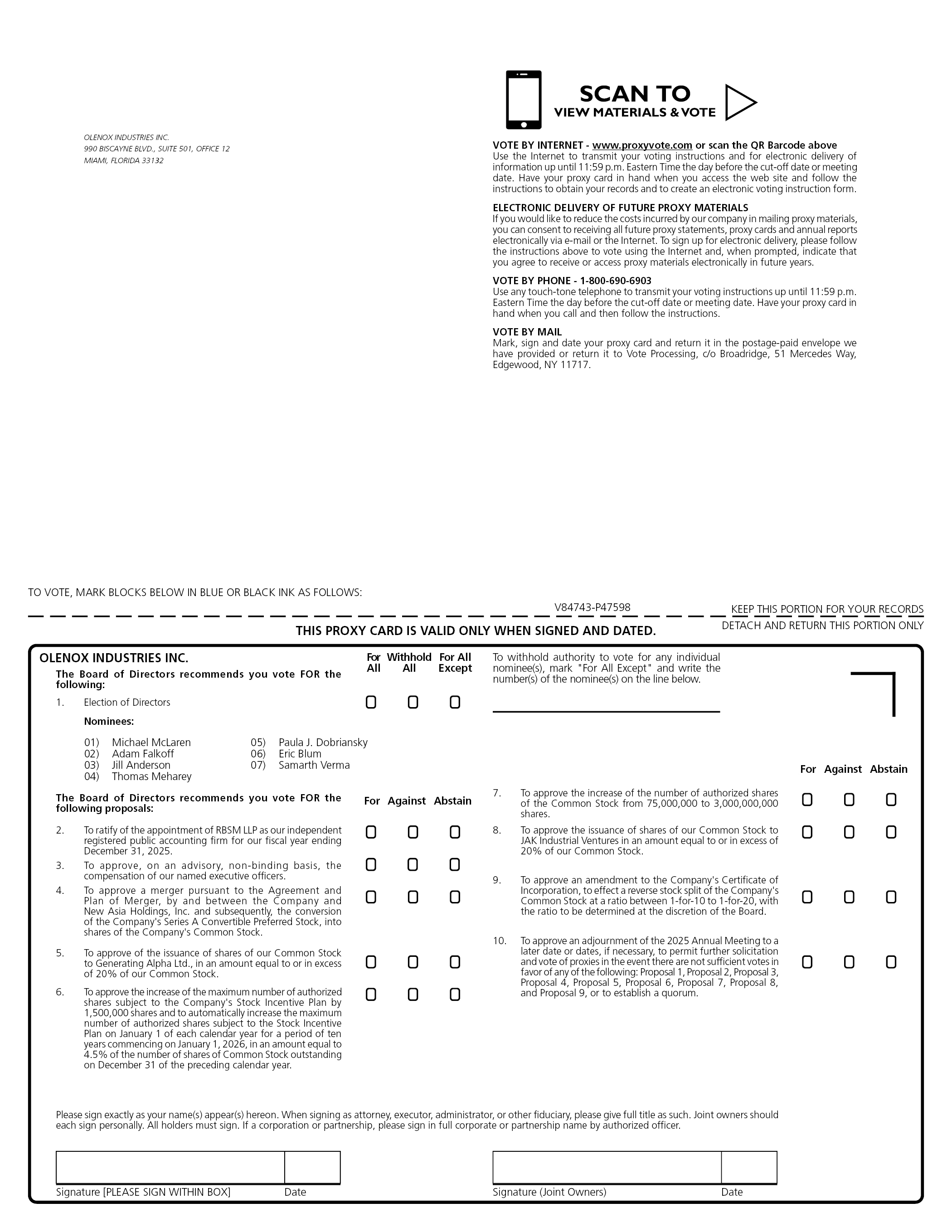
SCAN TO VIEW MATERIALS & VOTE OLENOX INDUSTRIES INC. 990 BISCAYNE BLVD., SUITE 501, OFFICE 12 MIAMI, FLORIDA 33132 VOTE BY INTERNET - www.proxyvote.com or scan the QR Barcode above Use the Internet to transmit your voting instructions and for electronic delivery of information up until 11:59 p.m. Eastern Time the day before the cut-off date or meeting date. Have your proxy card in hand when you access the web site and follow the instructions to obtain your records and to create an electronic voting instruction form. ELECTRONIC DELIVERY OF FUTURE PROXY MATERIALS If you would like to reduce the costs incurred by our company in mailing proxy materials, you can consent to receiving all future proxy statements, proxy cards and annual reports electronically via e-mail or the Internet. To sign up for electronic delivery, please follow the instructions above to vote using the Internet and, when prompted, indicate that you agree to receive or access proxy materials electronically in future years. VOTE BY PHONE - 1-800-690-6903 Use any touch-tone telephone to transmit your voting instructions up until 11:59 p.m. Eastern Time the day before the cut-off date or meeting date. Have your proxy card in hand when you call and then follow the instructions. VOTE BY MAIL Mark, sign and date your proxy card and return it in the postage-paid envelope we have provided or return it to Vote Processing, c/o Broadridge, 51 Mercedes Way, Edgewood, NY 11717. TO VOTE, MARK BLOCKS BELOW IN BLUE OR BLACK INK AS FOLLOWS: V84743-P47598 KEEP THIS PORTION FOR YOUR RECORDS THIS PROXY CARD IS VALID ONLY WHEN SIGNED AND DATED. OLENOX INDUSTRIES INC. The Board of Directors recommends you vote FOR the following: 1. Election of Directors Nominees: 01) Michael McLaren 02) Adam Falkoff 03) Jill Anderson 04) Thomas Meharey 05) Paula J. Dobriansky 06) Eric Blum 07) Samarth Verma For All Withhold All For All Except To withhold authority to vote for any individual nominee(s), mark “For All Except” and write the number(s) of the nominee(s) on the line below. The Board of Directors recommends you vote FOR the following proposals: 2. To ratify of the appointment of RBSM LLP as our independent registered public accounting firm for our fiscal year ending December 31, 2025. 3. To approve, on an advisory, non-binding basis, the compensation of our named executive officers. 4. To approve a merger pursuant to the Agreement and Plan of Merger, by and between the Company and New Asia Holdings, Inc. and subsequently, the conversion of the Company’s Series A Convertible Preferred Stock, into shares of the Company’s Common Stock. 5. To approve of the issuance of shares of our Common Stock to Generating Alpha Ltd., in an amount equal to or in excess of 20% of our Common Stock. 6. To approve the increase of the maximum number of authorized shares subject to the Company’s Stock Incentive Plan by 1,500,000 shares and to automatically increase the maximum number of authorized shares subject to the Stock Incentive Plan on January 1 of each calendar year for a period of ten years commencing on January 1, 2026, in an amount equal to 4.5% of the number of shares of Common Stock outstanding on December 31 of the preceding calendar year. For Against Abstain 7. To approve the increase of the number of authorized shares of the Common Stock from 75,000,000 to 3,000,000,000 shares. 8. To approve the issuance of shares of our Common Stock to JAK Industrial Ventures in an amount equal to or in excess of 20% of our Common Stock. 9. To approve an amendment to the Company’s Certificate of Incorporation, to effect a reverse stock split of the Company’s Common Stock at a ratio between 1-for-10 to 1-for-20, with the ratio to be determined at the discretion of the Board. 10. To approve an adjournment of the 2025 Annual Meeting to a later date or dates, if necessary, to permit further solicitation and vote of proxies in the event there are not sufficient votes in favor of any of the following: Proposal 1, Proposal 2, Proposal 3, Proposal 4, Proposal 5, Proposal 6, Proposal 7, Proposal 8, and Proposal 9, or to establish a quorum. Please sign exactly as your name(s) appear(s) hereon. When signing as attorney, executor, administrator, or other fiduciary, please give full title as such. Joint owners should each sign personally. All holders must sign. If a corporation or partnership, please sign in full corporate or partnership name by authorized officer. Signature [PLEASE SIGN WITHIN BOX] Date Signature (Joint Owners) Date
Important Notice Regarding the Availability of Proxy Materials for the Annual Meeting: The Notice, Proxy Statement, and Form 10-K are available at www.proxyvote.com. OLENOX INDUSTRIES INC. ANNUAL MEETING OF STOCKHOLDERS MARCH 31, 2026 1:00 P.M. CENTRAL TIME THIS PROXY IS SOLICITED ON BEHALF OF THE BOARD OF DIRECTORS The stockholder(s) hereby appoint(s) Michael McLaren and Patricia Kaelin, or either of them, as proxies, each with the power to appoint his/her substitute, and hereby authorize(s) them to represent and to vote, as designated on the reverse side of this ballot, all of the shares of Common Stock of Olenox Industries Inc. that the stockholder(s) is/are entitled to vote at the Annual Meeting of Stockholders to be held at 1:00 p.m. Central Time, on March 31, 2026, at 1207 N FM 3083 Rd E, Building C, Conroe, TX 77304, and any adjournment or postponement thereof. This proxy, when properly executed, will be voted in the manner directed herein. If no such direction is made, this proxy will be voted in accordance with the Board of Directors’ recommendations. Continued and to be signed on the reverse side V84744-P47598